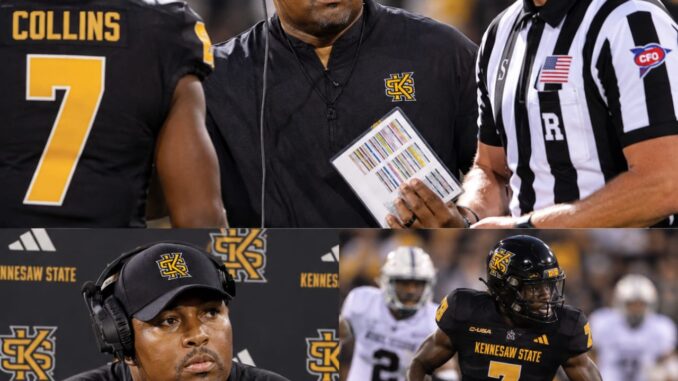
“We did better and it seems the referees weren’t on our side…” Those reported postgame remarks from Kennesaw State head coach Jerry Mack added an unexpected layer of controversy to an otherwise decisive 42-9 defeat against Tennessee at Neyland Stadium.
The final score suggested a one-sided contest, with Tennessee controlling large stretches of the game and eventually pulling away from the Owls in the second half. Yet Mack’s reported reaction focused attention beyond the scoreboard, with the Kennesaw State coach expressing frustration over officiating and indicating that he intended to raise his concerns through the appropriate channels.
Tennessee entered the matchup ranked No. 15 in the Associated Press poll and unbeaten through its opening two games. Kennesaw State arrived at Neyland Stadium with a 1-1 record, facing its first SEC opponent in program history. The challenge was always expected to be significant, particularly inside one of the largest and most intimidating environments in college football.
The Volunteers ultimately produced the kind of performance their ranking and home-field advantage suggested they were capable of delivering. Quarterback Faizon Brandon completed 18 of 26 passes for 178 yards and a touchdown while also rushing for another score. Running back Daune Morris delivered one of the biggest individual performances of the night, rushing for 116 yards and a touchdown on only 14 carries.
Tennessee finished with 446 total yards compared with Kennesaw State’s 291. The Volunteers also dominated the ground game, rushing for 268 yards while limiting the Owls to 102. Four different Tennessee players found the end zone on the ground, allowing the home team to gradually turn a competitive opening period into a comfortable victory.
But Mack’s reported comments suggested that he believed the game deserved a closer examination than the final score alone might indicate.
The Owls actually moved the ball effectively through the air at times. Quarterback Rickie Collins finished with 189 passing yards on 22 completions, helping Kennesaw State generate 18 first downs. The Owls also controlled the clock for nearly 31 minutes, demonstrating that the game was not simply a matter of Tennessee having possession throughout the entire evening.
Where the contest became particularly difficult for Kennesaw State was its inability to consistently finish drives and establish the run. The Owls managed only 102 rushing yards, averaging 3.4 yards per attempt. Tennessee, meanwhile, averaged 6.5 yards per rushing attempt and repeatedly created explosive plays.
Morris’ 42-yard touchdown run in the third quarter was one of the defining moments of the game. The play helped Tennessee extend its advantage and reflected the growing difference between the two teams as the night progressed.
Kennesaw State was also penalized heavily. The official statistics credited the Owls with nine penalties for 90 yards, while Tennessee was charged with three penalties for 20 yards. That disparity may help explain why officiating became part of the postgame discussion from the Kennesaw State side.
Still, the official statistics do not establish that the referees caused the outcome or that individual calls were incorrect. The numbers show a significant penalty-yardage difference, but determining whether particular decisions were wrong requires examination of the individual plays and the applicable rules.
That distinction is likely to matter if Mack follows through on the reported intention to submit a complaint or request a review. A formal complaint would give the program an opportunity to identify specific calls, provide game footage and seek clarification from the appropriate conference or officiating authorities.
For Mack, the circumstances were particularly notable because Tennessee is not an unfamiliar place. Before becoming Kennesaw State’s head coach, he spent three seasons on Josh Heupel’s Tennessee staff as the Volunteers’ running backs coach from 2021 through 2023. Saturday therefore represented a return to Neyland Stadium, but this time Mack stood on the opposing sideline.
The familiarity made the matchup one of the more intriguing nonconference games on Tennessee’s schedule. Mack knew the environment, understood the program and had previously worked with several people connected to the Volunteers. He also knew the challenge his team faced against a Tennessee roster capable of producing explosive plays on both sides of the football.
Kennesaw State’s defense struggled to contain that offensive balance. Tennessee scored touchdowns on seven of its nine drives at one point during the game, while Brandon demonstrated the ability to hurt the Owls both through the air and on the ground.
Despite the eventual margin, Mack’s reported frustration indicates that he did not want the conversation surrounding his team to end with the scoreboard. His comments placed emphasis on what he believed happened during the game and suggested that he wanted the relevant authorities to examine the officiating.
That approach would not change the result. Tennessee remains the winner, improving to 3-0, while Kennesaw State fell to 1-2. But a formal review could potentially address whether particular officiating decisions met the applicable standards and whether any mistakes occurred during the contest.
The Owls now have to turn their attention toward the remainder of their season. A loss at Neyland Stadium against a ranked SEC opponent was always going to be a difficult result to avoid, but the manner in which Kennesaw State responds could become more important than the final margin.
For Mack, the immediate challenge will be keeping his players focused while the controversy surrounding the game receives attention. His team will need to correct the issues that were clearly visible on the field, particularly the rushing defense, offensive efficiency and penalties that contributed to the difficult night.
At the same time, the reported officiating concerns could remain part of the conversation if Kennesaw State formally pursues them.
Tennessee’s 42-9 victory was comprehensive on the scoreboard, but Mack’s reaction ensured that the discussion did not end when the final whistle sounded. His reported decision to question the officiating has created another storyline around a game that already carried plenty of significance because of his return to Knoxville.
Whether the complaint produces any further action remains to be seen. What is clear is that Mack was unwilling to let the result speak for itself. For a coach attempting to build Kennesaw State into a more competitive program, the next step will be determining what his team can learn from the defeat—and making sure the controversy does not overshadow the work still required when the Owls return to the field.
Leave a Reply