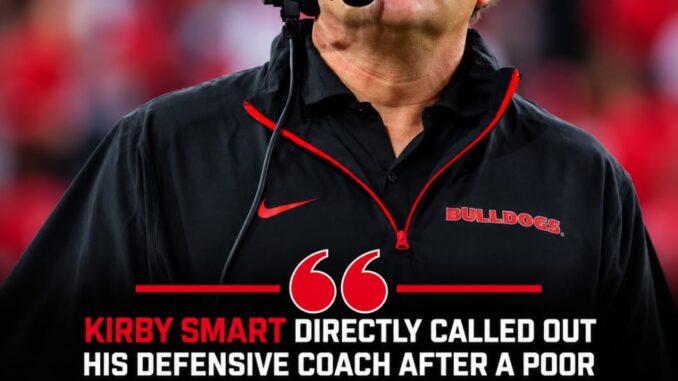
🚨 TENSION IN GEORGIA: Kirby Smart Demands More From Defense After Oklahoma Performance
Georgia may have walked away from its latest SEC showdown with a convincing 41–13 victory over Oklahoma, but head coach Kirby Smart made it clear that the final score was not enough to satisfy him. Behind the scenes, the message from the Georgia head coach was unmistakable: winning is important, but meeting the standard expected inside the program matters even more.
The Bulldogs entered the matchup carrying enormous expectations. Georgia had dominated its opponents through the opening weeks of the season, and the Oklahoma game represented the program’s first major test against a respected SEC opponent. Instead of allowing the Sooners to control the contest, Georgia forced four turnovers and turned those mistakes into 17 points, helping produce one of the most decisive victories of the weekend.
Yet Smart’s reaction afterward was far more demanding than celebratory.
For a coach who has built Georgia around discipline, physicality and defensive excellence, the performance was not simply about the number displayed on the scoreboard. Smart made it clear that there were stretches of the game in which Georgia failed to perform at the level he expects from his players and coaches.
“The scoreboard should never matter,” Smart said after the game, emphasizing that the standard must remain consistent regardless of the margin.
That mentality has become one of the defining characteristics of Smart’s tenure in Athens. A 28-point victory might be celebrated by most programs, but Georgia operates under different expectations. Smart has repeatedly challenged his team even after dominant victories, particularly when he believes players are becoming comfortable or allowing the scoreboard to disguise mistakes.
The Oklahoma game provided several examples of why that philosophy remains important.
Georgia’s defense was effective for much of the afternoon, creating pressure and repeatedly forcing Oklahoma into difficult situations. The Sooners struggled to turn opportunities into points, while Georgia’s defenders capitalized on mistakes that changed the momentum of the game.
But Smart still saw room for improvement.
After the victory, he pointed specifically to the need for more three-and-outs and greater disruption on defense. Georgia pressured Oklahoma’s quarterback and affected his timing, but Smart acknowledged that the Bulldogs did not always finish those opportunities by bringing the quarterback down.
That distinction is important.
Creating pressure is one thing. Converting pressure into sacks, tackles for loss, turnovers or stalled drives is another. Against stronger opponents later in the season, Georgia cannot assume that disrupting a quarterback without finishing the play will always be enough.
That is where the coaching staff becomes an important part of the conversation.
Smart has spent years establishing an internal culture in which coaches are expected to evaluate themselves just as aggressively as they evaluate their players. When something breaks down on the field, the answer inside the Georgia program is rarely as simple as blaming an individual player.
Defensive assignments, communication, preparation, positioning and play-calling can all contribute to what happens during a possession. A missed tackle may begin with a player’s execution, but the circumstances surrounding that play can also be examined by the coaching staff.
That approach is particularly relevant after the Oklahoma game because Georgia’s defense is expected to carry a significant portion of the team’s championship aspirations.
The Bulldogs have recruited at an elite level and developed a reputation for producing defensive players capable of succeeding at the highest level. With that talent comes enormous responsibility. Smart knows that the defense will eventually face offenses capable of exploiting even the smallest weaknesses.
Oklahoma itself demonstrated why Georgia cannot become complacent.
Although the Sooners were ultimately overwhelmed, they moved the ball at various points and created situations that forced Georgia’s defense to respond. The Sooners finished with more passing yards than Georgia, while the Bulldogs’ offense also experienced stretches of inconsistency.
Smart’s comments after the game reflected that reality. Rather than treating the victory as proof that everything was working perfectly, he described areas where Georgia needed to improve.
That approach may sound unusual after a 41–13 victory, but it is consistent with the culture Smart has built.
Earlier in the season, he expressed frustration when Georgia’s reserves surrendered late touchdowns during comfortable victories. His concern was not necessarily the immediate consequence of those points. Instead, he viewed them as an indication that players might be relaxing once the outcome appeared secure.
The same principle applies to coaching.
Georgia cannot afford to evaluate itself solely by wins and losses. The Bulldogs have aspirations that extend beyond simply winning regular-season games. Every mistake is therefore viewed through the lens of what could happen against elite competition when the margin for error becomes much smaller.
That is why Smart’s post-Oklahoma message could resonate inside the program long after the final whistle.
The defensive staff will have plenty to study from the game. Georgia created turnovers, limited Oklahoma’s scoring opportunities and helped turn the matchup into a comfortable victory. At the same time, there were opportunities to create even more disruption, finish pressures and force more three-and-outs.
Those details may not have mattered against Oklahoma in the final score, but they could matter enormously later.
The Bulldogs are now moving deeper into a demanding SEC schedule, and the level of competition will continue to increase. Opponents will study the Oklahoma film carefully, looking for tendencies, weaknesses and opportunities to attack Georgia.
Smart knows that.
His insistence on improvement is therefore less about criticizing one individual and more about making sure the entire operation remains accountable. Players must execute. Coaches must prepare. Adjustments must be made. And everyone must maintain the same intensity regardless of whether Georgia is leading by three points or 30.
That is also why the conversation surrounding Georgia’s defense should not be reduced to statistics alone.
The Bulldogs’ defense can produce impressive numbers and still have areas that require attention. A championship-caliber team cannot simply ask whether it won. It must ask how it won, where it struggled and whether those weaknesses could become problems against better opponents.
Against Oklahoma, Georgia answered several important questions. The Bulldogs showed they could handle a major SEC matchup, create turnovers and punish mistakes. But Smart’s response afterward suggested that he believes the team has not yet reached its ceiling.
For Georgia fans, that may be both encouraging and demanding.
A coach who remains dissatisfied after a 41–13 victory is signaling that the expectations inside the program remain extremely high. The victory over Oklahoma may have strengthened Georgia’s position, but Smart is already looking toward the next challenge.
The message is simple: the Bulldogs cannot allow a comfortable victory to convince them that they are finished improving.
Georgia’s defense will continue to receive scrutiny, and every coaching decision will become more important as the season progresses. The Oklahoma game exposed areas that Smart believes must be cleaned up, particularly when it comes to finishing defensive opportunities and creating more consistent disruption.
The final score may have suggested domination.
Smart’s reaction suggested unfinished business.
And with the SEC schedule becoming increasingly demanding, that relentless approach could define Georgia’s season as much as any individual performance or spectacular victory.
Leave a Reply