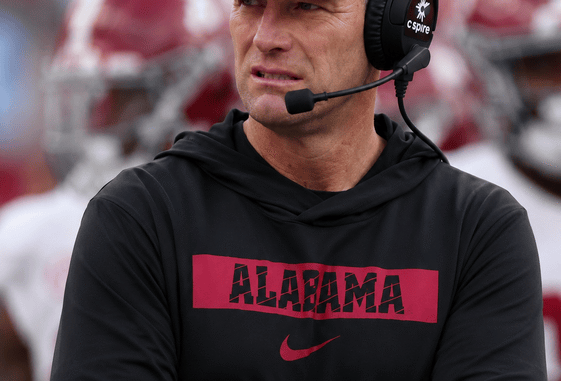
Kalen DeBoer Sounds the Alarm on College Football’s Growing Chaos
College football has entered one of the most transformative—and controversial—eras in its history. Between NIL deals, the transfer portal, conference realignment, revenue sharing, and ongoing legal battles, many coaches have struggled to navigate a landscape that seems to change by the month.
Now, Alabama head coach Kalen DeBoer is joining the growing list of influential voices calling for structure, consistency, and accountability.
In comments that have quickly spread across the college football world, DeBoer addressed what he sees as the sport’s biggest problem: a lack of enforceable rules.
“The only thing worse than having no rules is having rules you can’t enforce or don’t enforce,” DeBoer said.
The statement was simple, but it struck at the heart of a debate that has consumed college athletics for years.
For decades, the NCAA operated with a strict rulebook that governed nearly every aspect of college sports. Athletes could not profit from their name, image, and likeness. Transfers often required players to sit out a season. Recruiting regulations were tightly controlled. Schools largely operated within a system that, while imperfect, maintained a predictable structure.
That world no longer exists.
Today, athletes can earn substantial NIL compensation, transfer more freely than ever before, and explore opportunities that were previously unavailable. Many supporters believe these changes were long overdue and have helped restore fairness to a system that generated billions of dollars while limiting player earning power.
However, even advocates of player rights have begun questioning whether college football has swung too far in the opposite direction.
DeBoer appears to be among those who believe the sport desperately needs balance.
His concern is not necessarily about athletes making money or pursuing opportunities. Instead, his comments focused on the absence of order and the difficulty of enforcing standards that apply equally across the sport.
“I don’t think any of us thought we’d be in a world where there’s no order,” he explained.
That sentiment reflects frustrations that many coaches, administrators, and even players have expressed behind closed doors.
The modern transfer portal has become one of the most debated topics in college athletics. Every offseason brings thousands of player entries, creating an environment where roster management has become significantly more difficult.
Programs spend months recruiting and developing players only to see them leave unexpectedly. At the same time, coaches must continuously monitor available talent in the portal, creating what some describe as year-round free agency.
For powerhouse programs like Alabama, the challenge is unique.
The Crimson Tide remain one of the premier destinations in college football. The program’s tradition, resources, facilities, and national visibility continue to attract elite recruits. Yet even Alabama is not immune to the realities of today’s landscape.
Players who are unhappy with playing time can leave more easily than ever. Rivals can aggressively pursue talent through NIL opportunities. Roster continuity has become increasingly difficult to maintain.
DeBoer’s NFL comparison may have been the most striking part of his comments.
“Even in the NFL, there are rules,” he said.
He then painted a scenario that would sound absurd in professional football.
A player signs with one team, practices for two weeks, receives a better financial offer from another organization, and immediately leaves.
In the NFL, such a situation simply cannot happen. Contracts, salary cap regulations, collective bargaining agreements, and league governance create clear boundaries.
College football currently operates under a much looser framework.
While there are rules in place, enforcement often appears inconsistent. Legal challenges have further complicated matters, limiting what governing bodies can regulate and how aggressively they can intervene.
As a result, many observers believe the sport is caught in an awkward middle ground.
It is no longer operating under the traditional amateur model, but it has not fully evolved into a professional model either.
The result is uncertainty.
Schools are attempting to adapt to new realities. Coaches are learning how to recruit in a world where NIL plays a major role. Athletes are navigating opportunities that previous generations never experienced.
Meanwhile, fans are left wondering what college football will look like five years from now.
For Alabama supporters, DeBoer’s comments may resonate particularly strongly because of the program’s historical emphasis on discipline, accountability, and long-term development.
During Nick Saban’s legendary tenure, Alabama became synonymous with “The Process”—a philosophy built around consistency, preparation, and attention to detail.
Players were expected to earn opportunities through performance and commitment. Stability became one of the program’s defining characteristics.
The modern landscape presents challenges to that model.
Roster turnover has accelerated. Recruiting cycles have become more complicated. NIL negotiations now play a role in talent acquisition and retention.
DeBoer inherited not only one of the most prestigious jobs in sports but also one of the most challenging eras in college football history.
Replacing a legend is difficult under any circumstances. Doing so while the sport undergoes massive structural change adds another layer of complexity.
His comments suggest he understands that success in today’s environment requires more than recruiting elite talent and winning games.
It also requires navigating a constantly evolving system.
The broader conversation surrounding NIL and transfers often becomes polarized.
One side argues that athletes deserve complete freedom to maximize their opportunities. After all, coaches can change jobs for larger salaries, and universities have long benefited financially from player performance.
The opposing side worries that unrestricted movement and escalating financial competition could undermine the traditional foundations of college athletics.
DeBoer’s comments seem to avoid those extremes.
Rather than criticizing player compensation directly, he focused on the importance of enforceable standards.
In many ways, his argument centers on predictability.
Successful organizations thrive when expectations are clear and consistently applied. Whether in sports, business, or government, uncertainty creates challenges for everyone involved.
College football currently faces significant uncertainty.
Recruiting strategies change rapidly. NIL markets vary dramatically between schools. Transfer decisions can reshape rosters overnight.
Programs are increasingly forced to operate in a reactive environment.
That reality affects not only coaches but also players.
Athletes benefit from clarity as much as anyone else.
Clear guidelines help players understand their options, evaluate opportunities, and make informed decisions. When regulations are vague or inconsistently enforced, confusion can emerge for all parties involved.
The timing of DeBoer’s remarks is notable.
College athletics is approaching another pivotal phase as revenue-sharing models continue to develop and conferences adapt to new financial realities.
Many believe the next few years will determine the long-term direction of the sport.
Will college football establish a more structured framework similar to professional leagues?
Will athlete compensation systems become standardized?
Will transfer regulations evolve to create greater stability?
These questions remain unanswered.
What is clear is that influential figures across the sport are increasingly calling for solutions.
DeBoer is far from alone.
Numerous coaches from various conferences have voiced concerns about roster management, tampering allegations, and the absence of consistent oversight.
Athletic directors have echoed similar sentiments. Conference commissioners have repeatedly emphasized the need for national standards.
Even some athletes have expressed frustration with the uncertainty that surrounds the current system.
The challenge lies in finding a solution that balances competing interests.
Players deserve opportunities and fair compensation.
Schools need roster stability.
Fans want competitive balance.
Administrators seek sustainable governance.
Achieving all four objectives simultaneously is far easier said than done.
For Alabama, the stakes are especially high.
The Crimson Tide remain one of college football’s flagship programs. Every development in the sport affects Alabama’s ability to recruit, develop talent, and compete for championships.
DeBoer’s perspective carries weight because he now leads one of the most influential brands in the game.
When Alabama’s head coach speaks, the college football world listens.
His comments are unlikely to end the debate, but they contribute to an increasingly important discussion about the future of the sport.
What should college football become?
That question has no easy answer.
The game has evolved dramatically throughout its history. Scholarship limits changed competitive balance. Television contracts transformed revenue streams. Conference realignment reshaped traditional rivalries.
Each era brought challenges and adjustments.
Today’s challenges may simply be larger than any that came before.
The combination of NIL, transfer freedom, legal pressures, and financial expansion has fundamentally altered the sport’s operating environment.
Some view these changes as necessary progress.
Others see them as a threat to the traditions that made college football unique.
Most likely, the future will involve elements of both perspectives.
Athletes will continue to receive greater opportunities and compensation. At the same time, governing bodies will likely seek mechanisms that provide greater structure and stability.
Exactly what those mechanisms look like remains uncertain.
What is becoming increasingly certain is that voices like Kalen DeBoer’s will play an important role in shaping the conversation.
His warning about unenforced rules reflects a concern shared across the sport: a system without clear boundaries ultimately creates confusion for everyone involved.
Whether college football leaders can establish those boundaries remains one of the defining questions of the modern era.
Until then, programs like Alabama will continue competing in a landscape that remains as unpredictable as it is fascinating.
And if DeBoer’s comments are any indication, the debate over order, enforcement, and the future of college football is only just beginning.
Leave a Reply