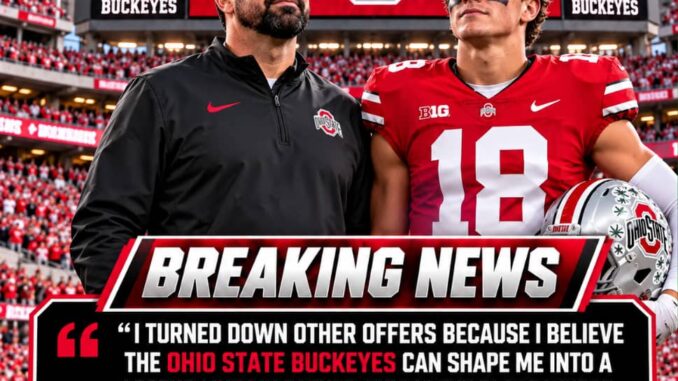
Hall of Famer’s Son Rejects Florida Gators Offer for Ohio State Buckeyes Workout — Considered a Top 2029 Recruiting Prodigy and Highly Coveted Prospect Who Believes Ohio State Can Unlock His Talent and Turn Him Into a Future NFL Legend Like His Father
The college football recruiting world is buzzing over a reported development involving the son of a Hall of Fame football legend, a highly coveted young prospect whose future is already attracting attention from major programs across the country. The talented athlete is reportedly drawing a clear distinction between his options after choosing to prioritize an Ohio State Buckeyes workout over an opportunity involving the Florida Gators. With the 2029 recruiting class still years away from reaching its full potential, the decision has sparked conversations about his ambitions, his family’s football legacy, and the program he believes can help him reach the highest level of the sport.
For Ohio State, the prospect represents the type of high-upside talent that major programs hope to identify early. For Florida, the development highlights the intense competition involved in pursuing elite young athletes. And for the recruit himself, the decision could become an important step in a journey that carries enormous expectations because of his father’s accomplishments.
Being the son of a Hall of Famer comes with unique advantages, but it also creates pressure that few young athletes fully understand until they begin navigating the recruiting process. Growing up around professional football can provide an early understanding of preparation, discipline, competition, and the demands of an elite sporting career. At the same time, it can leave a young player constantly compared with a parent whose achievements have already secured a place in football history.
That is why the prospect’s reported interest in Ohio State has generated so much attention. Rather than simply following the path that others might expect, he appears focused on finding an environment that can develop his own abilities and help him establish an identity separate from his father’s legacy. For a young athlete with ambitions of reaching the NFL, that distinction matters.
Ohio State has built a reputation as one of college football’s most prominent destinations for elite talent. The Buckeyes regularly compete for highly rated recruits and place considerable emphasis on player development, strength and conditioning, technical improvement, and preparation for professional opportunities. For prospects who dream of playing in the NFL, the opportunity to learn within such a competitive environment can be an attractive part of the decision-making process.
The reported workout opportunity would give the young athlete a chance to experience the expectations associated with a major college program. Workouts can provide coaches with valuable information about a player’s movement, athletic coordination, physical development, competitiveness, and response to instruction. They can also help a prospect understand the standards required to compete against some of the country’s most talented players.
At this stage of his development, however, potential is only one part of the equation. Young prospects must continue building their fundamentals, improving their physical conditioning, and learning how to apply their abilities consistently. Even athletes with exceptional natural gifts need years of preparation before they are ready to compete at the highest level of college football.
The 2029 recruiting class is particularly interesting because many of its future stars are still developing their games. Rankings can change significantly as prospects grow physically, gain experience, and demonstrate their abilities against stronger competition. A player considered a potential national standout today must continue proving himself through performance, consistency, and steady improvement.
That reality makes the prospect’s reported focus on Ohio State especially intriguing. If he believes the Buckeyes can unlock his talent, the decision reflects the importance of finding a coaching environment that matches his goals. Recruiting is not simply about choosing a famous uniform or joining a program with a celebrated history. It is also about identifying the people, training methods, competitive opportunities, and developmental support that can help a player maximize his potential.
Florida remains a significant name in the college football landscape, and the Gators have their own history of attracting talented athletes. The program competes in the Southeastern Conference, where recruiting battles are intense and elite prospects are frequently pursued by multiple schools. Losing ground in a recruitment can be frustrating for any coaching staff, particularly when the player has the potential to become a major contributor in the future.
Nevertheless, early recruiting interest does not guarantee a final commitment. Young athletes often explore different programs, attend workouts and camps, speak with coaches, and evaluate their options before making decisions about their college futures. Their priorities can also evolve as they mature and gain a clearer understanding of their strengths, preferred playing style, and long-term ambitions.
For Ohio State, the key would be demonstrating that its development plan fits the player’s individual needs. A famous family name may attract headlines, but coaches ultimately need to evaluate the athlete himself. His speed, technique, football intelligence, competitive mentality, and willingness to learn will determine how far he can progress.
The connection to a Hall of Fame father will inevitably remain part of the story. Fans naturally wonder whether the next generation of a celebrated football family can reproduce the achievements that made the previous generation famous. Yet the most successful legacy stories often involve children who learn from their parents without attempting to become exact copies of them.
The young prospect will need to build his own reputation through his decisions and performances. His father’s accomplishments may offer valuable lessons about preparation and professionalism, but they cannot substitute for the work required to succeed. Every training session, every competition, and every opportunity to improve will contribute to the player he eventually becomes.
There is also a broader lesson in the attention surrounding this recruitment. The modern college football landscape places enormous emphasis on identifying talent early, and prospects increasingly face national scrutiny long before they reach college. Social media, recruiting evaluations, highlight videos, and public rankings can amplify expectations and create pressure for teenagers who are still developing as athletes and individuals.
Managing that attention will be important. The best young players are often those who remain focused on controllable goals rather than becoming distracted by rankings or comparisons. Improving technique, maintaining academic progress, developing physical strength safely, and learning to respond to coaching are more valuable over time than any single recruiting headline.
If Ohio State succeeds in developing a relationship with the prospect, the Buckeyes could position themselves as an important option in his future college decision. But the recruiting process will continue to evolve, and other programs may remain interested as his abilities become clearer. His eventual destination will depend on multiple factors, including his development, academic plans, coaching relationships, and the opportunities available when he is ready to make a decision.
For now, the reported choice to prioritize an Ohio State workout over a Florida opportunity has created an intriguing storyline around one of the young athletes being discussed as a potential standout in the 2029 class. It highlights the competitive nature of recruiting and the importance of finding a program that aligns with a player’s ambitions.
The dream of following a Hall of Fame father into football greatness is powerful, but the road to the NFL remains demanding. Reaching that level requires exceptional ability, sustained commitment, resilience, and the capacity to improve year after year. No program can guarantee that outcome, regardless of its reputation or recruiting success.
Ohio State’s appeal lies in the possibility of providing a challenging environment in which a talented young player can continue developing. If the prospect believes that environment gives him the best opportunity to grow, exploring the Buckeyes makes sense as part of his broader journey.
Ultimately, the biggest story will not be the famous name attached to the prospect or the programs competing for his attention. It will be whether he can translate his early promise into consistent performance and build a career that stands on its own merits.
For the Buckeyes, the opportunity to pursue a high-upside athlete with a celebrated football background is the kind of recruiting storyline that captures national attention. For Florida, the competition illustrates how difficult it can be to secure the most promising young talent. And for the prospect, the challenge is clear: learn from the legacy that came before him, develop his own identity, and pursue the level of excellence required to make his own mark on the game.
Leave a Reply