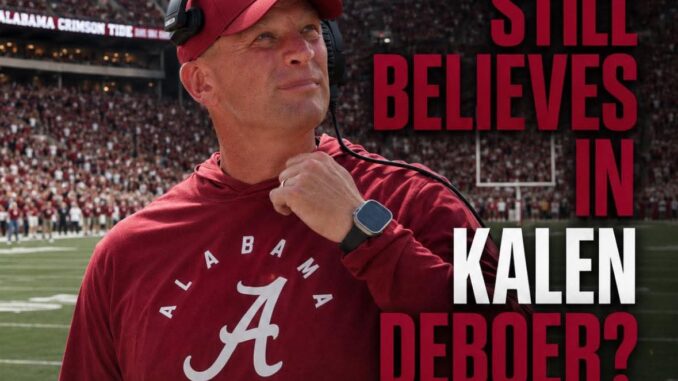
Why Alabama Crimson Tide head coach Kalen DeBoer could lead Alabama back to glory next season is a question that has quietly transformed from hopeful offseason optimism into a serious national conversation. College football fans are beginning to realize that Alabama may be entering the most dangerous phase possible for the rest of the SEC: the phase where the program is no longer adjusting to change, but mastering it.
For the first time in years, Alabama is no longer carrying the impossible burden of replacing a legend every single day. The shock of transition has faded. The constant comparisons to the Nick Saban era are still there, but they no longer dominate every discussion surrounding the program. Instead, something else is beginning to emerge inside Tuscaloosa — belief in DeBoer’s system, belief in his culture, and belief that Alabama is building toward something explosive.
The fascinating part is that DeBoer does not resemble the stereotypical Alabama coach that many expected after Saban. He is not fiery in public. He is not theatrical. He does not dominate headlines with emotional press conferences or controversial quotes. His style is quieter, calmer, and more methodical. Yet throughout his coaching career, that exact personality has consistently produced winning football.
That matters more than people realize.
College football has changed dramatically over the last few years. Recruiting still matters, but roster management, quarterback development, adaptability, and player relationships now matter just as much. Programs can no longer survive purely on intimidation and tradition. Players today want development, communication, and offensive systems that prepare them for the future. DeBoer checks every one of those boxes.
One of the biggest reasons Alabama could rise back to championship level next season is the simple fact that DeBoer is an elite offensive mind. That has been true at nearly every stop of his coaching journey. Whether it was at Sioux Falls, Fresno State, Washington, or now Alabama, his offenses have consistently displayed creativity, balance, and quarterback efficiency.
At Washington, he transformed Michael Penix Jr. into one of the most feared quarterbacks in college football. His offenses attacked defenses vertically, created explosive plays, and forced opponents into impossible coverage decisions. Defenses could never fully predict where the pressure would come from because DeBoer’s systems thrive on timing, spacing, and rhythm. He understands how to manipulate defensive structures without overcomplicating things for his quarterback.
That could become terrifying at Alabama because the Crimson Tide do not just have talent — they have elite talent. The combination of DeBoer’s offensive philosophy and Alabama’s athlete advantage may finally be reaching its dangerous point.
For much of the past season, Alabama still looked like a team in transition. There were moments of brilliance mixed with inconsistency. Some games showcased explosive potential while others exposed communication breakdowns and execution issues. That is normal for a program replacing the greatest coach in modern college football history. What matters is whether those early struggles become permanent problems or learning experiences.
Everything surrounding Alabama right now suggests they were learning experiences.
The quarterback room is perhaps the clearest example of why Alabama fans should be excited. Reports surrounding the program continue to emphasize how much DeBoer prioritizes quarterback recruiting and development. The talent pipeline at the position is becoming one of the strongest in college football, and that is rarely accidental. Elite quarterbacks want to play for coaches who understand modern offense and can maximize their careers.
That is exactly why Alabama continues landing highly regarded quarterback prospects under DeBoer.
More importantly, the competition inside the quarterback room appears healthy rather than toxic. That says a lot about the culture DeBoer is building. According to reports surrounding the program, DeBoer has emphasized professionalism, growth, and accountability among his quarterbacks. In today’s transfer portal era, maintaining that kind of chemistry is incredibly difficult. Quarterbacks often leave the moment adversity appears. Alabama instead appears to have competition without division.
That could become one of the defining strengths of the team next season.
Championship teams usually have one thing in common: internal pressure. Players push each other because nobody’s position feels guaranteed. DeBoer seems to understand that balance. He creates competition while still building trust. Players develop faster in environments where they feel challenged but supported.
Another major reason Alabama could return to dominance is the likely improvement along the offensive structure itself. First-year coaching transitions are messy even for elite programs. Terminology changes. Practice styles change. Conditioning philosophies change. Expectations change. Sometimes even the smallest adjustments create major inconsistencies early on.
Now Alabama enters another season with continuity.
Players understand the offense better. Coaches understand the roster better. DeBoer understands SEC football better. That experience matters because the SEC is different from every other conference in college football. Week after week, teams face elite defensive athletes, hostile road environments, and enormous media pressure. There is almost no room for slow development.
Yet despite those challenges, Alabama still showed flashes of dominance under DeBoer. That is the part many people overlook. The ceiling appeared even during inconsistent stretches. There were moments where Alabama looked fast, creative, and explosive in ways that resembled the modern evolution of elite offense.
If those flashes become consistent, Alabama immediately becomes a national title contender.
The recruiting momentum is another enormous factor. Elite recruiting is the lifeblood of championship football, and Alabama continues attracting premier talent under DeBoer. That is critical because one of the biggest fears surrounding the post-Saban era was whether Alabama could maintain its recruiting dominance.
So far, the answer appears to be yes.
The reality is that players still view Alabama as one of the premier destinations in football. The facilities are elite. The exposure is elite. The fan support is elite. NFL development remains elite. DeBoer did not inherit a rebuilding project. He inherited one of the most powerful football infrastructures in sports.
Now he is gradually molding it into his own vision.
That process takes time, but once it clicks, the results could be devastating for opponents.
There is also something psychologically dangerous about Alabama entering next season with lower national expectations than usual. During the peak Saban years, Alabama often entered seasons carrying overwhelming pressure. Every game became a national event. Every close win triggered criticism. Every weakness became headline material.
This version of Alabama feels different.
Some analysts still question whether DeBoer can truly dominate the SEC long-term. Others wonder if Alabama’s dynasty years are permanently over. That skepticism may actually benefit the team. Players often perform better when they feel disrespected or overlooked. The internal motivation becomes stronger.
And make no mistake — Alabama still has championship standards inside that building.
Another critical factor is DeBoer’s adaptability. One reason many coaches fail after early success is stubbornness. They refuse to evolve. They force systems onto players rather than maximizing player strengths.
DeBoer has repeatedly shown the opposite throughout his career. His offenses adjust based on personnel. He understands tempo, but he also understands situational football. He values explosive passing attacks, but he also recognizes the importance of physical balance. That flexibility gives Alabama a strategic advantage because SEC defenses vary dramatically from week to week.
Against one opponent, Alabama may need vertical aggression. Against another, ball control and efficiency might matter more. Great coaches adapt without losing identity. DeBoer appears capable of doing exactly that.
Defensively, Alabama also has the potential to become significantly better. While DeBoer receives most attention for offense, championship football still requires defensive toughness, especially in the SEC. Reports around the program indicate an increased emphasis on physicality and leadership entering next season. ([Roll ‘Bama Roll][6])
That emphasis matters because Alabama’s identity has historically been rooted in physical dominance. Even during offensive explosions, the best Alabama teams controlled line play, tackled aggressively, and overwhelmed opponents mentally. If DeBoer successfully combines modern offensive creativity with traditional Alabama physicality, the result could resemble a complete championship formula.
The offensive line may ultimately determine just how far Alabama goes next season. Every elite offense depends on protection and physicality up front. Young offensive lines often struggle with consistency, communication, and discipline, especially in the SEC where defensive fronts are brutal every week.
But young offensive lines can also improve dramatically with experience.
If Alabama’s line takes a significant developmental leap, everything changes. The running game becomes more reliable. Explosive pass concepts develop properly. Quarterbacks gain confidence. The offense becomes balanced instead of predictable.
That is when DeBoer’s creativity becomes hardest to defend.
The schedule itself could also create momentum opportunities. Championship runs often begin with confidence-building stretches that allow teams to develop rhythm before facing major tests. If Alabama starts strong next season, belief inside the locker room could grow rapidly.
Confidence matters enormously in college football because momentum can transform entire seasons. Teams that believe they are dangerous often become dangerous.
And Alabama’s roster has the type of athletic ceiling that can create avalanche moments against opponents. One explosive quarter can suddenly become a 21-point lead. One dominant defensive stretch can completely crush a rival emotionally.
Those traits still exist inside the program.
There is also the reality that DeBoer has already experienced enormous pressure before arriving at Alabama. Leading Washington to a national championship appearance placed him under major scrutiny long before Tuscaloosa. ([Wikipedia][1]) He understands media pressure, playoff expectations, and national attention.
That experience matters because Alabama is not a normal coaching job. Every decision becomes magnified. Every recruiting battle becomes national news. Every loss becomes a crisis. Coaches who cannot emotionally handle that environment eventually collapse under it.
DeBoer appears steady enough to survive it.
Perhaps the most underrated reason Alabama could return to glory is cultural stability. The post-Saban transition could have become chaotic. Players could have transferred in massive numbers. Recruiting momentum could have collapsed. Internal uncertainty could have damaged the program for years.
Instead, Alabama remained highly competitive while continuing to recruit elite talent. ([New York Post][3]) That suggests the foundation inside the building remains strong.
And now DeBoer enters the phase where the roster increasingly reflects his preferences, his evaluations, and his developmental priorities.
That is when coaches truly become dangerous.
The scary possibility for the rest of college football is that Alabama may eventually become even more explosive offensively than it was during parts of the Saban era. Saban built dynasties through discipline, defense, and elite adaptability over time. DeBoer could potentially maintain the talent advantages while introducing a more consistently aggressive offensive philosophy.
If that happens, Alabama will not simply return to relevance.
They could return to dominance.
There is still work to do, of course. Questions remain at quarterback. Leadership must emerge. Consistency must improve. Physicality must increase. The SEC remains brutally difficult, and several programs are capable of competing for championships.
But the ingredients for a major breakthrough are clearly present.
An elite recruiter. An elite offensive mind. Improving roster chemistry. Strong quarterback development. Program continuity. Explosive athletes. Championship infrastructure. Growing confidence.
That combination is why Alabama fans believe the next great chapter may already be forming.
And if Kalen DeBoer successfully brings all those elements together next season, the rest of college football may realize too late that Alabama never truly disappeared at all.
Leave a Reply