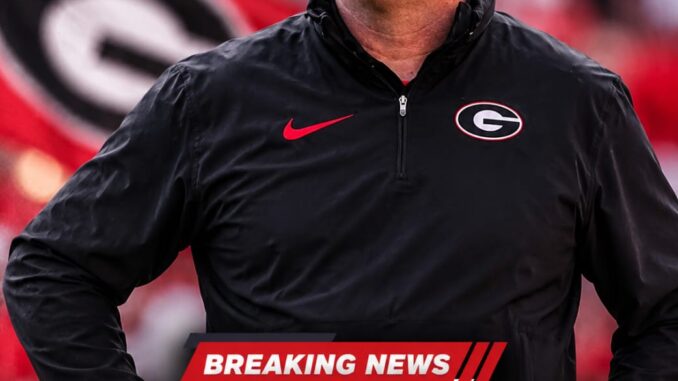
BREAKING: Kirby Smart Reportedly Removes Georgia Bulldogs Player From Roster Following Late-Night Nightclub Controversy
The Georgia Bulldogs football program is facing renewed attention following reports that head coach Kirby Smart has informed his team that one player has been removed from the roster and will not return to the active lineup. The reported decision comes amid allegations that the player was seen partying at a downtown nightclub late Friday night, just hours after missing a team practice because of what was described as a health issue.
The situation has sparked conversations about discipline, accountability, and the standards expected of players competing for one of college football’s most recognizable programs. For Smart, who has built his reputation around demanding preparation, physical toughness, and team-first principles, any alleged breach of trust involving a player’s availability and conduct could raise serious concerns about the culture inside the locker room.

The reported circumstances surrounding the incident have drawn particular interest because of the apparent contrast between the player’s stated reason for missing practice and the alleged nightclub appearance later that evening. In a sport where preparation and recovery are carefully managed, a player’s availability can affect not only individual development but also the team’s overall planning for an upcoming game.
College football programs operate under demanding schedules that require players to balance practices, meetings, conditioning, film study, academic responsibilities, and recovery. Coaches depend on their players to communicate honestly about injuries, illnesses, and other circumstances that may prevent them from participating. When questions arise about whether those expectations have been met, trust can quickly become a central issue.
For Georgia, the reported situation places renewed emphasis on the importance of accountability within a championship-caliber football environment. The Bulldogs have established themselves as a major force in the Southeastern Conference under Smart, and the program’s identity has consistently emphasized discipline, preparation, and collective responsibility. Maintaining those standards requires players to understand that their obligations extend beyond what happens between the lines on game day.
Smart has become widely associated with a demanding coaching philosophy that places considerable importance on effort, toughness, and attention to detail. His teams are expected to approach practices with the same seriousness they bring to competitive games. Every player is responsible for preparing properly, following team expectations, and contributing to an environment in which teammates can depend on one another.
Against that backdrop, the reported decision to remove a player from the roster would represent a significant disciplinary development. However, the player’s identity, the precise nature of the alleged health issue, and the details of any internal review remain essential pieces of information in understanding the situation fully.
The alleged nightclub appearance has also raised questions about the responsibilities that come with being a member of a high-profile college football team. Players at major programs often live under considerable public scrutiny, and their decisions away from the practice facility can attract attention when those decisions appear inconsistent with their responsibilities to the team.
That does not mean athletes must abandon every aspect of their personal lives. College players are young adults who need opportunities to maintain friendships, relax, and enjoy time away from football. The challenge is balancing those personal activities with the demands of a competitive program, particularly when a player has reported being unable to participate in a scheduled team activity because of a health concern.
The distinction between a legitimate health issue and a potential failure to meet team expectations is important. Missing practice because of illness or injury is not inherently a disciplinary matter. Players can experience genuine medical difficulties, and responsible programs must prioritize their health and recovery. Concerns arise when available information creates questions about communication, judgment, or compliance with established team rules.
For a head coach, handling such a situation can require difficult conversations. Coaches must consider the circumstances, the applicable team policies, the player’s explanation, and the potential consequences for the rest of the roster. A response that is too lenient could create the perception that expectations are negotiable, while an excessive response without a fair review could undermine confidence in the team’s leadership.
The reported decision has therefore become a broader discussion about how Smart manages discipline and whether the Bulldogs’ standards apply equally to every player, regardless of talent, experience, or importance to the lineup.
In a competitive locker room, trust is an essential part of team chemistry. Players depend on one another to attend meetings, prepare for opponents, follow assignments, and remain committed to a shared objective. When one teammate is unavailable, others may have to assume additional responsibilities. If questions emerge about the reasons for that absence, frustration can develop unless the situation is handled clearly and appropriately.
The impact can be particularly significant during the regular season, when preparation time is limited and every practice contributes to the team’s readiness. Coaches use those sessions to evaluate personnel, identify weaknesses, and determine which players are prepared to execute the game plan. Uncertainty surrounding a player’s availability can complicate those decisions.
Georgia’s depth could also become a factor if a roster change is confirmed. The Bulldogs recruit talented athletes across multiple positions, creating competition for playing time and opportunities for younger players to establish themselves. If a player is unavailable, teammates may be asked to take on expanded roles, although the practical effect would depend on the individual’s position and previous contribution to the team.
For the other players, the reported situation offers a reminder that reputation and past performance cannot always shield an athlete from the consequences of personal decisions. A talented player may contribute significantly on Saturdays, but coaches also evaluate reliability, preparation, communication, and willingness to follow team rules.
At the same time, a disciplinary decision involving a young athlete can have consequences that extend well beyond one season. College football careers can influence professional opportunities, educational progress, and future employment. That makes it important for players to recognize the long-term value of sound judgment and for programs to handle disciplinary matters through fair and consistent procedures.
The controversy also highlights the pressure that comes with playing for a program such as Georgia. The Bulldogs operate in an environment where expectations are high, supporters closely follow developments, and every personnel decision can generate widespread debate. Under those conditions, coaches must protect the team’s competitive interests while ensuring that individual players are treated fairly.
Smart’s leadership will inevitably be part of the conversation if the reported removal is confirmed. His response would be evaluated not only by the consequences imposed on the player but also by the message communicated to the entire team. Strong leadership involves establishing clear boundaries, explaining expectations, and demonstrating that accountability is part of the program’s everyday culture.
Ultimately, the situation raises an important question about the balance between personal freedom and professional responsibility in college athletics. Players deserve appropriate opportunities to manage their health and enjoy life outside football, but they also accept obligations when they join a team with demanding competitive goals.
For Georgia, maintaining a united locker room requires every player to understand those obligations and recognize the importance of trust. Preparation, communication, and accountability remain essential elements of a successful football program, particularly when the margin between winning and losing can be extremely small.
As attention surrounding the reported incident continues, the key issues are whether the alleged conduct violated team policy, what explanation the player provided, and whether the reported roster decision has been formally confirmed. Those details will determine the full significance of the situation.
The larger message remains clear: success in college football depends on more than athletic ability. Coaches need players who can be counted on, teammates need one another’s commitment, and programs must maintain standards that support both performance and personal responsibility. For a team with Georgia’s ambitions, preserving that trust is a priority that reaches far beyond any single practice or Friday night.
Leave a Reply