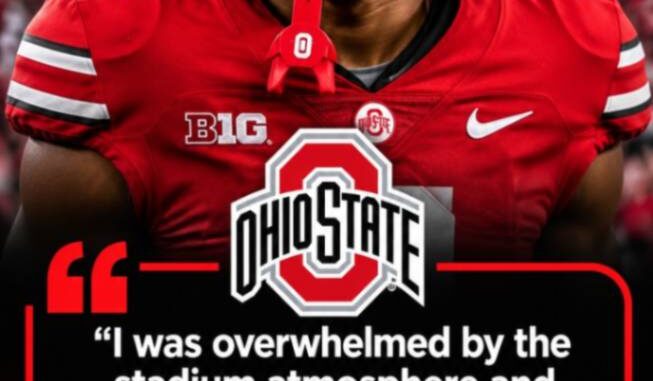
Big Nation’s No. 1 Recruit Rejects Michigan’s $1.5 Million NIL Offer for Ohio State Buckeye’s $1 Million Deal, Proving It Was Never About Money
In a recruiting decision that has sent shockwaves across the college football landscape, the nation’s No. 1 recruit has reportedly turned down a lucrative $1.5 million NIL offer from Michigan in favor of a $1 million deal with Ohio State. The decision has immediately sparked conversations among college football fans, recruiting analysts, and supporters of both programs, particularly because the prospect reportedly walked away from a substantially larger financial offer.
The move represents a significant recruiting victory for Ohio State and raises fresh questions about the factors that influence elite prospects when choosing where to play college football in the increasingly competitive NIL era. With financial incentives playing a growing role in recruiting conversations, a decision to accept less money in favor of another program has naturally attracted considerable attention.
Michigan reportedly made a serious effort to secure the nation’s top-ranked prospect, offering a deal valued at approximately $1.5 million. The offer reflected the Wolverines’ determination to land one of the most sought-after players in the recruiting cycle. However, despite the financial advantage, Ohio State ultimately emerged as the prospect’s preferred destination, with the Buckeyes reportedly presenting an NIL package worth around $1 million.

The difference between the two offers is significant. Michigan’s proposal was reportedly $500,000 higher, representing a considerable financial advantage. For a young athlete entering college, that amount of money could potentially influence a major decision. Yet the recruit’s choice suggests that financial considerations were not the only factors shaping his commitment.
Ohio State has long positioned itself as one of the nation’s premier destinations for elite football talent. The Buckeyes’ reputation for player development, their history of producing NFL talent, their competitive environment, and their ambitions to compete for national championships have consistently helped them attract some of the country’s most highly rated prospects.
Those qualities could have played a central role in the recruit’s decision.
For elite athletes, the college experience is about more than immediate financial rewards. While NIL opportunities have dramatically transformed recruiting, prospects still consider coaching relationships, playing opportunities, development plans, team culture, facilities, and the possibility of reaching the NFL when evaluating their options.
Ohio State’s reputation for developing talented players into professional prospects has been an important part of its recruiting identity. The program has produced numerous NFL players across different positions, and that history continues to serve as an attractive selling point for recruits who hope to build successful careers beyond college football.
The opportunity to train in a competitive environment and receive guidance from experienced coaches can be particularly valuable for a prospect ranked No. 1 nationally. At that level, expectations are enormous, and the difference between simply being talented and becoming an elite college football player often comes down to preparation, consistency, and development.
Ohio State’s coaching staff reportedly made those elements central to its recruiting pitch, emphasizing the long-term benefits of joining the Buckeyes rather than focusing exclusively on the immediate financial package.
The decision also highlights how recruiting conversations have evolved in recent years. NIL opportunities have become an increasingly important component of the college football landscape, allowing players to benefit financially from their name, image, and likeness. Programs and their associated organizations now compete to provide attractive opportunities that can help persuade talented athletes to choose their schools.
Michigan’s reported $1.5 million offer demonstrates the level of financial commitment that can be involved in pursuing elite prospects. Recruiting the nation’s No. 1 player requires considerable effort, and programs understand that securing a highly rated recruit can have a significant impact on their future roster.
However, the Ohio State decision illustrates that a higher financial offer does not necessarily guarantee a commitment.
The prospect’s reported willingness to accept a $1 million deal instead of Michigan’s $1.5 million proposal has created a compelling narrative about priorities in modern college football recruiting. It suggests that the prospect may have placed greater importance on the overall football environment, personal relationships, or his vision for future development than on maximizing the immediate financial opportunity.
For Ohio State fans, the decision is likely to be viewed as an encouraging sign. Securing a recruit who reportedly had the opportunity to earn considerably more money elsewhere reinforces the belief that the Buckeyes can compete for elite talent based on the strength of their program.
Recruiting victories of this magnitude can also have a broader impact. Highly rated prospects frequently influence the decisions of other players in their recruiting classes. When a nationally recognized recruit chooses a program, other athletes may become more interested in joining him, particularly if they believe the team could develop into a championship contender.
The presence of the nation’s top recruit could potentially strengthen Ohio State’s recruiting momentum and help the coaching staff pursue additional high-profile prospects.
Michigan, meanwhile, will have to regroup after reportedly losing an important recruiting battle despite making a substantial financial offer. The Wolverines remain one of the most recognizable programs in college football, and losing a prospect does not diminish their ability to attract other talented players.
Recruiting is an ongoing process, and even the most successful programs experience setbacks. Coaches must continually identify talent, establish relationships, and adapt their recruiting strategies to meet the changing demands of college football.
The situation could also encourage discussions about the role of NIL money in recruiting. While financial opportunities are undeniably important, the decision-making process for elite prospects is often complicated. Athletes must balance financial considerations with the opportunity to compete, develop their skills, receive an education, and prepare for life beyond college football.
For some recruits, the largest offer may be the most attractive option. For others, the football environment and personal development opportunities may carry greater weight. There is no single formula that determines how a prospect makes such an important decision.
The nation’s No. 1 recruit choosing Ohio State despite the reported financial difference is a reminder that recruiting remains a deeply personal process. Relationships between players and coaches, confidence in an offensive or defensive system, the atmosphere surrounding a program, and a player’s long-term ambitions can all influence the final decision.
Ohio State will now have the responsibility of ensuring that the expectations surrounding the recruit are matched by the development opportunities available to him. Being ranked No. 1 nationally comes with enormous pressure, and the prospect will be expected to demonstrate that his talent can translate into success at the college level.
The transition from high school to college football is demanding, regardless of a player’s recruiting ranking. The speed of the game, the complexity of offensive and defensive systems, and the physical demands of competing against experienced athletes require considerable adjustment.
The Buckeyes will need to help the recruit navigate that transition while maintaining the competitive standards that have become part of the program’s identity.
Nevertheless, the recruiting victory has already generated excitement among Ohio State supporters. The idea that the nation’s top prospect reportedly chose the Buckeyes over a significantly larger financial offer from Michigan is the kind of development that can energize a fan base and strengthen confidence in the program’s recruiting direction.
In an era where NIL negotiations are increasingly prominent, Ohio State’s reported $1 million deal may ultimately prove to be about more than the financial package itself. It could represent the strength of the program’s recruiting pitch, the confidence a prospect has in his future development, and the appeal of competing for championships in Columbus.
The recruiting battle may have ended, but the real test begins when the prospect steps onto the field. For Ohio State, landing the nation’s No. 1 recruit is a major achievement. Now, the Buckeyes will hope that the decision becomes the beginning of a successful college football journey that lives up to the expectations surrounding one of the country’s most highly regarded talents.
Leave a Reply