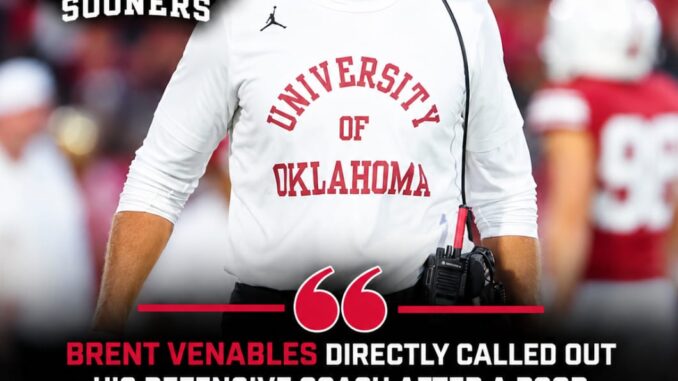
🚨 TENSION IN OKLAHOMA: Brent Venables Directly Called Out His Defensive Coach After a Poor Showing Against Georgia, Saying the Mistakes Were Not Just on the Players
The Oklahoma Sooners walked out of Sanford Stadium with plenty of questions after a difficult 41–13 loss to No. 2 Georgia, and the result has put renewed attention on every part of Brent Venables’ program. Oklahoma entered the matchup with one of the most respected defenses in the country, but the Sooners struggled to contain Georgia during a game that quickly got away from them. The Bulldogs scored 28 points in the first half and never allowed Oklahoma to seriously threaten the outcome.
For Venables, a defensive-minded head coach who has built much of his reputation around aggressive, technically sound football, the performance was particularly difficult to overlook. Georgia did not simply win the game; it exposed several areas where Oklahoma failed to execute at the level expected from a defense that had entered the contest with considerable national attention. Before the game, Georgia head coach Kirby Smart had praised Venables and described Oklahoma’s defense as fundamentally sound, aggressive and difficult to block. That made the struggles in Athens even more noticeable.
The most damaging stretch came during the second quarter, when Georgia turned a competitive opening period into a commanding advantage. The Bulldogs added three touchdowns in the second quarter and went into halftime with a 28–0 lead. Oklahoma eventually managed to put points on the board, but by then the deficit was too large to overcome. Georgia ultimately finished with 306 total yards, while Oklahoma accumulated 296. The numbers show that the game was not simply a matter of overwhelming offensive production from the Bulldogs. Instead, turnovers, field position and critical moments played a major role in determining the result.
Four Oklahoma turnovers were particularly costly. Georgia converted those mistakes into 17 points, including an 85-yard fumble return for a touchdown by linebacker Chris Cole. Oklahoma was trailing 14–0 and had driven deep into Georgia territory when the turnover dramatically changed the momentum. Instead of potentially cutting into the deficit, the Sooners watched Georgia extend its advantage.
That sequence highlighted an important distinction for Oklahoma. Not every problem against Georgia was caused by the defense. John Mateer finished with 231 passing yards, but Oklahoma’s offense struggled to consistently finish drives, and turnovers repeatedly put the team in difficult situations. The Sooners also converted only two of 14 third-down attempts and went one-for-three on fourth down. Those numbers made it extremely difficult for Oklahoma to maintain momentum against an opponent of Georgia’s quality.
Nevertheless, the defensive performance remains a major talking point because of the expectations surrounding Venables’ unit. Entering the matchup, Oklahoma had allowed only 23 points across its first three games, according to pregame coverage, while averaging just 3.5 yards allowed per play. Georgia presented a completely different challenge, and the Sooners were unable to maintain the same level of control once the Bulldogs established their rhythm.
The situation has inevitably brought attention to the relationship between Venables and his defensive staff. A head coach with Venables’ background is expected to examine not only player execution but also preparation, communication, scheme and play-calling when a defense struggles. Venables had already spoken publicly before the Georgia game about the need for Oklahoma to eliminate what he described as fundamental mistakes and become more consistent. That emphasis suggests that accountability inside the program extends beyond the players themselves.
Against Georgia, those fundamentals were tested relentlessly. The Bulldogs attacked with a balanced approach and did not need to rely on an extraordinary passing performance. Gunner Stockton finished with 171 passing yards, while Dwight Phillips Jr. rushed for 84 yards. Talyn Taylor was Georgia’s leading receiver with 110 yards. The Bulldogs produced 129 rushing yards and 177 passing yards, demonstrating that they were able to move the football without needing to overwhelm Oklahoma in one specific statistical category.
For a defense built around pressure, physicality and forcing opponents into difficult situations, the challenge now becomes figuring out why the unit could not consistently dictate the game against Georgia. The Bulldogs entered the matchup with a strong offensive identity, and their ability to stay ahead of the chains prevented Oklahoma from creating enough disruptive plays to change the direction of the contest.
The loss also comes at a difficult point in Oklahoma’s season. The Sooners began the year 2–1 and were preparing to open SEC play against a Georgia team that had already established itself as one of the conference’s most difficult opponents. Oklahoma now sits at 2–2 after the defeat, while Georgia improved to 4–0.
For Venables, the immediate priority will be correcting the problems rather than allowing one difficult afternoon to define the defense. The Sooners still have considerable talent, and the program has demonstrated that its defense can play at a high level. The challenge is consistency, particularly when Oklahoma faces opponents capable of exploiting even small communication or assignment errors.
The idea that mistakes cannot simply be placed on the players is particularly important in a coaching environment. Players are responsible for executing their assignments, but coaches are responsible for preparing those players, designing the calls and putting them in positions where they can succeed. When multiple problems appear during the same game, the evaluation naturally extends to the entire operation rather than stopping with individual players.
That is where the Georgia game could become an important teaching moment for Oklahoma. The Sooners cannot change the final score, and they cannot recover the possessions lost to turnovers. What they can do is examine the film, identify where preparation and execution broke down and determine how those issues can be corrected before the next SEC challenge.
The defensive staff will therefore face considerable scrutiny in the aftermath of Athens. Oklahoma’s defense entered the season with a reputation for physicality and discipline, and maintaining that identity will require adjustments. Venables has spent years developing defenses around aggressive fundamentals, and the response to this setback will reveal how the coaching staff handles adversity as the SEC schedule becomes increasingly demanding.
The Georgia loss was a significant setback, but it also provided Oklahoma with a detailed picture of the areas requiring attention. The Sooners were outplayed on the scoreboard, yet the underlying statistics show a game shaped by more than simple yardage totals. Turnovers, third-down failures, red-zone mistakes and missed opportunities combined to create the 28-point halftime deficit that ultimately decided the contest.
Now the attention turns back to Norman and the work that follows. Venables and his staff will have to determine which mistakes came from players, which came from coaching decisions and which resulted from Georgia simply executing at a higher level. Oklahoma’s response will begin in practice, where corrections can be made before they become recurring problems.
The Georgia game exposed weaknesses, but it also gives Oklahoma a clear blueprint for what needs to improve. The Sooners cannot afford to repeat the same mistakes as the SEC schedule continues. If Venables wants his defense to remain one of the defining strengths of the program, accountability will have to begin with everyone involved, from the coaching staff to the players on the field.
Leave a Reply