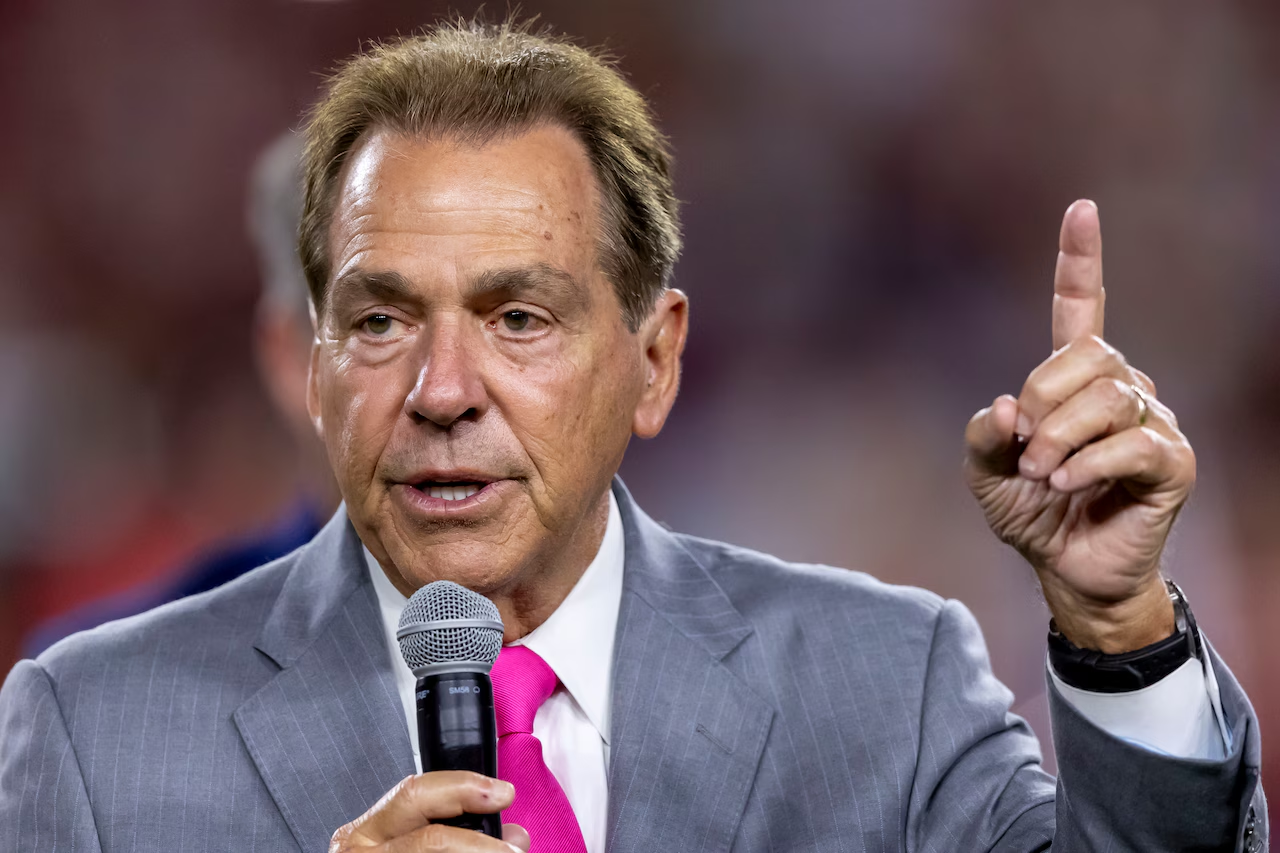
Nick Saban’s Message About Recruiting Rankings Is a Reality Check College Football Needs
For as long as modern recruiting has existed, college football fans have been fascinated by stars.
Every summer, social media timelines fill with commitment graphics, recruiting rankings, and debates over which program “won” the offseason. Entire fan bases celebrate top-five recruiting classes as if championships have already been secured. Analysts dissect every commitment, assigning significance to a player’s ranking and projecting future success based largely on where that player sits in a recruiting database.
But according to legendary former Alabama head coach Nick Saban, college football’s obsession with recruiting rankings has gone too far.
Saban recently offered a perspective that serves as both a warning and a reminder for fans, media members, and even people working within the sport. His comments challenged one of the most deeply rooted assumptions in college football: the belief that recruiting rankings automatically determine future success.
The seven-time national championship coach has spent decades evaluating talent at the highest levels of football. Few people in the history of the sport have signed more elite prospects. Few have produced more NFL players. Few have built dynasties on the scale of what Alabama accomplished under his leadership.
Yet despite benefiting from some of the nation’s top recruiting classes year after year, Saban remains cautious about placing too much value on stars beside a player’s name.
His reasoning is simple.
Potential and production are not the same thing.
That distinction may sound obvious, but it is often forgotten during recruiting season.
When a five-star prospect commits to a major program, the reaction is immediate. Fans celebrate. Expectations skyrocket. Predictions about future awards, championships, and NFL careers begin almost instantly. On the other hand, when a lower-rated prospect signs, skepticism often follows.
The problem is that football careers rarely follow a script.
Saban’s own experience provides countless examples.
Throughout his coaching career, he has watched highly touted recruits arrive on campus carrying enormous expectations. Some lived up to the hype. Others did not. Injuries, motivation issues, struggles with development, academic challenges, and countless other factors affected their careers.
At the same time, he witnessed overlooked players exceed every expectation.
Some arrived without national attention. Some were considered developmental prospects. Some lacked elite recruiting rankings altogether. Yet through hard work, discipline, and continuous improvement, they became stars.
This reality highlights one of the greatest misconceptions surrounding recruiting.
Rankings evaluate what a player might become.
They do not determine what a player will become.
The difference matters.
Recruiting analysts perform an incredibly difficult job. They evaluate thousands of high school athletes across the country, projecting how those players might develop at the collegiate level. Their rankings provide valuable information and often identify elite talent.
Many highly ranked prospects do become stars.
Many eventually hear their names called during the NFL Draft.
The rankings themselves are not the problem.
The issue arises when rankings are treated as guarantees.
A five-star rating does not guarantee All-American honors.
A top-100 ranking does not guarantee a starting position.
A highly ranked recruiting class does not guarantee championships.
Football has always been more complicated than that.
Success at the college level depends on countless variables that rankings cannot fully measure.
Work ethic is one of them.
A player’s willingness to improve every day often determines whether potential becomes reality. Talent can open doors, but effort determines how far someone walks through them.
The transition from high school to college football is demanding. Players enter programs where everyone was a star in high school. Suddenly, they are competing against athletes who are bigger, faster, stronger, and more experienced.
Some embrace the challenge.
Others struggle to adapt.
Recruiting rankings cannot predict which path a player will choose.
Discipline is another factor.
Elite college football requires consistency. The best players maintain high standards in practice, meetings, workouts, film study, nutrition, and recovery. Those habits often separate good players from great ones.
Again, these qualities rarely appear in recruiting rankings.
Mental toughness may be even more important.
Every player experiences adversity.
Injuries happen.
Depth chart battles occur.
Mistakes are made.
Confidence gets tested.
Some players respond by working harder. Others become discouraged.
As Saban pointed out, rankings do not measure how someone responds when things get difficult.
Yet that response often determines the trajectory of an entire career.
Perhaps the most important point in Saban’s comments involves player development.
Modern recruiting conversations frequently focus on acquisition rather than development.
Programs celebrate signing elite talent.
Fans track recruiting rankings obsessively.
Media outlets publish class rankings and assign winners and losers.
But three years later, very few people revisit those rankings to evaluate which coaching staffs actually developed their players.
Development remains one of the most underrated aspects of building a successful football program.
The best programs do more than recruit talented athletes.
They transform them.
They improve technique.
They build strength.
They teach discipline.
They cultivate leadership.
They maximize potential.
This process often determines championships more than recruiting rankings alone.
History provides plenty of evidence.
Numerous teams have assembled highly ranked recruiting classes without achieving sustained success. Conversely, several championship-caliber programs have consistently developed players beyond expectations.
Talent matters.
Development matters more.
That philosophy became a cornerstone of Alabama’s dominance under Saban.
Although the Crimson Tide regularly signed elite recruiting classes, the program’s true advantage often emerged after players arrived on campus. Alabama’s culture emphasized accountability, improvement, competition, and preparation.
Players were expected to develop.
Nothing was guaranteed.
A five-star recruit still had to earn playing time.
A lower-rated recruit still had an opportunity to rise.
The standard remained the same for everyone.
That environment helped produce countless success stories.
It also reinforced one of Saban’s most consistent messages throughout his career: focus on the process rather than external recognition.
Recruiting rankings represent external recognition.
They reflect opinions formed before a player’s college career begins.
The process determines what happens afterward.
This perspective feels particularly relevant in today’s college football landscape.
The sport has become increasingly driven by attention, social media engagement, and constant news cycles. Recruiting announcements generate massive audiences. Commitment ceremonies become national events. Rankings updates spark endless debates.
The visibility of recruiting has never been greater.
At times, it can create unrealistic expectations for young athletes.
Imagine being a seventeen-year-old player labeled a future superstar before ever taking a college snap. The pressure can be immense. Every performance gets scrutinized. Every mistake gets magnified.
Not every athlete handles that attention the same way.
Likewise, lower-ranked players often face assumptions about their limitations before they have an opportunity to prove themselves.
Saban’s comments serve as a reminder that football careers are earned, not predicted.
The star rating may influence where a player starts.
It does not determine where he finishes.
For fans, this message encourages patience.
Recruiting victories are exciting.
They provide reasons for optimism.
They can offer insight into a program’s future talent level.
But they should not be mistaken for championships.
Every season writes its own story.
Every player develops differently.
Every recruiting class faces challenges that cannot be predicted on Signing Day.
The most successful fans understand this distinction.
They celebrate commitments without assuming outcomes.
They appreciate rankings without worshiping them.
They recognize that the true evaluation begins after players arrive on campus.
For coaches, Saban’s message reinforces the importance of culture.
Recruiting talent remains essential.
No championship contender can ignore talent acquisition.
However, identifying players who fit a program’s culture may be just as important as identifying elite athletic traits.
The right mindset often amplifies talent.
The wrong mindset can waste it.
Great coaching staffs understand this balance.
They recruit character alongside ability.
They evaluate competitiveness alongside athleticism.
They seek players who embrace development rather than simply relying on natural gifts.
For players, Saban’s comments offer something even more valuable: hope.
Not every future star enters college as a five-star recruit.
Not every NFL player arrives with national recognition.
Many successful athletes began their journeys overlooked, underestimated, or underappreciated.
Their stories share a common theme.
They improved.
They worked.
They developed.
They refused to let rankings define them.
That lesson extends beyond football.
Potential matters in every field.
But potential alone accomplishes very little.
Achievement comes from consistent effort, resilience, discipline, and growth.
Whether in athletics, business, academics, or life, the people who ultimately succeed are often those who maximize their abilities rather than those who simply possess the most natural talent.
That is why Saban’s comments resonate beyond recruiting discussions.
They challenge a culture increasingly focused on predictions instead of progress.
They remind us that success remains uncertain, earned, and deeply connected to personal development.
Most importantly, they emphasize a truth that has defined football for generations.
Stars can attract attention.
Potential can create excitement.
Hype can dominate headlines.
But when the games begin, none of those things guarantee success.
Performance does.
As college football continues to celebrate recruiting rankings and Signing Day victories, Saban’s words provide a necessary dose of perspective.
Recruiting rankings have value.
They identify talent.
They generate interest.
They help fans understand the future of their favorite programs.
But they are not crystal balls.
They cannot measure determination.
They cannot predict growth.
They cannot guarantee greatness.
The players who ultimately become legends are often not the ones who arrive with the most hype.
They are the ones who improve the most after they arrive.
And according to Nick Saban, that is the lesson college football should never forget.
Leave a Reply