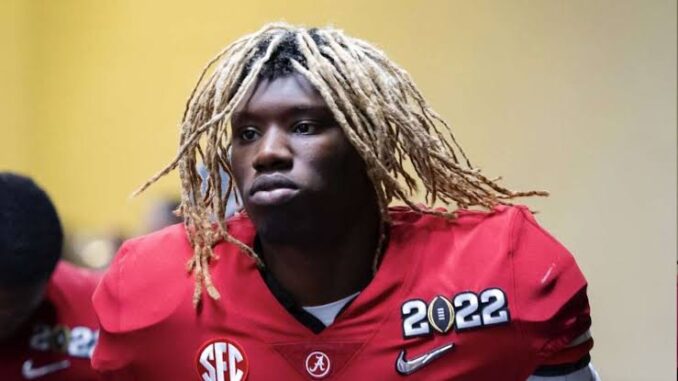
The news broke on a quiet Monday morning and quickly spread through college football circles with a kind of disbelief that often follows the sudden end of a career that once felt destined for something far bigger. According to multiple sources close to the situation, former Alabama Crimson Tide wide receiver Agiye Hall has decided to retire from football, stepping away from the sport after a journey that began with immense promise and ended far earlier than many expected.
For fans who remember his emergence out of high school, the announcement carries a weight that is difficult to ignore. Hall was not just another recruit in Alabama’s yearly cycle of elite talent. He arrived in Tuscaloosa as part of a highly competitive receiver class, bringing with him the kind of physical tools that tend to make coaches pause mid-sentence when describing a prospect. At six-foot-three with long strides, strong hands, and a natural ability to separate at the line of scrimmage, he looked like the prototype of the modern outside receiver Alabama had long been known for developing.
His early days with the Crimson Tide only strengthened that perception. Even in a receiver room crowded with future NFL talent, Hall occasionally flashed moments that reminded observers why he had been so heavily recruited. There were practices where he would beat seasoned defensive backs on vertical routes, tracking deep passes with confidence that seemed beyond his experience level. There were scrimmages where his catch radius alone made him stand out, reaching for throws that most young receivers would not even attempt to secure.
At the time, Alabama’s system was unforgiving in its depth chart but rewarding for those who could climb it. Competition was not just part of the environment; it was the identity. Every snap in practice felt like a referendum on a player’s readiness. For a young receiver like Hall, this meant that every rep mattered, every mistake was magnified, and every success came with the pressure of maintaining it against equally talented teammates pushing from behind.
Yet, even within that structure, expectations around Hall continued to rise. Coaches and analysts alike saw a player who, if developed properly, could evolve into one of the next great Alabama receivers. The program had already produced a pipeline of elite wideouts in recent years, and Hall was widely believed to be the next in that lineage. His combination of size and athleticism made him difficult to ignore, and there were moments when it seemed only a matter of time before he would break through into a starting role.
But college football careers rarely follow straight lines, especially in programs where the margin between success and transfer portal decisions is razor thin. Hall’s time at Alabama, while promising in flashes, became increasingly complicated. The competition never eased, and consistency became the central challenge. In an environment where a single dropped pass or missed assignment could shift depth chart positioning, maintaining momentum proved difficult.
Eventually, Hall made the decision to leave Alabama, a move that sent ripples through the fan base but was not entirely uncommon in the modern era of college football. The transfer portal had changed the landscape, allowing players to seek new opportunities when circumstances no longer aligned with their expectations or development paths. For Hall, it represented a chance to reset, to find a system where his talents could be fully unlocked without the constant pressure cooker of Alabama’s receiver room.
What followed, however, was a journey marked by movement rather than stability. Hall transferred again, searching for the right fit, the right offensive scheme, and the right opportunity to reestablish himself as the kind of receiver many once projected him to be. Each stop carried optimism in its early stages. Coaches spoke about his potential, teammates described his athletic ability in glowing terms, and glimpses of his natural talent still appeared in practice sessions and occasional game moments.
But football, particularly at the collegiate level, is often less about potential alone and more about rhythm, continuity, and confidence built over time. Without sustained stability in one system, it becomes difficult for a player to fully settle into a role. Timing with quarterbacks, understanding of playbooks, and trust within an offensive structure all take repetition. For Hall, the repeated transitions meant those foundational elements were constantly being rebuilt rather than refined.
As seasons passed, the narrative surrounding him began to shift. The conversation moved away from future stardom and toward uncertainty. Not because his physical talent had disappeared, but because the opportunities to fully translate that talent into consistent production became increasingly fragmented. Coaches at each stop saw pieces of what once made him such a coveted recruit, but those pieces never quite assembled into the complete picture that had once been envisioned.
Behind the public perception, the internal experience of such a journey can be far more complex. Athletes in Hall’s position often carry the weight of external expectations that were formed long before they ever stepped onto a college field. High school highlights, recruiting rankings, and early program hype create a narrative that can be difficult to escape, even when circumstances change. Every new opportunity comes with the hope of rewriting that narrative, but also the pressure of proving it should have never needed rewriting in the first place.
For Hall, those expectations never fully faded. Even as he moved through different programs, there remained a lingering sense among fans and observers that his best football was still ahead of him, waiting for the right environment to finally emerge. That belief persisted in highlight discussions, offseason conversations, and speculation about what his next chapter might look like. It is part of what makes his retirement so unexpected to many who followed his early career closely.
According to the reports surrounding his decision, Hall has chosen to step away from football entirely, bringing an early close to a career that once carried the weight of immense possibility. While no single moment defines the entirety of a player’s journey, the arc of Hall’s path reflects the unpredictable nature of modern college athletics, where talent alone does not always guarantee longevity or stability.
Within Alabama circles, his name still carries echoes of what might have been. There are players who leave programs quietly, their careers blending into the endless rotation of roster changes. Hall was never one of those players. His arrival was too highly anticipated, his physical tools too noticeable, and his early flashes too memorable for his presence to fade without recognition. Even years later, his name still surfaces in conversations about recruiting classes that had the potential to be transformative.
For Alabama fans, the news brings a mix of reflection and melancholy. The program has seen countless players come through its doors, many of whom went on to thrive elsewhere or within the system itself. But there is always a unique curiosity attached to players who arrive with elite expectations but leave before fully realizing them. Hall fits into that category, not as a cautionary tale, but as an example of how narrow the path to sustained success can be at the highest levels of college football.
His story also reflects the evolving reality of the sport. The transfer portal, increased player movement, and changing expectations around development timelines have created a landscape where careers can shift rapidly. A player can be a future cornerstone one season and searching for a new opportunity the next. Stability has become just as valuable as talent, and without it, even the most promising trajectories can lose momentum.
As Hall steps away from the game, questions naturally arise about what comes next. Many former players transition into coaching, training, media roles, or entirely new professional fields outside of football. Others take time away from the sport to reassess their goals and identities beyond the field. For someone who has spent years under the intense spotlight of high-level competition, the decision to walk away often signals a deeper personal evaluation of purpose, fulfillment, and future direction.
What remains clear is that his journey will be remembered in layers. There is the early promise that made him one of the most talked-about recruits in his class. There is the Alabama chapter, defined by competition, flashes of potential, and the weight of expectation. There are the transfers, each representing a search for alignment between talent and opportunity. And now, there is the retirement, which closes the chapter far earlier than many would have imagined when his career first began.
In the broader story of college football, Agiye Hall becomes another example of how unpredictable the sport can be. Talent is only one part of a much larger equation that includes timing, fit, development, confidence, and circumstance. When even one of those elements is misaligned, the trajectory of a career can change in ways that no recruiting ranking or highlight reel can fully anticipate.
For fans, coaches, and teammates who watched him at different stages, the memory of his athletic ability will likely remain the most enduring aspect of his career. The strides down the sideline, the contested catches in practice, and the raw physical potential that once made him a standout in high school football in Valrico, Florida, will continue to define how he is remembered.
And while the ending may feel abrupt, it does not erase the beginning, nor the moments in between when the future still felt wide open. In that sense, his story is not only about retirement, but about the complex and often unpredictable journey that defines modern college football itself.
Leave a Reply