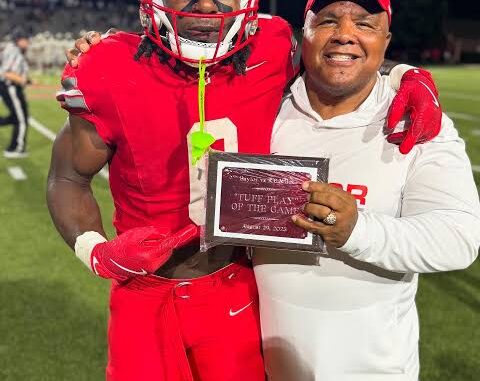
The college football recruiting world rarely waits for permission before turning a teenager into a national storyline, and in the case of five-star running back David Gabriel Georges, the attention has already reached a level usually reserved for established college stars or even NFL prospects. With a commitment date now officially set for July 22nd, the entire sport has shifted its focus toward one question that feels both simple and impossible at the same time: where will one of the most electric offensive talents in the country decide to play his football?
For Alabama, this is not just another recruiting battle. It feels personal. Georges is widely considered one of the most important in-state targets in his class, a player whose rise through high school football has been followed closely in the state of Alabama from the moment he first broke onto varsity fields as a younger, faster, and more instinctive version of himself than anyone expected at that age. Now fully developed into a complete offensive weapon, his blend of vision, acceleration, and contact balance has made him a nightmare for defenders and a dream for recruiting coordinators.
The stakes are higher because of who is involved. The program that has historically dominated in-state recruiting battles, the Alabama Crimson Tide, finds itself locked in a tense, modern recruiting war against three of the most powerful brands in college football: the Ohio State Buckeyes, the Georgia Bulldogs, and the Ole Miss Rebels. Each program brings its own identity, its own pitch, and its own vision of how Georges would fit into their offensive future.
What makes this recruitment particularly fascinating is not just the talent of the player, but the timing of his decision. In today’s era of college football, where NIL opportunities, transfer portal movement, and early playing time expectations heavily influence recruiting outcomes, a commitment date is no longer just a ceremonial announcement. It is a culmination of months, sometimes years, of quiet persuasion, campus visits, family discussions, and behind-the-scenes evaluations that fans rarely see but programs live and breathe every day.
For Georges, those months have been filled with attention that most teenagers would struggle to process. Coaches from every corner of the country have made their presence felt. Position coaches have broken down film with him not just to explain what he does well, but to show him how he could evolve in their systems. Head coaches have stepped into living rooms and training facilities, projecting futures that stretch far beyond college Saturdays. And through it all, Georges has remained composed, absorbing everything while carefully avoiding any public hint about where his heart might truly be leaning.
At Alabama, the pitch is familiar but still powerful. The idea of continuing a legacy of elite running backs, of stepping into a system where physical backs are not just featured but central to offensive identity, carries weight. The Crimson Tide have long prided themselves on producing NFL-ready talent at the position, and Georges’ skill set aligns naturally with that tradition. His ability to read blocks, break arm tackles, and accelerate through tight lanes makes him a prototype for the kind of back that has thrived in Tuscaloosa for years.
Yet even with that tradition, the recruiting landscape is no longer dominated by history alone. Modern players want clarity on usage, development, and immediate opportunity. They want to know how they will be featured in the passing game, how quickly they can earn meaningful carries, and how their brand will grow within the program. Alabama’s staff has responded by modernizing their pitch, emphasizing versatility, offensive creativity, and the ability to build a national profile while still competing for championships.
Still, competition is fierce.
In Columbus, Ohio State has positioned itself as a national recruiting powerhouse with a consistent track record of developing offensive stars who transition seamlessly into the NFL. The Buckeyes’ pitch to Georges has centered on explosive offensive production, space utilization, and the opportunity to play in one of the most high-powered systems in college football. They see him not just as a running back, but as a weapon who could be deployed in multiple formations, stretching defenses horizontally and vertically.
Meanwhile, Georgia brings something different entirely. The Bulldogs have built an identity rooted in physical dominance, defensive strength, and a balanced offensive approach that often relies on controlling the line of scrimmage. For a running back, that environment can be extremely appealing. The idea of running behind one of the most consistently dominant offensive lines in the country, of being part of a system that wears down opponents and controls games, is a powerful narrative. The Georgia Bulldogs have also recently proven that they can rotate elite backs without sacrificing production, which adds another layer of confidence for recruits evaluating long-term durability and opportunity.
Then there is Ole Miss, a program that has quietly but effectively reshaped its recruiting identity under modern offensive philosophy. The Ole Miss Rebels have become known for creativity, tempo, and maximizing offensive production in ways that appeal strongly to skill position players. For Georges, the appeal lies in the possibility of becoming the centerpiece of an explosive system where space is created quickly and running backs are consistently put in position to make defenders miss in open field situations.
What makes this recruitment even more compelling is that none of these programs are seen as long shots. This is not a situation where one or two schools are simply filling space on a list. Instead, each program has built a legitimate case, each has invested meaningful time, and each believes it has a real chance to land one of the most important offensive prospects in the country.
Inside Alabama’s recruiting circles, there is a quiet confidence that comes from familiarity. Georges is not just another national recruit to them; he is a player from their backyard, someone who has been evaluated early, watched closely, and prioritized for an extended period. There is a belief that in-state ties still matter, especially when combined with championship expectations and developmental consistency.
But confidence does not eliminate concern. The modern recruiting era has proven repeatedly that geography alone is no longer a guarantee. Players now weigh exposure, scheme fit, coaching relationships, and long-term development just as heavily as proximity to home. In some cases, even more heavily.
That reality is what makes July 22nd feel like a turning point rather than just a date on a calendar. As the day approaches, speculation will intensify. Every social media interaction, every unofficial comment from family members, every subtle visit recap will be analyzed and reanalyzed by fan bases desperate for clues. Recruiting has always been emotional, but in cases like this, it becomes almost cinematic, with each program believing it can see the final outcome clearly while knowing deep down that nothing is certain until the announcement is made.
For Georges himself, the pressure is undeniable, even if he does not publicly acknowledge it. Choosing a college is already a life-defining decision for most athletes, but choosing among four elite programs with national expectations attached to every option raises the stakes even further. It is not just about where he will play football, but how he will be developed, how he will be used, and what kind of legacy he wants to build over the next several years of his life.
What makes elite running backs like Georges so valuable is not just athletic ability, but timing and decision-making in real time on the field. Ironically, those same qualities are now being tested off the field as he navigates one of the most important decisions of his young life. Every visit, every conversation, every film session with coaches has been building toward a single moment of clarity.
As the commitment date approaches, Alabama’s position remains strong but far from secure. Ohio State continues to press with offensive excitement and national exposure. Georgia offers stability, physicality, and a proven pipeline for elite talent. Ole Miss brings innovation and a chance to be featured in a fast-paced, highlight-driven system that appeals to modern skill players.
The question is not whether Georges is a program-changing talent. That part is already accepted across the country. The real question is which program has done enough, said enough, and proven enough to convince him that his future is best built in their colors.
On July 22nd, that question will finally be answered. Until then, every fan base involved will continue to believe, continue to hope, and continue to analyze every detail as if the next clue might be the one that reveals everything. In reality, though, only Georges knows where this is headed, and the rest of college football is simply waiting for the moment he decides to make it official.
Leave a Reply