The rain had not stopped falling over Dublin for three straight days.
It came in soft silver waves that painted the city streets with reflections of old street lamps and glowing storefront signs. Cars hissed through puddles while tired pedestrians hurried beneath umbrellas, eager to escape the cold bite of the February morning. Along a narrow street tucked between a bookstore and an aging flower shop sat O’Malley’s Diner, a modest family-owned restaurant that had somehow survived changing times, rising prices, and the slow disappearance of old Dublin charm.
Inside the diner, warmth replaced the icy weather outside.
The scent of sizzling bacon and fresh coffee drifted through the room while old jazz music played softly from a dusty radio mounted near the kitchen entrance. The booths were worn from years of customers leaning back during conversations about politics, football, heartbreak, and life. The walls carried framed photographs of smiling families, local rugby teams, and faded newspaper clippings from decades ago.

For twenty-two-year-old Sera Whitmore, it was just another morning shift.
She moved between tables with practiced efficiency, balancing plates carefully while offering polite smiles to customers she’d probably never see again. Life had become repetitive lately. Wake up before sunrise, catch the crowded bus into the city, work double shifts, return home exhausted, and repeat the cycle the next day.
There had once been bigger dreams.
At eighteen, Sera imagined herself becoming a writer. She used to stay awake at night filling notebooks with stories about people she met or imagined. But dreams changed when reality demanded rent payments, medical bills for her mother, and sacrifices no one prepares for when they are young.
Now those notebooks sat untouched beneath her bed.
Still, there was something about Sera that customers remembered. Maybe it was her calm voice. Maybe it was the sincerity in her smile. Or perhaps it was because she listened when people spoke, genuinely listened, even when the world had stopped listening to them long ago.
That morning had started slowly.
A pair of elderly men argued quietly over football near the window while a mother struggled to feed pancakes to her toddler near the counter. Sera wiped down empty tables and glanced at the clock hanging near the kitchen.
9:17 a.m.
Then the door opened.
A young man stepped inside, bringing a gust of cold wind and rain behind him.
At first glance, there was nothing extraordinary about him.
He wore a dark hoodie beneath a plain gray jacket, blue jeans, and white sneakers slightly damp from the rain outside. His hood rested low enough to shadow part of his face, though not completely. He looked tired, as though he hadn’t slept properly in days.
But there was a quietness about him that stood apart from everyone else.
Not arrogance. Not nervousness.
Just calm.
He scanned the diner briefly before choosing the most secluded booth in the corner near the fogged-up window. No phone in his hand. No headphones. No bodyguards or friends following behind him.
Sera grabbed a menu and approached with her usual smile.
“Morning,” she said gently. “You alright there?”
The young man looked up, and for a brief second she noticed how unusually kind his eyes were.
“Morning,” he replied warmly. “Yeah, I’m good. Thanks.”
His voice carried a soft Southern accent she couldn’t immediately place.
She handed him the menu, though he barely glanced at it.
“What can I get for you?”
“Just eggs, toast, and black coffee,” he answered. “Nothing fancy.”
“You picked the right place for that.”
That earned a quiet laugh from him.
As Sera walked back toward the kitchen, she noticed something strange.
A teenage boy sitting with his father near the counter kept staring toward the corner booth. The boy squinted several times as if trying to recognize the customer.
Then his eyes widened.
He whispered frantically to his father, who turned around quickly before looking equally shocked.
Sera frowned slightly.
She looked back toward the young man in the corner, but he simply sat there staring out at the rain as though he wanted to disappear into it.
The food arrived a few minutes later.
When she placed the plate before him, he smiled appreciatively.
“This looks amazing.”
“You haven’t tasted it yet,” she teased lightly.
“I can already tell.”
Again, that quiet laugh.
Most customers buried themselves in phones while eating alone, but not him. Instead, he watched the rain outside thoughtfully between bites, occasionally sipping his coffee while the diner buzzed around him.
Sera found herself glancing toward the corner more often than she expected.
There was something oddly refreshing about someone who didn’t seem desperate for attention.
During her break, she walked past the counter where the teenage boy still looked excited.
“You know who that is?” he whispered urgently.
Sera blinked. “Should I?”
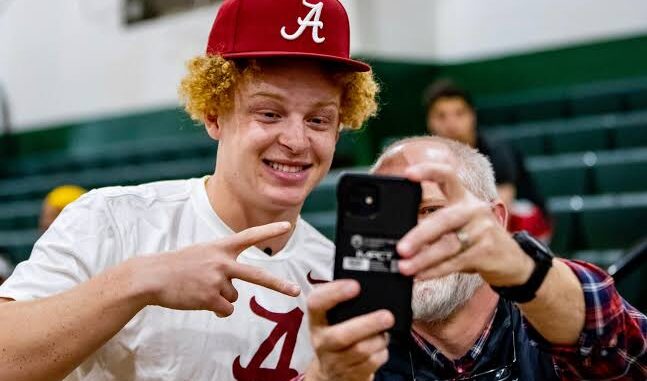
“That’s Cayden Jones.”
The name meant nothing to her initially.
The boy looked horrified.
“The Alabama linebacker? Seriously?”
Recognition slowly surfaced. She wasn’t deeply invested in American football, but even she had heard fragments about a rising college football star dominating headlines recently. Sports channels talked endlessly about him. Analysts called him one of the most explosive defensive players in the country. Social media compared him to future NFL legends.
Cayden Jones.
The same athlete reporters described as the face of Alabama Crimson Tide’s future.
Sera glanced back toward the booth again.
He certainly didn’t look like a celebrity athlete worth millions in future contracts.
No expensive jewelry.
No cameras.
No ego.
Just a quiet young man eating breakfast alone in a small Dublin diner.
“Are you sure?” she asked softly.
“One hundred percent,” the teenager said. “I watch all his games.”
The realization felt surreal.
Why would someone that famous sit alone in a nearly forgotten diner on a rainy Dublin morning?
She considered asking him but decided against it.
Customers deserved peace sometimes.
Especially famous ones.
The morning crowd eventually thinned, leaving the diner quieter than before. Cayden remained in his booth longer than expected, nursing his second cup of coffee while reading something from a small notebook.
Not a phone.
A notebook.
That surprised her.
Finally, curiosity overcame hesitation.
As she refilled his coffee, she smiled carefully.
“So… Dublin vacation?”
He looked amused.
“Something like that.”
“You don’t sound Irish.”
“No,” he chuckled softly. “Guess I gave that away.”
“Just a little.”
He leaned back slightly, glancing toward the rain-soaked window again.
“I needed somewhere quiet,” he admitted. “Somewhere nobody expects anything from me.”
The honesty in his voice caught her off guard.
People spoke about athletes as if fame solved every problem imaginable. Money, attention, admiration — the world assumed those things created happiness automatically.
But exhaustion sat behind his eyes.
Not physical exhaustion.
Emotional exhaustion.
“You picked the right city for rain and quiet,” Sera said.
“That’s exactly why I came.”
For a moment neither spoke.
Then he surprised her again.
“You ever feel stuck?” he asked suddenly.
The question felt so personal that she almost laughed.
“All the time.”
He nodded as if he understood perfectly.
“People think success makes life simpler,” he murmured. “Truth is… it just changes the type of pressure.”
Sera studied him carefully now.
Not as a celebrity.
As a human being.
“You don’t seem like someone who enjoys attention much.”
“I don’t hate it,” he replied. “I’m grateful for everything happening. But sometimes people stop seeing you as a person. They see headlines instead.”
That sentence lingered heavily between them.
Headlines instead.
Sera thought about all the articles and clips she had seen playing on televisions recently. Analysts debating his future. Sports commentators dissecting every performance. Fans idolizing him.
Yet here he sat alone in silence eating eggs and toast.
“You know,” she said carefully, “for someone everyone talks about, you’re surprisingly normal.”
That made him laugh harder than before.
“Best compliment I’ve gotten in months.”
Their conversation ended when another table needed attention, but something about it stayed with her throughout the shift.
Hours later, near noon, Cayden finally stood to leave.
The diner had grown busier again, and Sera was helping carry plates from the kitchen when she noticed him walking toward the register.
He pulled his hood back up lightly.
“Thank you,” he told her sincerely. “For the food and the conversation.”
“You’re welcome.”
There was no arrogance in him.
No expectation of special treatment.
Just gratitude.
As he prepared to leave, Sera noticed him place something carefully on the table inside the booth. Then he reached into his pocket, left cash beneath the folded paper, and gave her one final smile before stepping back into the rain.
The bell above the diner door jingled softly as he disappeared outside.
For reasons she couldn’t explain, Sera immediately walked toward the booth.
The plate had been cleaned completely.
Beside the coffee mug sat the folded note.
And beneath it was the largest tip she had ever received in her life.
Her breath caught instantly.
It was enough money to cover nearly two months of rent.
Hands trembling slightly, she unfolded the note.
The handwriting was neat and deliberate.
“Thank you for treating me like a human being instead of a headline.
The world gets loud sometimes. Your kindness made this city feel peaceful today.
Don’t give up on your dreams.
— Cayden”
Sera stared at the words silently while the sounds of the diner faded around her.
Don’t give up on your dreams.
Tears unexpectedly filled her eyes.
Not because of the money.
But because somehow, impossibly, a stranger had seen straight through her exhaustion.
She folded the note carefully and slipped it into her apron pocket.
The rest of the day passed differently after that.
Lighter somehow.
For the first time in years, Sera returned home without immediately collapsing into bed. Instead, she pulled the old notebooks from beneath her mattress and sat quietly beside the window while rain tapped gently against the glass.
She began writing again.
At first the words came slowly.
Then faster.
Stories she thought had died inside her returned piece by piece.
Meanwhile, across the Atlantic Ocean, Cayden Jones returned to the chaos waiting for him.
Reporters.
Training camps.
Interviews.
Predictions about championships and NFL futures.
But something about Dublin remained in his mind too.
Not the tourist attractions.
Not the fame.
Just a quiet diner and a waitress who spoke to him like he was ordinary.
Weeks passed.
Then months.
Cayden’s star continued rising rapidly. His performances became legendary throughout college football. Sports channels debated whether he was the greatest linebacker Alabama had produced in years. Fans packed stadiums wearing his jersey while reporters followed him endlessly.
Yet every now and then, after difficult games or exhausting interviews, he found himself thinking about that rainy morning in Dublin.
About peace.
About simplicity.
About being seen as human again.
One evening after a major televised victory, a reporter asked him an unexpected question during a postgame interview.
“With all the pressure surrounding your career now,” the reporter said, “how do you stay grounded?”
Cayden paused thoughtfully before answering.
“A few months ago, I had breakfast at this tiny diner in Dublin,” he said quietly. “Nobody there cared about football. They just treated me kindly. Sometimes people don’t realize how powerful simple kindness can be.”
The clip spread online almost immediately.
Fans became obsessed with identifying the diner.
Within days, internet detectives tracked down O’Malley’s.
Suddenly reporters arrived asking questions.
Customers flooded the restaurant.
Business tripled almost overnight.
Sera hated the attention initially.
But something unexpected happened.
A small publishing company reached out after reading a short story she had posted online weeks earlier — encouraged by the confidence Cayden’s note had unknowingly restored.
They wanted to meet her.
Apparently her writing carried emotional honesty they rarely found anymore.
Life began changing slowly after that.
Not magically.
Not perfectly.
But genuinely.
Nearly a year later, on another rainy Dublin morning, Sera sat alone inside the diner before opening hours.
In front of her rested a freshly printed copy of her very first published novel.
Her fingers traced the cover silently.
Then the diner door opened unexpectedly.
She looked up.
And froze.
Cayden Jones stood there again, taller somehow, broader from another brutal football season, but carrying the same calm presence as before.
This time recognition followed him instantly.
The world now knew his name everywhere.
Yet he still wore simple clothes.
Still looked humble.
Still smiled warmly.
“You came back,” Sera whispered.
“Told you I liked the coffee.”
She laughed softly.
“You became even more famous.”
“Unfortunately.”
That earned another laugh between them.
He noticed the book immediately.
His eyes widened.
“You wrote it?”
She nodded slowly.
“You were right,” she admitted. “About not giving up.”
Cayden picked up the novel carefully, studying the cover with genuine admiration.
Then he looked back at her.
“See?” he said softly. “Sometimes people just need someone to remind them who they are.”
Outside, Dublin rain continued falling endlessly against the streets.
Inside the little diner, two lives that had crossed by pure chance sat quietly once more over eggs, toast, and black coffee — proof that even brief moments of kindness can echo far longer than anyone ever expects.
Leave a Reply