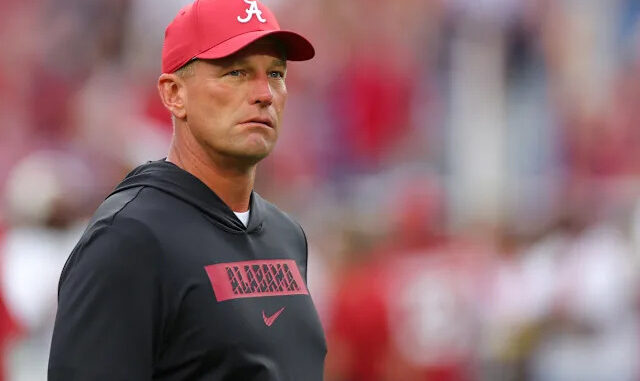
When a program like Alabama is discussed in college football circles, the conversation is rarely quiet, rarely neutral, and almost never without weight. Expectations are not just high; they are institutional. For over a decade, under the shadow and leadership of Nick Saban, Alabama was not simply a contender but a standard. Every season began with championship assumptions, and anything short of that was treated as a deviation from identity rather than a failure of execution.
Now, in the post-Saban landscape, the conversation has shifted in a way that feels uncomfortable for many observers. Among the voices weighing in on this transition, Joel Klatt has offered a particularly sharp perspective—one that suggests Alabama may not be progressing in the traditional sense. In his view, the Crimson Tide under Kalen DeBoer might not be “getting better” in the way fans expect improvement to look. But beneath that surface-level concern lies a more unsettling possibility for the rest of college football: Alabama could be quietly assembling something far more dangerous than a simple continuation of what came before.

It is a paradox that defines this new era in Tuscaloosa. A team that looks, at times, less dominant on paper may actually be becoming more adaptable, more unpredictable, and potentially more difficult to contain when it matters most.
Joel Klatt’s perspective, whether one agrees with it or not, taps into a broader uncertainty surrounding transitional greatness. When a dynasty loses its architect, the instinct is to measure everything against the past. Saban’s Alabama was built on precision, defensive suffocation, and a ruthless efficiency that left little room for chaos. Every unit knew its role. Every mistake was corrected quickly. Every game felt like a controlled experiment in dominance.
Under Kalen DeBoer, however, Alabama begins to resemble something different. Not weaker, but less rigid. Not lost, but less predictable. And that distinction is where Klatt’s skepticism emerges. To him, and to others who share a similar analytical lens, Alabama may appear to be in a phase of recalibration rather than clear upward trajectory. The offensive identity is evolving, the defensive consistency is being restructured, and the overall rhythm of the team feels less like a machine and more like an organism learning to move in a new environment.
But that is precisely where the danger lies.
Because Alabama has never been most dangerous when it is perfectly predictable. It has been most dangerous when it has been evolving in real time while still possessing elite talent and institutional belief. DeBoer’s arrival represents not a dismantling of Alabama’s identity but a redefinition of it. And in that redefinition, something subtle is happening beneath the noise of comparison.
The assumption that improvement must be linear is what fuels the idea that Alabama is not getting better. People expect sharper dominance, more convincing blowouts, and a clearer resemblance to the Saban era. When those markers are absent or inconsistent, the immediate conclusion is stagnation. But DeBoer’s system does not necessarily operate on those visible metrics. Instead, it prioritizes synchronization between offensive creativity and controlled aggression, while allowing for adaptability that Saban’s final teams sometimes struggled to maintain in an increasingly offensive-driven college football landscape.
In that sense, Alabama’s current state can look like inconsistency when it may actually be experimentation with intent.
There is also a psychological layer that cannot be ignored. Programs transitioning from legendary leadership often carry a kind of inherited pressure that can distort perception. Every loss is magnified. Every close win is dissected. Every imperfect performance is framed as regression rather than adjustment. Alabama is no exception to this rule, but in many ways, it is the ultimate example of it.
Joel Klatt’s skepticism fits neatly into this narrative because it reflects what many analysts feel when they watch Alabama now: the absence of familiar dominance cues. The crushing defensive sequences are less automatic. The offensive rhythm sometimes shifts mid-game rather than dictating from the opening snap. The aura of inevitability is not as constant as it once was.
Yet what often goes unnoticed in this interpretation is how intentional some of these changes may be.
Kalen DeBoer is not attempting to recreate Alabama in the image of its past. That would be both impossible and strategically limiting. Instead, he is shaping a team that can survive in the current era of college football, where offensive tempo, quarterback mobility, and schematic unpredictability often dictate success more than sheer defensive dominance alone. The Crimson Tide under his leadership is learning how to operate in multiple identities within a single season, sometimes within a single game.
That fluidity can be mistaken for instability. But in reality, it can be a form of controlled danger.
The idea that Alabama is “not getting better” assumes a fixed definition of improvement. It assumes that better means more convincing wins, higher rankings, or more dominant statistical outputs. But what if better, in this context, means harder to prepare for? What if better means less reliant on a singular identity and more capable of shifting between styles depending on the opponent?
That is where the more unsettling interpretation of DeBoer’s Crimson Tide emerges. Because if Alabama is no longer tied to one dominant system, it becomes more difficult for opponents to scheme against. In the Saban era, teams often knew what they were facing even if they could not stop it. There was a structure, a philosophy, a recognizable blueprint of control.
In the current iteration, that clarity is fading.
Defensively, Alabama is still anchored in physicality and discipline, but the edge is now paired with more variation. The pressure schemes are less predictable, the secondary alignments more fluid, and the in-game adjustments more experimental. Offensively, the shift is even more pronounced. The quarterback role is evolving into a more dynamic decision-making hub rather than a purely system-driven executor. Receivers are being utilized in ways that emphasize spacing and timing over sheer vertical dominance.
These changes do not always produce immediate, visible superiority. But they build toward something less obvious and potentially more dangerous: adaptability under pressure.
Joel Klatt’s argument, in its most generous interpretation, is not necessarily that Alabama is declining. It is that Alabama no longer looks like Alabama in the way the college football world has been conditioned to recognize it. And in that gap between expectation and reality, perception becomes fragile.
What complicates matters further is the talent pipeline. Alabama continues to recruit at an elite level, attracting players who are not only physically gifted but increasingly versatile. The modern Crimson Tide athlete is being asked to operate in a system that demands cognitive flexibility as much as athletic dominance. That shift is subtle, but it changes the long-term identity of the program.
Where Saban’s teams often specialized in perfection within defined roles, DeBoer’s approach appears to favor multi-role capability. Players are no longer just executing assignments; they are interpreting situations in real time. That may introduce short-term inconsistency, but it also creates a foundation for unpredictability that can overwhelm opponents who rely on pre-game film analysis as their primary preparation tool.
This is where the “silently assembling something dangerous” idea becomes most relevant.
Because while Alabama may not always look like a finished product on a week-to-week basis, the pieces being assembled suggest a team that could peak in a way that is difficult to anticipate. It is not the loud dominance of the past. It is the quiet accumulation of flexibility, depth, and strategic variability.
The SEC landscape amplifies this transformation. Opponents are no longer just trying to beat Alabama’s talent; they are trying to decode its evolution in real time. And that creates a different kind of pressure. Teams preparing for Alabama can no longer rely on a fixed identity to guide their game plan. They must prepare for multiple versions of the same opponent.
That uncertainty can be more intimidating than raw dominance.
It is also worth considering that early perceptions of coaching transitions are often misleading. Programs rarely peak immediately under new leadership when replacing a figure as influential as Saban. Instead, they undergo phases of recalibration, where identity is negotiated rather than imposed. DeBoer’s challenge is not simply to win games, but to reshape expectation without losing competitiveness.
In that sense, Alabama’s current trajectory may be less about immediate dominance and more about strategic positioning for sustained relevance in a changing sport.
Joel Klatt’s skepticism, then, becomes part of a larger conversation about how we evaluate elite programs during transition periods. If improvement is judged only by continuity of dominance, then any deviation appears as regression. But if improvement is measured by long-term adaptability and structural evolution, then Alabama’s current state may represent something far more significant than it first appears.
What makes this situation compelling is that both interpretations can coexist. Alabama may not yet be better in the conventional sense, and yet it may already be becoming more dangerous in ways that are not immediately visible. That tension is what defines this moment in its history.
The Crimson Tide are no longer just defending a legacy. They are constructing a new one in real time, and like all constructions in progress, it does not yet reveal its final shape. But the materials being used, the methods being tested, and the direction of change suggest a program that is not standing still, even if it occasionally appears to be.
In college football, perception often lags behind reality. And in Alabama’s case, that gap between what is seen and what is forming beneath the surface may be exactly where its next era of dominance is quietly taking shape.
Leave a Reply