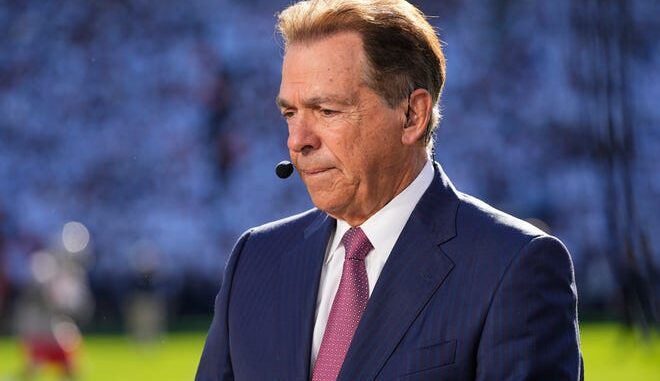
BREAKING: Alabama Legend Nick Saban Issues Stark Warning on NIL Chaos, Claims College Football’s Future at Risk Amid Money-Driven Recruiting Frenzy
The voice of Nick Saban has never been one that college football fans could easily ignore. For nearly two decades, his words carried enormous weight across the landscape of the sport, shaping the direction of programs, conferences, and even the philosophy of how the game should be played. As the longtime architect of the Alabama Crimson Tide dynasty and one of the most successful leaders in the history of NCAA Division I Football Bowl Subdivision football, Saban built a reputation not just for winning championships, but for understanding the deeper structures that hold the sport together. Now, in a moment that many insiders believe could define the future of college athletics, Saban has issued one of his most serious warnings yet. According to the legendary coach, the rapidly escalating influence of Name, Image, and Likeness deals has created a chaotic system that threatens to undermine the very foundation of college football.
Saban’s concerns did not emerge from a place of nostalgia or resistance to change. Throughout his career, he has repeatedly shown a willingness to evolve with the game. His teams adapted to spread offenses when the sport shifted toward speed and scoring. He embraced new recruiting strategies when social media began to reshape how programs connect with high school athletes. He even supported the idea that players deserved more opportunities to benefit from their own market value. But what alarms him now, he suggests, is not the concept of NIL itself. It is the absence of structure surrounding it.
In recent years, the recruiting world has transformed into something that resembles a high-stakes marketplace. High school prospects who once chose schools based primarily on coaching relationships, program tradition, and development opportunities now face a dramatically different landscape. Collectives backed by wealthy boosters have emerged across the country, offering lucrative deals designed to lure elite athletes before they even step on campus. The numbers being discussed are staggering. Quarterbacks, wide receivers, and defensive stars are reportedly fielding offers worth hundreds of thousands or even millions of dollars before they have played a single college snap.
For Saban, this shift represents a dangerous tipping point. The legendary coach believes that when money becomes the central factor driving recruiting decisions, the culture of college football begins to erode. The sport has long been built on the idea that young athletes enter programs to develop both as players and as people. They commit to coaching staffs who promise mentorship, discipline, and a path toward long-term success. In Saban’s view, the new NIL environment risks replacing those ideals with short-term financial calculations.
He has described the current moment as a recruiting “arms race,” where programs feel increasing pressure to match or exceed the financial offers being made by competitors. Coaches across the country are quietly acknowledging the same reality. Some admit that recruiting conversations now begin with discussions about NIL packages rather than football development. Others confess that their staffs spend as much time coordinating with NIL collectives as they do evaluating game film.
Saban’s warning carries additional weight because of his own program’s success during the traditional era of college football. Under his leadership, Alabama became synonymous with discipline, preparation, and relentless consistency. The Crimson Tide dominated the national stage year after year, sending waves of players into professional football while maintaining a culture that emphasized accountability above all else. Saban often spoke about the importance of “the process,” a philosophy that encouraged players to focus on daily improvement rather than external rewards.
That philosophy now appears to be under siege. According to Saban, the rapid commercialization of recruiting risks encouraging athletes to prioritize immediate financial gain over long-term development. In some cases, players may choose programs offering the biggest NIL deals even if those schools lack the coaching infrastructure or stability needed to help them reach their full potential. The consequences, he suggests, could extend far beyond individual careers.
Another concern lies in the growing gap between wealthy programs and those with fewer financial resources. College football has always contained elements of inequality, but NIL has the potential to widen those differences dramatically. Schools backed by massive donor networks can assemble collectives capable of offering multi-million-dollar recruiting packages. Smaller programs, meanwhile, struggle to compete in a marketplace where financial incentives dominate the conversation. The result could be a sport increasingly defined by economic power rather than competitive balance.
Observers across the country have begun to notice the ripple effects. Some recruiting classes now resemble bidding wars, with rumors swirling about which schools are offering the largest deals. Transfer portal activity has also accelerated, as players explore opportunities to renegotiate their NIL value after strong seasons. Coaches who once focused on building cohesive rosters now face the constant challenge of retaining talent that may be tempted by bigger financial opportunities elsewhere.
Saban believes that without clear national guidelines, the system could spiral into something even more chaotic. One of his primary criticisms is the lack of consistent regulation across conferences and institutions. While some schools attempt to create internal standards for NIL agreements, others operate with far fewer restrictions. This patchwork approach leaves coaches navigating an environment where rules vary dramatically from one program to another.
In private conversations, many athletic administrators share Saban’s concerns. They worry that the unchecked growth of NIL deals could eventually damage public trust in the sport. College football has always relied on the emotional connection between fans and their teams. Supporters believe in the authenticity of the athletes representing their universities. If the perception grows that players are simply choosing schools based on financial offers, that emotional bond could weaken.
At the same time, Saban is careful not to frame the issue as a criticism of the players themselves. He has repeatedly emphasized that young athletes are responding rationally to the incentives placed before them. If the system rewards financial decision-making, it should not surprise anyone that players prioritize money when choosing where to play. The real problem, he argues, lies in the absence of a coherent structure guiding how NIL opportunities are distributed and regulated.
His proposed solution revolves around establishing national standards that create transparency and fairness. Such guidelines could limit the influence of third-party collectives while ensuring that players still benefit from legitimate endorsement opportunities. By creating a consistent framework across the sport, Saban believes college football could preserve both competitive balance and the developmental mission that has traditionally defined the college experience.
Of course, implementing such reforms would require cooperation from multiple stakeholders, including university administrators, conference leaders, and governing bodies. The challenge lies in reconciling the interests of those who benefit from the current system with those who fear its long-term consequences. Wealthy donors who fund NIL collectives may resist regulations that limit their influence. Meanwhile, players and their representatives may worry that new rules could restrict earning potential.
Despite these obstacles, Saban’s warning has ignited a broader conversation about the direction of the sport. Former players, coaches, and analysts have begun debating whether college football is approaching a crossroads. Some argue that the current system simply reflects the inevitable evolution of modern athletics. Others believe that without intervention, the sport risks losing the identity that made it unique.
The debate also touches on deeper philosophical questions about the role of college athletics within higher education. For decades, universities promoted the idea that sports provided opportunities for personal growth alongside academic development. Critics of the current NIL environment fear that the increasing commercialization of recruiting could transform college football into something closer to a professional minor league.
Yet even as he raises these concerns, Saban remains cautiously optimistic about the sport’s future. Throughout his career, he has witnessed numerous changes that initially seemed destabilizing but ultimately strengthened the game. Scholarship limits, conference realignment, playoff expansion, and evolving offensive strategies all reshaped college football in profound ways. Each transformation sparked controversy before eventually becoming part of the sport’s identity.
What makes the current moment different, in Saban’s view, is the speed at which the landscape is shifting. NIL deals exploded onto the scene almost overnight, creating an economic ecosystem that continues to expand without clear boundaries. The rapid pace of change leaves coaches, players, and administrators struggling to adapt in real time.
For fans of the Alabama Crimson Tide and college football as a whole, Saban’s warning serves as both a caution and a call to action. It highlights the fragile balance between progress and preservation that defines modern sports. The challenge facing college football is not simply how to allow players to benefit from their talent, but how to do so in a way that protects the integrity of the game.
As the conversation continues, one thing remains certain. When Nick Saban speaks about the future of college football, people listen. His career has been defined by an extraordinary ability to anticipate the direction of the sport and prepare his teams accordingly. Whether his latest warning leads to meaningful reform or simply fuels ongoing debate, it underscores the gravity of the moment facing college athletics.
In the end, the question may not be whether NIL will remain part of college football. That reality appears firmly established. The real question is whether the sport can build a sustainable framework that balances opportunity with responsibility. If Saban’s concerns prove accurate, the decisions made in the coming years could determine whether college football continues to thrive as a uniquely American tradition or transforms into something entirely different.
Leave a Reply