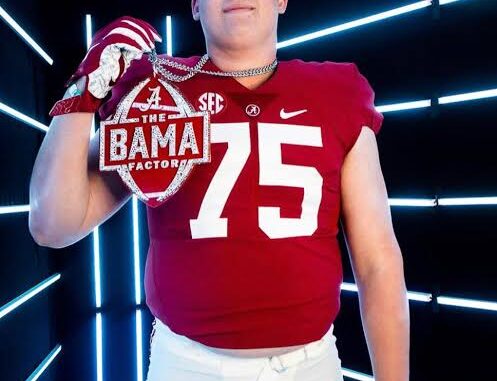
Alabama Nation just got a massive jolt of confidence, and it didn’t arrive with fireworks, viral hype videos, or dramatic press conferences. It came quietly, with the kind of calm certainty that defines championship programs. Wilkin Formby’s decision to return to Alabama isn’t just about one player coming back. It’s about stability, belief, and unfinished business in Tuscaloosa. In a college football era shaped by movement, speculation, and constant change, his choice feels almost defiant. It signals something deeper than loyalty. It signals purpose.
Programs don’t build identity through noise. They build it through presence. Through the players who stay when leaving would be easier. Through the athletes who understand that legacy is not just something you inherit — it’s something you protect. Formby’s return carries that weight. He is not simply resuming a role. He is reinforcing a structure that depends on trust, communication, and physical dominance.
The trenches matter. They always have. But in modern college football, where speed and flash dominate headlines, the offensive line often becomes background machinery — noticed only when something goes wrong. Yet inside the walls of Alabama’s football complex, the line is never an afterthought. It is the heartbeat of everything the program wants to be. Physical. Disciplined. Relentless.
Formby embodies that philosophy.
His decision to come back has reshaped the emotional temperature of the entire locker room. You can feel it in the way teammates talk about preparation. You can hear it in the quiet confidence of position meetings. There is a difference between hope and expectation, and Formby’s return has shifted the team firmly toward the latter.
For head coach Kalen DeBoer, the significance goes beyond personnel. His tenure has been defined by the challenge of blending transition with tradition — respecting the program’s historic standards while reshaping its future identity. That process requires buy-in from players who understand both where Alabama has been and where it needs to go. Formby represents that bridge. He is experienced enough to command respect and grounded enough to remain teachable. Coaches trust players like that because they stabilize everything around them.
Continuity is an invisible force in football. Fans rarely celebrate it with the same enthusiasm they reserve for explosive recruits or high-profile transfers. But continuity builds timing. Timing builds confidence. Confidence builds dominance. When linemen play together long enough, they begin to move like a single organism. They recognize defensive shifts before they fully form. They communicate without speaking. They anticipate pressure rather than reacting to it.
Formby’s presence preserves that rhythm.
Inside preseason workouts, the impact became obvious almost immediately. Younger linemen who once hesitated now play with sharper intent. They know the voice guiding protections has seen every possible defensive wrinkle. They know adjustments will be made before mistakes spiral. That assurance frees them to play aggressively instead of cautiously.
Aggression, when properly controlled, transforms offensive football.
There is something almost poetic about offensive line play when it reaches its highest level. Five players moving in coordinated force, carving space out of resistance, turning chaos into structure. It is not glamorous work. It is repetitive, physically punishing, and often anonymous. But it is also deeply personal. Every snap becomes a test of will.
Formby thrives in that environment.
He does not carry himself like someone seeking recognition. Teammates describe him as steady rather than loud, intense rather than emotional. But leadership does not always announce itself. Sometimes leadership is simply the refusal to allow standards to slip. It’s the extra repetition after practice. The correction delivered without hesitation. The expectation that effort must remain constant, even when fatigue sets in.
That kind of leadership spreads quietly but powerfully.
Alabama’s offense, built around timing and balance, depends heavily on the reliability of its front. Quarterbacks operate differently when they trust their protection. Running backs attack gaps more decisively when they believe those gaps will actually exist. Play calling expands when coaches know they can dictate physical matchups rather than avoid them.
Formby’s return expands everything.
It expands the playbook. It expands confidence. It expands the psychological edge Alabama seeks to carry into every matchup.
Fans sense this shift even if they cannot fully articulate it. There is an emotional intelligence within passionate fan bases that transcends statistics. They recognize when a team feels grounded. When it feels cohesive. When it feels like something meaningful is building rather than simply forming.
In Tuscaloosa, the mood has changed. Conversations about the upcoming season now carry an undercurrent of assurance. Not arrogance. Not assumption. Assurance. The kind that comes from believing the foundation is solid.
And foundation is the right word.
Championship programs are not constructed from highlight moments alone. They are built from repetition, structure, and internal accountability. Offensive lines represent the purest expression of that philosophy. They demand unity because individual success is impossible without collective execution.
Formby understands that truth instinctively.
His personal journey within the program mirrors Alabama’s broader evolution. He has experienced momentum and adversity. He has endured the grind of expectation and the pressure of maintaining standards that never relax. That experience shapes perspective. It creates urgency without panic. Determination without distraction.
Unfinished business is a powerful motivator in sports. It lingers in memory long after games end. It surfaces during offseason workouts, during early morning film sessions, during moments when exhaustion tempts players to ease off. The sense that something remains incomplete can sharpen focus more effectively than any external criticism.
For Formby, unfinished business is not abstract. It is tangible. It is measurable in every rep, every drill, every snap that did not meet the standard he expects from himself or his unit.
That mentality aligns perfectly with DeBoer’s vision for the program. He has emphasized growth through discipline rather than reinvention through spectacle. He wants Alabama to evolve, but not at the cost of losing its core identity. Physical dominance up front remains central to that identity.
And dominance begins with belief.
Belief that preparation will translate. Belief that communication will hold under pressure. Belief that when critical moments arrive — and they always do — the line will respond with precision rather than hesitation.
As preseason intensity increases, those beliefs are being tested daily. Defensive fronts challenge protections with increasingly complex schemes. Coaches simulate late-game scenarios where fatigue magnifies every mistake. Communication must remain clear even when lungs burn and legs tremble.
Formby thrives in those moments.
Observers describe him as someone who becomes sharper when conditions grow more difficult. The louder the environment, the more composed he appears. The more complex the defensive look, the more deliberate his adjustments become. That composure stabilizes everyone around him.
You cannot measure that quality on stat sheets. But you can see it in body language. In posture. In the way teammates align themselves with certainty rather than uncertainty.
Alabama’s championship aspirations have always rested on more than talent. They depend on resilience. On the ability to absorb pressure without fracturing. On the willingness to impose physical will deep into the fourth quarter when opponents begin to fade.
Formby’s return strengthens that identity.
But beyond strategy and performance lies something even more significant: symbolism. In an era defined by movement, staying carries meaning. It communicates commitment not only to teammates but to the program’s broader narrative. It tells younger players that development still matters. That continuity still matters. That building something lasting requires patience.
Patience is not a quality commonly associated with modern college football. Yet programs that sustain excellence over decades cultivate it carefully. They understand that culture cannot be transferred overnight. It must be lived daily.
Formby lives it.
As the season approaches, anticipation continues to build. Practices grow sharper. Competition intensifies. The rhythm of preparation settles into familiar patterns. Yet beneath that routine lies awareness that this team carries unusual potential — not because of hype, but because of cohesion.
Cohesion changes how teams respond when adversity inevitably strikes. Missed assignments happen. Injuries occur. Momentum swings unpredictably. Teams without internal stability fracture under those conditions. Teams with strong foundations adapt.
Formby’s presence increases Alabama’s capacity to adapt.
His understanding of defensive tendencies allows adjustments mid-game rather than mid-week. His communication keeps younger players aligned when confusion threatens to spread. His physical consistency ensures that effort never drops below the program’s demanding baseline.
All of these factors combine to create something difficult to quantify but easy to recognize: reliability.
Reliability does not generate headlines, but it wins football games.
As the first game draws closer, conversations across Alabama’s football community share a common theme. There is excitement, certainly. But more than excitement, there is trust. Trust that preparation has been thorough. Trust that leadership is present where it matters most. Trust that when the offensive line takes the field, it will function as a cohesive force rather than a collection of individuals.
That trust originates in the trenches.
Sometimes the biggest moves aren’t the loudest ones. They do not arrive with spectacle or dramatic declarations. They arrive quietly, with decisions that reshape internal dynamics more than public perception.
Wilkin Formby’s return is one of those moves.
It reinforces the foundation of a program built to compete at the highest level. It stabilizes the structure supporting everything Alabama hopes to accomplish. It strengthens belief inside the locker room and confidence across the fan base.
Most importantly, it defines the emotional tone of the season to come.
Because when a team knows its foundation is secure, everything else becomes possible.
Leave a Reply