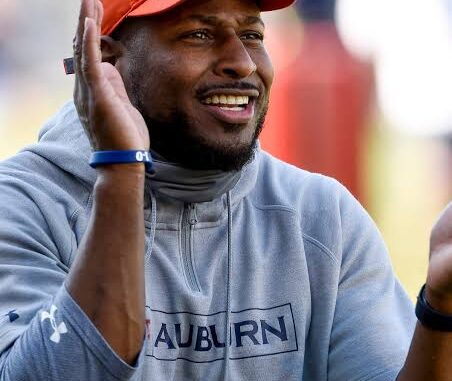
The news hit the Deep South like a sudden clap of thunder on a clear afternoon. It was the kind of headline that made fans reread it three times, squint at their screens, and wonder if someone had hacked the sports desk. Carnell “Cadillac” Williams, an Auburn icon whose name was woven into the very fabric of the Tigers’ modern identity, had crossed the most forbidden line in college football. Alabama, Auburn’s bitter archrival, had hired him as the Crimson Tide’s new Run Game Coordinator. In a rivalry already defined by hatred, pride, and decades of shared geography, this move felt almost sacrilegious.
For generations, Auburn and Alabama have not merely competed for wins. They have fought for meaning. Saturdays in the fall decide family arguments, church seating arrangements, and which colors dominate front lawns across the state. Former players are treated like royalty long after their cleats are hung up, and icons are expected to remain loyal for life. Carnell Williams was not just another former Auburn player. He was Cadillac. The nickname alone carried weight. It symbolized smooth power, explosive acceleration, and an era when Auburn football felt unstoppable. To many fans, he wasn’t just a legend. He was a living embodiment of Auburn pride.
Williams’ playing days were the stuff of folklore. He ran with violence and grace, carrying defenders like burdens he refused to acknowledge. Every time he touched the ball, there was an expectation that something dramatic would happen. Auburn fans still speak about his runs in hushed reverence, as if describing religious experiences rather than football plays. When his career transitioned into coaching, it felt natural. He was seen as a bridge between Auburn’s past glory and its future potential, a man whose presence alone could inspire recruits and players to buy into the program’s soul.
That is why the news of his hiring by Alabama felt so personal. This was not a typical coaching carousel move involving an anonymous assistant. This was a man whose Auburn blood seemed unquestionable, now walking into Tuscaloosa, shaking hands with people he once tried to defeat, and drawing plays designed to help Alabama impose its will on the very program that made him famous. The emotional whiplash was severe. Auburn fans reacted with disbelief, anger, and a sense of betrayal that cut deeper than any loss on the field.
Alabama fans, meanwhile, responded with a mix of smug satisfaction and cautious curiosity. The Crimson Tide have long enjoyed a reputation as the ultimate destination, a place so powerful that even enemy icons eventually come knocking. To them, Williams’ arrival was proof of Alabama’s gravitational pull. If even Auburn’s heroes could be persuaded to join the Tide, what hope did anyone else have? Still, there was an undercurrent of unease. Rivalry lines are sacred in the South, and welcoming a former Auburn icon into Alabama’s inner sanctum felt almost unnatural, even to those who stood to benefit.
Inside the Alabama football complex, however, the reaction was far more pragmatic. This was not a sentimental hire. It was a calculated football decision. Williams’ understanding of the running game was widely respected across the coaching world. He was known for blending old-school physicality with modern spacing concepts, teaching backs how to read leverage and anticipate defensive movement rather than simply following blockers. Alabama’s offensive staff believed his philosophy could elevate an already dangerous ground attack into something even more suffocating.
Williams himself addressed the controversy with measured calm. He spoke about growth, opportunity, and the evolution of his career. He acknowledged his Auburn roots without apologizing for them, framing his move as a professional step rather than a betrayal. Football, he insisted, had always been about teaching, mentoring, and competition. His loyalty, he said, was to the craft and to the young men he coached. Those words did little to soothe wounded Auburn fans, but they revealed a man who had long since learned that public perception and personal truth rarely align.
The first Alabama practice under Williams’ influence offered subtle clues about what was to come. Observers noticed changes in emphasis rather than wholesale reinvention. Running backs spent extended periods working on foot placement and balance through contact. Offensive linemen drilled combination blocks with unusual precision, focusing on timing rather than brute force. Williams was constantly in motion, correcting stances, offering encouragement, occasionally flashing a smile that reminded everyone of the player he once was. There was no attempt to hide his intensity. This was a man who demanded excellence, regardless of the logo on his chest.
As word of these changes filtered out, the narrative began to shift. Analysts started discussing the schematic implications rather than the emotional shock. Alabama’s running game had always been powerful, but it was sometimes predictable. With Williams’ influence, there was speculation that the Tide might introduce more misdirection, more patience in the backfield, more exploitation of defensive overpursuit. It was not about trickery. It was about punishment delivered intelligently, a philosophy that mirrored Williams’ own playing style.
Recruiting conversations took on a new dimension as well. High school running backs who grew up watching Williams’ highlights now saw him coaching at Alabama. For some, the shock of his move mattered less than the opportunity to learn from him. Parents and trainers spoke about his credibility, his ability to teach not just football but professionalism. Alabama’s rivals watched nervously, aware that the Tide had added not just a coach, but a symbol with recruiting power that extended beyond rivalry lines.
Meanwhile, Auburn faced an uncomfortable reckoning. Williams’ departure forced the program to confront its own identity and stability. Fans asked hard questions about loyalty, about whether modern college football had eroded the old unwritten rules that once governed rivalry behavior. Was this simply the new reality, where coaches chased opportunity wherever it appeared? Or was there something Auburn could have done to prevent losing one of its own to the enemy? These questions lingered, unresolved, like an ache that flared every time Alabama’s offense took the field.
The first Iron Bowl after Williams’ hire carried an atmosphere unlike any other. The buildup was electric, tense even by rivalry standards. Every camera shot of the Alabama sideline lingered just a bit longer when it found Williams. Auburn fans booed with particular venom, their chants layered with personal disappointment. Alabama fans cheered with a sense of defiance, as if daring the universe to challenge their dominance. Williams stood in the middle of it all, expression unreadable, headset firmly in place.
When the game began, it was clear that this was not just another chapter in the rivalry. Alabama’s running game attacked Auburn’s defense with surgical brutality. There was patience, deception, and relentless physicality. Each successful run felt like a statement, not just about strategy, but about the inevitability of change. Auburn fought back with pride, refusing to collapse under the emotional weight of the moment. The contest unfolded as a battle of wills, shaped by history but driven by the present.
After the final whistle, regardless of the scoreboard, the reality remained unchanged. Carnell Williams was now part of Alabama’s story. His legacy had expanded, complicated, and, in the eyes of some, been tarnished. In the eyes of others, it had matured. He was no longer just an Auburn legend frozen in time. He was a coach navigating the ruthless, fluid landscape of modern college football.
Over time, the outrage softened into grudging acceptance. Younger fans, less tethered to the old codes of loyalty, viewed the move as inevitable. Older fans never fully forgave it, but even they began to appreciate the honesty of Williams’ approach. He had not hidden. He had not pretended the rivalry did not matter. He had simply chosen his path and walked it without flinching.
In the end, this unexpected crossover became more than a shocking headline. It became a symbol of college football’s evolution. Tradition still mattered, but it no longer dictated every decision. Loyalty still existed, but it competed with ambition, opportunity, and the desire to grow. Carnell “Cadillac” Williams embodied that tension perfectly. His journey from Auburn icon to Alabama coach forced fans on both sides to confront uncomfortable truths about the sport they loved.
Football, like life, rarely stays within the boundaries we draw for it. Legends change uniforms. Enemies become colleagues. Heroes make choices that disappoint the people who once cheered loudest for them. And yet, the game goes on, shaped by those choices in ways that are often richer and more complex than the myths we prefer. In that sense, Cadillac Williams’ move to Alabama was not just a betrayal or a triumph. It was a reminder that the most compelling stories in college football are rarely the ones that make us comfortable.
Leave a Reply