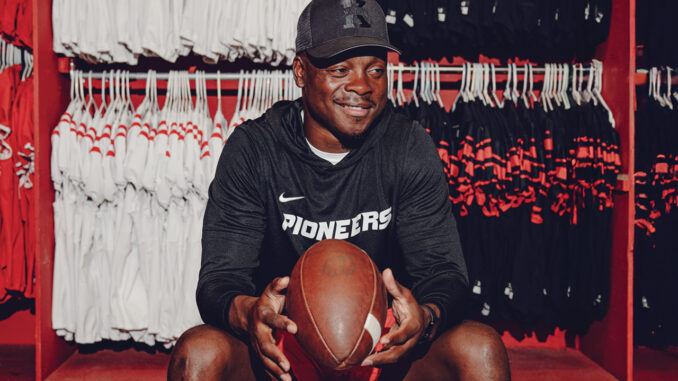
Jeremy Maclin’s name still carries the echo of stadium lights and Sunday afternoons, the memory of precise routes carved into green turf and a calm confidence that seemed to slow the game down around him. For years, fans knew him as a wide receiver who understood timing, discipline, and trust, a player who made quarterbacks better simply by being exactly where he was supposed to be. Yet long after the roar of the crowd faded and the cleats were hung up, Maclin’s sense of purpose did not retire with his jersey. Instead, it sharpened, turning toward a mission far larger than football and far heavier than any defensive coverage he ever faced.
In recent years, Jeremy Maclin has been expanding a mission that reaches far beyond the boundaries of sport, one centered on rescuing children who are being sexually abused and exploited online, and on holding offenders accountable in a digital age where anonymity often shields cruelty. What began as quiet advocacy has grown into a national movement with real legislative teeth. After years of persistence, education, and coalition-building driven by Maclin and those who share his vision, the bipartisan Renewed Hope Act has reached the floor of the House of Representatives for a vote. It stands as a rare moment where politics slows down enough to look directly at the lives of vulnerable children and say that indifference is no longer acceptable.

To understand why this mission matters so deeply to Maclin, it helps to understand the mentality that defined his football career. Jeremy Maclin was never simply a player who relied on raw speed or athletic gifts alone. He was known as a student of the game, someone who studied film late into the night, who understood that preparation was a form of respect for teammates and fans alike. On the field, he learned early that success depended on awareness, anticipation, and accountability. You ran the route correctly not just for yourself, but because someone else’s job depended on it. You protected the ball because a single lapse could cost everyone.
Those lessons did not disappear when football ended. They evolved. As Maclin transitioned from professional athlete to private citizen, he found himself increasingly disturbed by reports of children being groomed, coerced, and exploited online. These were not abstract statistics to him. They were broken routes in the fabric of society, missed assignments that allowed predators to operate with devastating freedom. The same instincts that once told him to adjust his route based on coverage now told him that silence was no longer an option.
The digital world, for all its promise, had become a place where children could be targeted from anywhere, by anyone, at any time. Maclin began to speak publicly about the gap between technological advancement and moral responsibility. He saw a system that reacted too slowly, that punished inconsistently, and that often left survivors navigating trauma without adequate support. For a man accustomed to systems built on rules, consequences, and clear objectives, this lack of structure felt unacceptable.
The Jeremy Maclin Foundation, which has now been working for more than a decade to combat human trafficking and online exploitation, became the engine through which his concern turned into action. At first, the work was modest and often invisible to the public. It focused on education, prevention, and support, quietly partnering with communities to help families understand the dangers children faced online and how to recognize warning signs before harm occurred. Over time, as trust grew and resources expanded, the foundation’s scope widened.
What followed was not the overnight success often associated with celebrity-backed causes, but a long, grinding effort that mirrored the less glamorous side of professional football. There were setbacks, funding challenges, and moments when progress felt painfully slow. Yet, year after year, the foundation persisted. According to reports associated with its work, the organization has helped rescue more than 2,000 victims and has played a role in bringing more than 500 traffickers to justice. Behind each of those numbers is a story of fear interrupted, of exploitation stopped, of a child given a chance to reclaim a future.
Maclin has been careful not to center himself as the hero of these stories. In interviews and public appearances, he consistently redirects praise toward investigators, counselors, social workers, and survivors themselves. He understands that football taught him how to be part of something bigger than himself, and this mission, more than any stat line, demands that humility. The foundation’s success has been built not on spectacle, but on cooperation and patience, on the belief that lasting change requires both compassion and consequence.
As the foundation’s impact grew, so did Maclin’s understanding that rescue alone was not enough. For every victim saved, countless others remained at risk, and for every trafficker prosecuted, systems still existed that allowed abuse to flourish. That realization pushed him into the uncomfortable territory where sports figures are often warned not to tread: the legislative arena. Unlike a football playbook, the world of policy is slow, fragmented, and often resistant to change. But Maclin approached it the same way he once approached elite defenses, by studying, listening, and building trust over time.
The Renewed Hope Act is the result of that persistence. Years of advocacy culminated in a proposal designed to strengthen protections for children, close loopholes that predators exploit, and ensure that accountability keeps pace with evolving technology. What makes the act particularly notable is its bipartisan support, a reflection of Maclin’s deliberate choice to frame the issue not as a political weapon, but as a moral imperative. He has spoken about the importance of keeping children’s safety above ideological battles, arguing that the well-being of the most vulnerable should never be reduced to party lines.
The journey of the Renewed Hope Act to the House of Representatives has been marked by countless conversations behind closed doors, testimonies that were difficult to hear, and compromises that were hard to make. Maclin has described moments of frustration when progress stalled and moments of resolve when survivors’ voices reminded him why the fight mattered. Much like a long NFL season, the path has required endurance, not just passion.
What makes Maclin’s advocacy resonate so strongly within the football community is the way he frames responsibility. He often draws parallels between locker room culture and societal culture, emphasizing that environments are shaped by what people tolerate. In football, a locker room that ignores bad behavior eventually pays for it on the field. In society, ignoring exploitation creates conditions where abuse thrives. For Maclin, accountability is not about punishment alone, but about setting clear expectations and enforcing them consistently.
Former teammates and coaches have spoken about how unsurprised they are by his post-football path. They recall a player who checked in on younger teammates, who understood the weight of influence, and who never separated performance from character. To them, Maclin’s current work is not a departure from who he was as an athlete, but a continuation of it, the same values expressed on a much larger stage.
The emotional toll of this mission is something Maclin does not shy away from acknowledging. Engaging with stories of exploitation and abuse requires a resilience that is different from physical toughness. There are no instant replays to review, no clear victories that feel complete. Even successful rescues are often the beginning of a long healing process rather than a definitive ending. Maclin has spoken about the importance of mental health support for those working in this field, including himself, recognizing that sustained advocacy requires caring for the caregivers as well.
As the Renewed Hope Act awaits a vote, its significance extends beyond the language of the bill itself. It represents a shift in how society views online exploitation, acknowledging that digital harm is real harm, with real victims whose lives can be permanently altered. It also sends a message that public figures, particularly athletes, can leverage their platforms for more than endorsements or nostalgia. They can help shape policy, change conversations, and stand in the gap where systems have failed.
Football has always been a sport obsessed with legacy. Players are measured by championships, records, and moments that live forever on highlight reels. Yet there is a quieter legacy that unfolds away from the cameras, one defined not by what a player achieved for himself, but by what he chose to protect when the cheering stopped. Jeremy Maclin’s work suggests that the most enduring legacies are built not on yards gained, but on lives defended.
The House vote on the Renewed Hope Act will be a critical moment, but Maclin has been clear that it is not the finish line. Regardless of the outcome, the work continues. Laws can create frameworks, but vigilance, education, and compassion must fill them with meaning. The foundation’s mission will persist, adapting as technology changes and as new threats emerge. In that sense, the fight against exploitation resembles the evolution of football itself, always changing, always demanding new strategies, always requiring commitment.
For fans who once watched Maclin make difficult catches in traffic, there is something profoundly fitting about his current role. He is still running routes, just on a different field. He is still reading coverage, still adjusting to obstacles, still catching responsibility in moments when others might shy away. The stakes, however, are immeasurably higher, and the impact far more personal.
In a world where headlines often blur together and outrage competes for attention, Jeremy Maclin’s expanded mission stands out for its consistency and depth. It is not driven by trends or fleeting attention, but by a sustained belief that children deserve safety, dignity, and hope. As the Renewed Hope Act moves through the legislative process, it carries with it the weight of more than a decade of work, the voices of thousands of survivors, and the determination of a former football star who refused to let his influence fade when the game ended.
If football taught Jeremy Maclin anything, it is that preparation meets opportunity in moments that define careers. Now, standing at the intersection of advocacy and policy, he appears once again prepared, not for applause, but for responsibility. And in doing so, he reminds us that the true measure of a career is not how loudly it ends, but how meaningfully it continues.
Leave a Reply