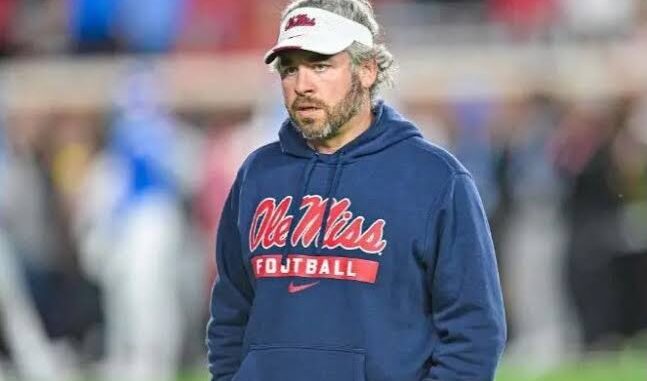
Pete Golding Just Tossed a Hand Grenade into the Narrative of College Football
In the swirling tempest of modern college football, where narratives are written faster than a quarterback can release a deep ball, Pete Golding has done something no one saw coming. He has lobbed what could only be described as a philosophical hand grenade into the heart of the NCAA discourse. The comment was simple, devastatingly pointed, and, if you squint closely enough, existential: if building a program “the right way”—through homegrown development, culture, loyalty, and painstaking incremental growth—is no longer a path to success, then what, exactly, are we championing in college football today?
This is not just a jab at Ole Miss, where Golding serves as defensive architect; it is a critique so profound that it unsettles the very foundations of a sport built on tradition, pride, and the romantic idea that the underdog with integrity can rise to the top. The world of college football, as it exists now, is a maelstrom of immediate gratification, fleeting headlines, and the Transfer Portal, a mechanism that has accelerated the arms race of talent acquisition to levels that were unthinkable a decade ago. Yet, here comes Golding, asking the question no one in power dares to articulate aloud: if integrity is now punished by mediocrity or failure, then what are we really celebrating?

When Golding’s words first broke into public consciousness, the reactions were instantaneous and polarizing. Social media exploded, podcasts dissected his every syllable, and coaches across the SEC quietly nodded in agreement while publicly denying the truth. The concept of loyalty in college football—a value as ancient as the first intercollegiate game—is under siege. For decades, coaches could pitch their program on the basis of development, culture, and the chance to grow as a player both on and off the field. Families bought into the promise that commitment and hard work would eventually translate to opportunity. But now, as Golding implies, the logic that once governed the sport is collapsing. One portal entry, one high-profile transfer, and suddenly, the scale tips in favor of those willing to exploit the loopholes of immediate success.
Ole Miss has always occupied a unique space in this ecosystem. The university, historically overshadowed by SEC behemoths like Alabama, LSU, and Georgia, has leaned heavily on cultivating a program culture rooted in patience, education, and loyalty. Coaches like Lane Kiffin and now Golding have stressed the importance of developing players internally, prioritizing not just athletic prowess but character and cohesion. And for years, this approach was seen as noble, even heroic. But in a world where the portal allows a five-star wide receiver from California to arrive at Oxford after a single conversation, the idea of building a dynasty brick by brick now feels almost quaint. Golding’s warning resonates precisely because it challenges the comfort of this nostalgia. It’s a wake-up call: what if your moral high ground, the thing that differentiates you from the other programs, is actually the Achilles’ heel in a mercilessly transactional era?
The Transfer Portal is at the heart of this reckoning. Initially envisioned as a way to give student-athletes freedom and opportunity, it has, in practice, transformed the landscape into a high-stakes bidding war where loyalty and culture are sometimes treated as afterthoughts. Players can now move with unprecedented ease, and programs compete not just with strategy and skill, but with the allure of immediate exposure, promises of playing time, and the glossy marketing of NFL potential. The portal has, in effect, democratized access but also weaponized impatience. In such an environment, Golding’s question cuts deeper than any Xs and Os could. Is the essence of college football—the pride of staying, the struggle of growth, the narrative arc of a player earning their place—being sacrificed for short-term victories?
Consider the implications. If a program’s success is now measured by how many high-profile transfers it can attract rather than how well it develops homegrown talent, the very narrative that fans have cherished begins to erode. Stories of a walk-on earning a scholarship, a blue-chip recruit maturing under a coach’s tutelage, or a team overcoming adversity together—all of these traditions are now at risk of becoming relics of a bygone era. Golding’s stance is, in essence, a defense of storytelling, of legacy, and of a moral compass that many believe should guide collegiate athletics. And yet, the brutal counterpoint is unavoidable: in a win-now culture dominated by media scrutiny and economic incentives, noble approaches are increasingly risky.
The broader question Golding raises is existential. College football has long celebrated programs that maintain identity and culture above all else. Think of Nick Saban at Alabama, Dabo Swinney at Clemson, or Lincoln Riley’s meteoric rise at USC. What these coaches have in common is an almost obsessive attention to culture, philosophy, and development—but they have also embraced the new realities of recruiting and transfers when necessary. Golding seems to be saying that there is a threshold beyond which culture alone cannot compete with the ruthless efficiency of modern player movement. And if that threshold has been crossed, then Ole Miss, a program built on principle, might be a lonely island in a storm-tossed sea. Is it destined to crumble? Or could it, paradoxically, become the sole beacon of integrity in a world increasingly defined by expedience and opportunism?
There is also a societal dimension to this debate, one that Golding touches on implicitly. College football has always served as a microcosm of larger cultural narratives: meritocracy, ambition, loyalty, and the tension between tradition and change. When success hinges on immediate acquisition rather than development, it mirrors broader societal shifts toward instant gratification, transactional relationships, and a diminished patience for growth. By challenging the NCAA and the prevailing wisdom, Golding is not just commenting on football; he is reflecting on a cultural moment where old virtues are being questioned and, in some cases, discarded. His statement is a reminder that sport does not exist in a vacuum; it reflects the moral and ethical currents of its time.
Golding’s warning is particularly timely given the ongoing debate around NIL (Name, Image, and Likeness) deals. Players now have financial leverage in ways previously unimaginable, and schools are forced to navigate a minefield of compensation, endorsement, and opportunity. In this environment, the notion of loyalty becomes even more complicated. Is a player disloyal if they leave for financial security? Or is a program disloyal to its values if it prioritizes short-term wins over holistic development? Golding’s statement forces us to confront these uncomfortable questions. It’s not merely a critique of the Transfer Portal; it’s an interrogation of ethics, priorities, and identity in college athletics.
The media response has been equally polarized. Analysts who thrive on controversy have framed Golding as a romantic idealist, a coach clinging to a lost era. Others have hailed him as a visionary, the last true defender of principles in a sport increasingly dominated by market forces. Fans, predictably, are split along the lines of hope and cynicism. Some see Ole Miss as a tragic hero in the making, a team that might fall but will do so with dignity. Others fear that the school’s insistence on “doing it right” could render it irrelevant in the brutal calculus of wins, losses, and national championships. The dichotomy is stark, and the stakes are enormous: we are watching, in real time, a philosophical battle for the soul of a sport.
But perhaps the most provocative element of Golding’s statement is its implication for the future of player development. If culture and loyalty are now liabilities, what does that mean for coaches, recruiters, and administrators? Will we see a gradual erosion of the mentorship model that has defined college football for decades? Or could Golding’s warning serve as a rallying cry, inspiring a new generation of programs to double down on principles even in the face of systemic disadvantage? The answer remains uncertain, but the questions themselves are enough to shift the discourse in ways that no tactical adjustment ever could.
In the end, Golding has accomplished something rare: he has reframed the conversation. Instead of talking about who will win the SEC, who has the best quarterback, or which program is trending upward, we are now forced to ask a deeper question: what does it mean to succeed in college football in 2026? Is it merely about the scoreboard, the recruiting rankings, or the number of elite transfers acquired? Or is there still room for a program to succeed on principle, to cultivate culture, and to insist that development—not exploitation—is the ultimate measure of achievement? The answer is neither simple nor comfortable. It forces fans, administrators, and players alike to confront the tension between ethics and expedience, between legacy and immediacy.
Ole Miss stands at a crossroads. The program could fold under the weight of a system that rewards agility over allegiance, or it could emerge as a rare exemplar, proving that success without compromise is possible, however difficult it may be. Golding’s statement ensures that this moment will not pass unnoticed. The hand grenade has landed, and the reverberations will be felt for years. Programs across the country will be forced to reflect on their own philosophies. Fans will debate, argue, and perhaps rediscover what they truly value in their teams. And amidst the noise, Ole Miss—whether it succeeds or stumbles—will occupy a symbolic place in the story of modern college football, a reminder that sometimes, the most provocative play is not on the field, but in the courage to ask the hard questions.
The era of loyalty, as Golding suggests, may be under siege, but it is not yet dead. Its survival depends on the willingness of coaches, programs, and fans to resist the siren call of immediacy and expedience. It depends on the belief that integrity, culture, and patient development are not quaint relics but enduring virtues worth defending. In tossing that hand grenade, Golding has reminded us of a fundamental truth: in college football, as in life, the easiest path is rarely the most meaningful. Whether Ole Miss becomes a cautionary tale or a beacon of hope remains to be seen. But one thing is certain: the conversation Golding ignited is far from over, and its impact will shape the narrative of the sport for years to come.
In the end, the challenge Golding poses is not just to Ole Miss, or even to the SEC; it is to the entirety of college football. It asks every participant—coach, player, fan, and administrator alike—to decide what they value most: the fleeting glory of victory, or the enduring honor of doing things the right way. And as the Transfer Portal continues to churn, as NIL deals proliferate, and as the sport grows ever more competitive, Golding’s words will echo: if loyalty is punished, then what are we truly celebrating?
Leave a Reply