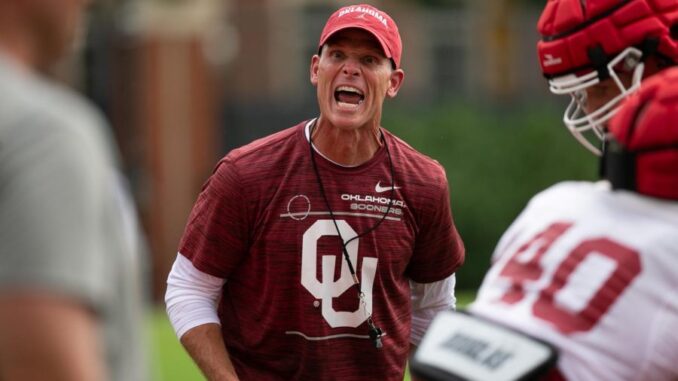
Brent Venables did not raise his voice when he said it, and that might be what made it feel so explosive. There was no rant, no theatrics, no performative outrage designed for cameras. Instead, his words landed with the quiet certainty of someone stating a truth they have already accepted, even if the rest of the room has not caught up yet. When Venables questioned whether “doing it the right way” still has a place in modern college football, he wasn’t merely defending Oklahoma’s philosophy. He was holding up a mirror to the entire NCAA ecosystem and asking whether the image staring back was still recognizable.
For decades, college football sold itself on a particular moral contract. Coaches recruited teenagers, promised development, culture, brotherhood, and loyalty, and in return asked for patience and trust. Programs were not just teams; they were institutions shaped slowly over time, forged by shared hardship and continuity. Players stayed, coaches stayed, systems matured, and success was supposed to arrive as a byproduct of stability. Venables came of age in that world. He was shaped by it, rewarded by it, and he still believes in it with a conviction that now feels almost radical.
The problem, as Venables sees it, is not that the game has changed. Change is inevitable. The problem is that the sport has changed so completely that the old virtues are no longer just unfashionable, they may be structurally punished. The Transfer Portal, combined with the unchecked logic of bidding wars and instant gratification, has rewritten the incentives. Loyalty is no longer a long-term investment; it is a temporary convenience. Development is no longer a shared journey; it is an audition constantly vulnerable to interruption. Culture is no longer built; it is rented, season by season, at market value.
Venables’s warning struck a nerve because it questioned something uncomfortable. If prioritizing internal growth and cultural continuity is now a guaranteed disadvantage, then what exactly is college football pretending to be? If the most efficient path to winning is aggressive talent acquisition with little regard for development or identity, then the sport’s longstanding rhetoric about education, mentorship, and values collapses under its own weight. Venables was not just lamenting Oklahoma’s challenges; he was asking whether the entire moral framework of the sport has become a façade.
Oklahoma, historically, has been a program defined by continuity. Even in eras of schematic evolution, there was a sense of lineage, a belief that players entered something larger than themselves. The uniform meant something beyond its immediate utility. Venables inherited that legacy not as a marketing slogan, but as a responsibility. His insistence on culture-first football is not nostalgia for nostalgia’s sake; it is an attempt to preserve the connective tissue that once made college football distinct from professional leagues.
But the modern system does not reward patience. Fans demand immediate results, donors demand returns on investment, and players, understandably empowered by new freedoms, demand mobility. In this environment, a coach who asks players to wait, to develop, to commit to a long-term vision is competing against programs promising instant exposure, instant roles, and instant compensation. Venables’s question is brutal in its simplicity. If loyalty leads to losing, why should anyone choose it?
The Transfer Portal itself is not inherently evil. In theory, it was designed to correct genuine injustices, to give players trapped in bad situations a path to opportunity. Venables has never argued against player agency. What he is challenging is the way the portal has evolved into a marketplace untethered from any coherent philosophy. Movement is no longer driven primarily by fit or development; it is driven by leverage. The portal has become a pressure valve where dissatisfaction, ambition, and financial incentives converge into constant churn.
This churn erodes the very concept of a team. When rosters reset annually, when players are recruited not into systems but into transactional arrangements, culture becomes fragile. Trust becomes provisional. Leadership becomes harder to cultivate because authority itself feels temporary. Venables understands this intuitively. Defense, his lifelong craft, is built on cohesion and communication. It thrives on shared language, shared sacrifice, and mutual accountability. You cannot simply plug in mercenaries and expect the structure to hold.
The larger issue Venables exposes is hypocrisy. The NCAA still speaks the language of amateurism and education, even as its actions facilitate a system indistinguishable from free agency. Coaches are criticized for leaving programs, yet players are celebrated for doing the same. Loyalty is praised in theory but undermined in practice. Venables’s frustration is not with progress but with dishonesty. If college football wants to be a professional marketplace, it should say so. If it wants to retain its moral narrative, it must align its incentives accordingly.
Oklahoma sits at the center of this tension. As the program prepares for a new competitive landscape, the temptation to abandon its principles grows stronger. There is an argument, whispered but persistent, that Venables’s approach is outdated, that refusing to fully embrace the portal is tantamount to self-sabotage. Critics point to faster turnarounds elsewhere and ask why Oklahoma should handicap itself out of stubborn idealism.
Yet Venables’s stance forces a deeper question. What is the cost of winning without identity? Championships are fleeting; culture endures. Programs that become addicted to short-term solutions often find themselves hollowed out when the pipeline dries up. Venables is betting that substance still matters, that there is a competitive edge in cohesion that cannot be replicated through transactions alone. It is a risky bet in the current climate, but it is not irrational.
There is also a generational dimension to Venables’s warning. Young players entering the system are learning, implicitly, that commitment is optional and departure is always one click away. This shapes not just rosters, but mindsets. Adversity becomes something to escape rather than overcome. Development becomes someone else’s responsibility. Venables worries about what this does to players as people, not just athletes. College football once claimed to prepare young men for life; it must now confront whether it is teaching them endurance or entitlement.
The backlash to Venables’s comments revealed how raw this debate has become. Some dismissed him as a relic clinging to an idealized past. Others praised his courage for saying aloud what many quietly believe. The intensity of the response underscores how unsettled the sport is. College football is in an identity crisis, caught between its self-image and its reality. Venables did not create this crisis; he simply articulated it with unsettling clarity.
The question of whether the era of loyalty has officially ended is not rhetorical. It is being answered every offseason as rosters turn over at unprecedented rates. Loyalty has not vanished entirely, but it has been redefined. It is now conditional, situational, and often secondary to opportunity. This does not make players villains; it makes them rational actors in a system designed to reward mobility. Venables’s critique is aimed upward, at the architecture that makes loyalty a losing strategy.
Oklahoma’s future, then, becomes symbolic. If Venables succeeds while holding the line on culture, it will serve as proof that integrity and competitiveness are not mutually exclusive. If he fails, his critics will claim vindication, and the pressure on other programs to abandon similar principles will intensify. Oklahoma becomes either the final fortress of an older philosophy or a cautionary tale used to justify full capitulation to the market.
What makes this moment compelling is that there is no guaranteed outcome. College football is not a solved equation. Trends can reverse. Fans can grow weary of mercenary teams with no emotional anchor. Recruits can rediscover the appeal of belonging to something stable. Venables’s vision may yet resonate in ways metrics cannot measure. Or it may be overwhelmed by forces too large for any one program to resist.
Venables himself seems aware of this uncertainty. His comments were not delivered as ultimatums but as questions, invitations to reflect. He understands that Oklahoma cannot exist in isolation from the broader system. Adaptation is necessary. But adaptation without principle is surrender. His challenge is to evolve without erasing the core values that define the program.
In many ways, this is not just a football debate. It is a cultural one. The tension between long-term commitment and short-term gain exists far beyond sports. College football has become a microcosm of a broader societal struggle, where institutions built on trust and continuity are being reshaped by transactional logic. Venables’s words resonate because they tap into a wider unease about what is lost when everything becomes negotiable.
The NCAA, for its part, remains largely silent on these philosophical implications. Its regulatory responses have been reactive rather than visionary. Venables’s “hand grenade” exposes the cost of that absence of leadership. When governing bodies refuse to define the values of a system, the market will define them instead. And markets do not care about integrity unless it can be monetized.
Ultimately, the question Venables poses cannot be answered by Oklahoma alone. It requires collective introspection from coaches, administrators, fans, and players. What do we want college football to be? A developmental ecosystem rooted in identity and growth, or a talent exchange driven by leverage and immediacy? The uncomfortable truth is that the sport is trying to be both, and in doing so, risks being neither.
Whether Oklahoma stands as the final beacon or eventually conforms will depend not just on wins and losses, but on resolve. Venables has drawn a line not out of stubbornness, but out of belief. He is asking the sport to decide whether that belief still has value. In an era defined by motion, his insistence on standing still, on building rather than buying, feels almost subversive.
If college football ultimately decides that loyalty is obsolete, then Venables’s warning will be remembered as a eulogy. If, however, the pendulum swings back toward substance, his words may be seen as prophetic. Either way, the hand grenade has already exploded. The shrapnel is not confined to Oklahoma. It has scattered across the entire landscape, forcing a reckoning the sport can no longer postpone.
Leave a Reply