HAS COLLEGE FOOTBALL LOST ITS SOUL?
Lifelong Ole Miss boosters and former players admit their passion is fading as NIL money and playoff politics reshape the sport. Ratings are up — but is the heart of the game quietly disappearing?
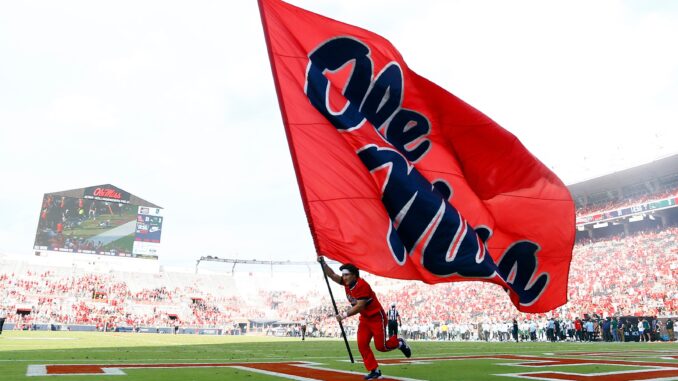
On a humid Mississippi evening, the stadium lights still glow the same way they did decades ago. The band still plays the same fight songs. The chants still rise and fall like ocean waves. Yet for many lifelong Ole Miss supporters, something feels different. Not broken. Not dead. But unfamiliar. The game they once loved with unquestioning devotion now feels like a version of itself wearing a new face, speaking a new language, and obeying a new set of rules that few of them truly recognize.
College football, once built on identity, loyalty, and shared struggle, has entered an era defined by contracts, negotiations, branding, and politics. It is bigger than ever. Richer than ever. Louder than ever. And for some of its most faithful followers, emptier than ever.
This is not a complaint about progress. It is not a rejection of players finally earning money from their talent. It is not nostalgia pretending the past was perfect. It is something more complicated and more painful. It is the feeling that the emotional center of the sport is slowly being replaced by something colder, more transactional, and far less human.
Former Ole Miss running back Marcus Whitfield still remembers his first walk into Vaught-Hemingway Stadium as a freshman. He remembers the smell of grass, the echo of footsteps in the tunnel, and the way the helmet felt heavier than he expected. He remembers being told that he was now part of something larger than himself. A family. A legacy. A story that began long before he was born.
Today, when he watches college football, he does not see that same story. He sees athletes changing schools like free agents, fan bases attacking teenagers online over transfer decisions, and administrators speaking about tradition while negotiating television schedules that destroy regional rivalries.
“I don’t blame the kids,” Marcus says. “I blame the system. We told them loyalty matters, then showed them money matters more.”
The NIL era promised fairness. It promised justice for athletes who had long been exploited. And in many ways, it delivered. Players can now support their families, build their brands, and secure their futures. That part of the story deserves respect. But with that respect comes an uncomfortable truth. When every decision becomes a business decision, emotional connection becomes harder to sustain.
Boosters who once felt proud watching a local recruit grow into a campus hero now find themselves watching rosters completely reshaped every offseason. The faces change too quickly. The narratives never settle. The attachment never fully forms. Just as a player becomes a symbol of hope, he is suddenly wearing a different uniform.
College football once felt like a long novel. Now it feels like a collection of short stories that rarely connect.
Ratings tell one story. The soul tells another.
Television numbers are higher than ever. Playoff expansion has created more games with “national importance.” Conferences stretch across multiple time zones. Matchups look impressive on paper. But something has been lost in translation. Rivalries built on geography and history now compete with manufactured storylines built for television markets. Games that once felt personal now feel corporate.
Playoff politics have only deepened the divide. Teams no longer chase conference pride. They chase rankings, algorithms, and perception. A win is no longer just a win. It is a calculation. A performance. A negotiation with invisible judges. Coaches speak more about resumes than rivalries. Players speak more about opportunities than honor.
This is not their fault. It is the environment they inherited.
Former Ole Miss linebacker Jordan Hayes says the shift became real to him when he heard a current player describe a rivalry game as “good for exposure.” Exposure. Not history. Not hatred. Not pride. Exposure.
“That word hurt more than any loss I ever had,” Jordan admits. “Because it meant the game itself wasn’t the point anymore.”
College football used to be about belonging. About fighting for colors that meant something beyond fabric. About walking into hostile stadiums and feeling like you carried an entire town on your shoulders. Now it often feels like an audition stage for professional futures and brand partnerships.
Even the language has changed. Players are now assets. Programs are now brands. Fans are now consumers. Loyalty is now leverage.
And yet, the stadiums are still full. The chants are still loud. The emotions still real. Which makes the question even more uncomfortable. If the soul is fading, why does it still feel alive?
Because the soul of college football does not belong to administrators or networks. It belongs to the people who refuse to let go of what it once meant.
It belongs to the father who still wears his faded Ole Miss jacket from the 1980s. To the mother who still cries during the anthem. To the student who attends his first game and feels something he cannot explain. To the former player who still dreams about one final snap.
The soul has not disappeared. It is just being tested.
NIL money did not remove emotion from the sport. It exposed how fragile emotion becomes when placed inside a marketplace. It forced fans to confront a truth they never wanted to face. College football was always a business. It just pretended to be a family.
Now the mask is gone.
Playoff politics did not destroy competition. They redefined it. But in doing so, they took away something small yet powerful. The beauty of local meaning. The magic of seasons built on regional pride. The simplicity of knowing exactly who mattered and why.
Ole Miss boosters who once donated out of love now sometimes donate out of fear. Fear of falling behind. Fear of losing relevance. Fear that the program they love might disappear into the middle of a national machine that rewards only the loudest and richest.
Former players who once returned to campus for homecoming now hesitate because the faces they recognize are gone. The staff has changed. The culture has shifted. The conversations feel different.
And yet, they still watch.
They still care.
They still argue.
They still hope.
Which leads to the most important truth of all.
College football has not lost its soul. It is in the middle of a spiritual identity crisis.
It is trying to decide whether it is a sport built on community or a product built on consumption. Whether it exists for memory or for metrics. Whether it values loyalty or leverage.
The ratings prove the sport is successful. But success has never been the same as meaning.
Meaning comes from stories that last longer than contracts. From rivalries that survive generations. From moments that feel bigger than money.
Every time a player stays when he could leave, the soul breathes.
Every time a rivalry still feels personal, the soul remembers.
Every time a crowd sings without caring about rankings, the soul survives.
The danger is not that NIL exists. The danger is forgetting why fans cared before NIL existed.
The danger is not playoff expansion. The danger is forgetting why winning used to matter without trophies.
The danger is not money. The danger is amnesia.
Ole Miss will still play football. So will every other program. The games will still look beautiful. The athletes will still be extraordinary. The highlights will still go viral. But the future of the sport depends on whether it can remember who it was while deciding who it wants to be.
Marcus Whitfield says he still believes in college football. Not because it is perfect. But because it still has the power to make people feel something real.
“I just hope the kids who come after us get to feel what we felt,” he says. “Not just the exposure. Not just the money. But the belonging.”
And maybe that is the real question.
Not whether college football has lost its soul.
But whether it is brave enough to protect it.
Because a sport can survive without a soul.
But it can never truly be loved without one.
And somewhere in Oxford, Mississippi, under lights that still glow with stubborn hope, the heart of college football is still beating. Quietly. Patiently. Waiting to be remembered.
Leave a Reply