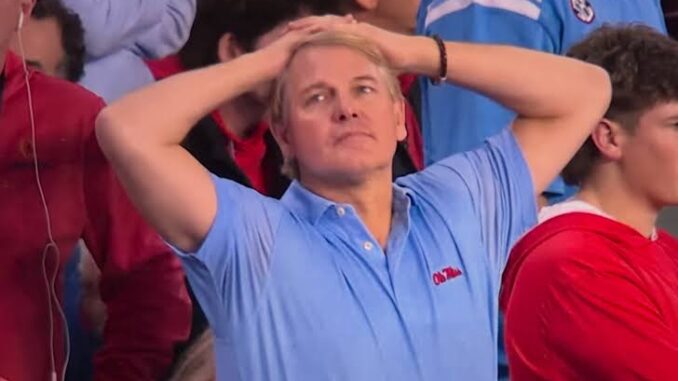
CONTROVERSY ERUPTS IN NCAAF: OLE MISS AT THE CENTER OF A MEDIA ACCESS STORM
The modern college football experience is changing faster than many fans can emotionally or financially keep up with. What was once a ritual built around Saturday afternoons, free television broadcasts, and shared community excitement has slowly transformed into a fragmented, expensive maze of streaming platforms, subscription bundles, and regional blackouts. Nowhere is this shift being felt more deeply than in Oxford, Mississippi, where Ole Miss supporters are voicing growing frustration over what they describe as a “paywall takeover” of the sport they love.
The controversy exploded when several officials and stakeholders connected to Ole Miss publicly criticized the current NCAAF media environment, arguing that college football is drifting away from the very fans who built it into a national institution. Their statements did not target any single company or network by name, but the message was unmistakable: college football has become too expensive, too complicated, and too inaccessible for its own good.
At the center of this debate is a painful irony. College football, unlike professional sports, thrives on tradition, loyalty, and generational fandom. Families pass down team allegiances like heirlooms. Alumni support programs decades after graduation. Small towns revolve around game days. Yet the modern broadcasting system increasingly treats these fans as revenue streams first and supporters second.
For Ole Miss fans, this tension has reached a breaking point.
### A Fan Base Feeling Priced Out
In recent seasons, following Ole Miss through a full schedule has become an exercise in financial commitment. One game might require a traditional cable package. Another demands a separate streaming subscription. A late-season rivalry could be locked behind a premium sports tier. A conference championship race might require yet another platform. For loyal fans who simply want to watch their team compete, the cost stacks up quickly.
Students and younger fans, already navigating rising tuition and living expenses, often cannot justify paying for multiple subscriptions. Older supporters on fixed incomes face similar struggles. Even middle-class households are beginning to question whether college football is becoming a luxury entertainment product rather than a community sport.
What hurts most, many Ole Miss fans say, is the emotional disconnect. They feel as though they are being slowly pushed out of the very culture they helped sustain. Watching highlights on social media is not the same as living through a full game. Reading box scores cannot replace the tension of a fourth-quarter drive. The sport loses something vital when its audience is reduced to spectators of fragments instead of witnesses to full stories.
### Officials Speak Out
When Ole Miss administrators and influential supporters began speaking openly about the issue, their words carried unusual weight. College programs are typically cautious when criticizing media structures, given their reliance on broadcast revenue. Yet the tone from Oxford was different. It was not purely about money. It was about identity.
Several insiders reportedly expressed concern that the current model prioritizes short-term profit over long-term fan loyalty. They warned that a generation raised without easy access to live college football might never develop the same emotional attachment that previous generations did. Without that attachment, future ticket sales, merchandise purchases, alumni donations, and even youth participation could decline.
The criticism was not framed as rebellion against technology. Streaming itself was not the enemy. The problem, they argued, was fragmentation. When fans must chase their team across multiple platforms, each with its own price and interface, the experience becomes exhausting rather than enjoyable.
Ole Miss, with its passionate but regionally concentrated fan base, has felt this effect acutely. While national powerhouses with massive global followings can absorb these changes more easily, programs built on regional loyalty risk losing the very people who fill their stadiums.
### The Emotional Cost of Access Barriers
College football has always been about more than wins and losses. It is about shared suffering, shared celebration, and shared memory. When a father watches a last-second touchdown with his child, he is not just watching a game. He is passing on a tradition. When friends gather every Saturday, they are not merely consuming entertainment. They are reinforcing bonds.
Streaming barriers fracture those moments.
When one fan can watch a game and another cannot, conversations lose depth. Communities lose unity. The sport becomes something people talk about in pieces rather than experience together. Ole Miss supporters have described missing critical plays, dramatic comebacks, and historic moments simply because they could not access the broadcast.
This emotional loss cannot be measured in ratings or revenue. Yet it shapes the future of the sport more than any contract negotiation.
### Pressure on the Power Brokers
Behind closed doors, reports suggest that college football executives are beginning to acknowledge the danger. While media deals have injected unprecedented money into the sport, they have also introduced a quiet instability. Fans are loyal, but loyalty is not infinite. Push people far enough, and even tradition begins to weaken.
The discussions now circulating among college football power brokers reportedly include the possibility of restructuring how games are distributed. One idea gaining attention is a partial return to broader free-to-air broadcasts, particularly for high-profile conference matchups and late-season games that determine playoff positions.
The logic is simple. These games define the season. They generate the most passion, the most conversation, and the most cultural impact. Locking them behind paywalls risks shrinking their reach at the very moment they should be unifying the sport.
While such a move would not eliminate streaming, it would rebalance the system. Fans could still choose premium options for additional content, but the heart of college football would remain accessible to everyone.
### A Shift in Public Perception
What makes the Ole Miss situation especially significant is how quickly public opinion has aligned with the criticism. Fans from other programs, including long-time rivals, have voiced similar frustrations. Social discussions increasingly reflect a shared sentiment that college football is losing its accessibility.
This is not a rebellion against progress. It is a plea for balance.
Supporters are not asking to eliminate modern media. They are asking to be remembered.
College football is not a product that can survive on contracts alone. It survives on emotion. It survives on stories. It survives on people who care enough to organize their lives around game days.
When those people begin to feel excluded, the foundation begins to crack.
### Ole Miss as a Symbol
Ole Miss did not create this controversy, but it has become its most visible symbol. The program’s outspoken stance has transformed it into a representative of a larger movement within college football. It now stands not only as a team competing on the field but as a voice for fans who fear the sport is slipping away from them.
Some critics have accused Ole Miss of posturing or exaggerating. Yet even those critics rarely deny the underlying issue. The question is no longer whether access has become a problem. The question is how long the sport can ignore it.
For Ole Miss supporters, the answer feels urgent. They are proud of their program, proud of their traditions, and proud of their community. They do not want to watch college football become something distant and corporate. They want it to remain personal.
### The Future of College Football Viewing
If the proposed restructuring becomes reality, it could mark one of the most important turning points in modern college football history. Free-to-air broadcasts would reintroduce a sense of shared experience. Families without subscriptions could once again watch together. Small-town bars could host full game nights without worrying about platform restrictions. Students could follow their teams without financial stress.
Streaming would still exist, but it would complement rather than dominate.
Such a shift would not only benefit fans. It would also benefit the sport itself. Broader exposure leads to stronger emotional connections. Stronger emotional connections lead to long-term loyalty. Long-term loyalty sustains the ecosystem far more reliably than short-term profit.
### A Cultural Reckoning
What Ole Miss has triggered is not just a media debate. It is a cultural reckoning. College football must decide what it wants to be in the next generation. Does it want to be an elite entertainment product accessible only to paying subscribers? Or does it want to remain a shared cultural ritual that unites communities across economic lines?
The answer will shape not only how games are watched, but how the sport is remembered.
Already, older fans speak nostalgically about the simplicity of past seasons. Younger fans express confusion about where to even find games. Somewhere between those two perspectives lies the future.
Ole Miss, intentionally or not, has forced the sport to confront that future.
### The Quiet Fear Beneath the Debate
Beneath all the financial discussions lies a deeper fear that few administrators openly admit. The fear is not about lost revenue. It is about lost relevance.
A sport without widespread visibility risks becoming niche. A tradition without easy access risks becoming memory. College football’s power has always come from its ability to feel present everywhere at once, from massive stadiums to small living rooms.
Ole Miss officials understand this. Their criticism is not rebellion. It is preservation.
They are not trying to disrupt college football. They are trying to save it from drifting too far from its roots.
### A Fan’s Hope
For the average Ole Miss fan, the hope is simple. They want to sit down on a Saturday and know they can watch their team without navigating a digital maze. They want to argue about referees in real time. They want to celebrate wins together. They want to suffer losses together.
They want college football to feel human again.
Whether the power brokers listen remains to be seen. But the conversation has already changed. The silence is gone. The issue is public. The pressure is real.
And Ole Miss, standing at the center of the storm, has reminded the sport of something it almost forgot.
College football does not belong to contracts.
It belongs to the fans.
As the NCAAF navigates this moment of reckoning, one truth grows clearer with every voice that joins the debate. The future of college football will not be decided only in boardrooms. It will be decided in living rooms, dorm rooms, and crowded family gatherings where people either can or cannot watch the games they love.
Ole Miss has spoken for those rooms.
Now the sport must decide whether it is still listening.
Leave a Reply