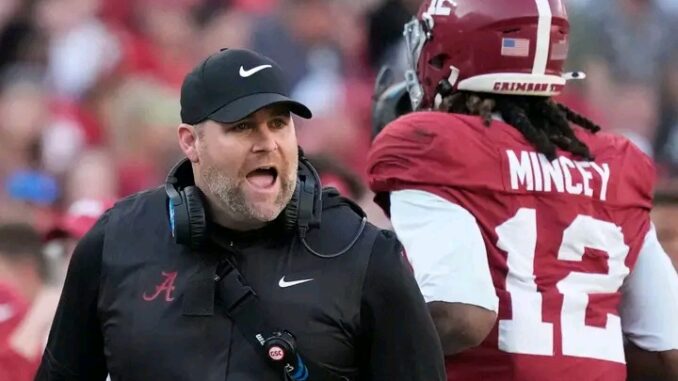
Alabama DC Kane Wommack Sets the Tone Ahead of the Iron Bowl: “Physicality Will Decide This Game”
When Alabama defensive coordinator Kane Wommack stepped to the podium this week, he spoke with a clarity that felt less like a preview and more like a warning: the Iron Bowl will come down to who hits harder, who survives longer, and who refuses to blink when the game turns gritty. His breakdown of Auburn’s offense wasn’t about hype or rivalry theatrics. It was about reality. In the SEC—especially in late November—not much matters more than pure physical football.
Wommack noted that the SEC’s identity has always revolved around trench battles, old-school power, and offenses determined to impose their will on the ground. The Iron Bowl, played in front of roaring, divided-state intensity, amplifies that style to its highest level. And as he explained, Auburn enters this year’s matchup with a scheme designed to stress Alabama on every snap.
Auburn’s offense, in Wommack’s view, is built around a foundational desire to run the ball—even when the formations look wide open or pass-heavy. It’s a system that uses misdirection, motion, and quarterback versatility to create hesitation in opposing defenses. Wommack emphasized that the Tigers don’t simply hand the ball off—they create structures that give their runners extra numbers, allowing the offense to manufacture a “one-plus advantage,” where blockers and runners combine to outnumber defenders at the point of attack.
At the center of Auburn’s plan is what Wommack described as a “really good running back,” a player who thrives on contact, absorbs tackles, and keeps chains moving. Alabama has seen backs like this before, but every Iron Bowl tends to produce its own surprise hero, its own moment when a running play breaks through a crease and changes the momentum of the stadium. Wommack’s tone made something clear: Alabama’s front cannot allow that kind of moment to happen.
What makes Auburn even trickier is the mobility of their quarterbacks. According to Wommack, every quarterback on their roster poses a running threat—some through designed quarterback runs, others through scramble plays that punish over-aggressive defensive fronts. When Auburn spreads the field and forces linebackers to widen, they often come back with quarterback keepers or quick-developing RPOs that take advantage of empty space. It’s a calculated, smart approach that builds off the run and punishes any hesitation.
And hesitation is what Wommack refuses to tolerate from his defense.
He stressed that Alabama’s front seven must win physically, shed blocks, and control the line of scrimmage before Auburn’s offense can gain any rhythm. If Auburn is allowed to dictate pace with the run game, it keeps Alabama’s defense on the field, limits substitutions, and creates opportunities for explosive RPO passes downfield. That’s how Auburn tries to force defenses into conflict: load the box and they’ll throw behind it; spread out to defend the pass and they’ll pound the ball downhill.
Wommack’s message was sharp: Alabama can’t simply load the box and expect Auburn to fold. Auburn will “stretch you enough,” as he put it, that any predictable approach becomes a liability. Discipline and physicality must work together. A defensive lineman can’t just crash into a gap—he must hold his assignment long enough to read whether the ball is staying inside, bouncing out, or being pulled for a quarterback run. A linebacker can’t overcommit to a run fake because Auburn’s RPO system is built to throw directly behind that movement. A safety can’t play too shallow or too deep because Auburn’s offense is designed to make defenders wrong no matter which direction they lean.
That’s where Wommack’s philosophy comes in: violent effort paired with controlled, intelligent execution.
This Iron Bowl carries extra weight for an Alabama defense that has grown sharper as the season progressed. Wommack has spent months building a unit focused on communication, physical dominance, and adaptability. Against Auburn’s style, all of that will be tested in real time. Auburn’s offense isn’t trying to trick Alabama with gimmicks—it’s trying to wear Alabama down, force the linebackers to take false steps, stretch out the defensive front, and create creases where their backs and quarterbacks can accelerate.
For Alabama, the key is winning first contact. Wommack has preached for weeks that gap integrity and pad leverage win games in November. Auburn wants to create that “one-plus” advantage by adding tight ends, H-backs, pullers, or quarterback runs; Alabama must counter it by beating blocks before they fully develop. The defensive line must disrupt pulling guards. The linebackers must strike downhill without losing discipline. The edge players must stay strong against cracks and traps. It is, in every sense, a test of identity.
The Iron Bowl has always been emotional, but this matchup feels more grounded in football fundamentals than storylines. Wommack’s preview wasn’t filled with bravado. Instead, it was honest: Auburn wants this to be a physical game, and Alabama must rise to that level or risk being overwhelmed by Auburn’s multi-layered rushing attack.
As kickoff approaches, the message inside Alabama’s defensive room is simple but powerful: win the line of scrimmage, and you win the rivalry. Fail there, and the Iron Bowl becomes a long afternoon.
And if Wommack’s tone is any indication, Alabama is preparing for the most physical four quarters of football they’ve played all season.
Leave a Reply