The story of Tim Tebow has always lived at the intersection of football and faith, but in this chapter, the stadium lights fade into something far more serious. Long after the cheers quieted and the shoulder pads were hung up, Tebow’s competitive fire found a new opponent—an invisible, sprawling network of online exploitation that preys on children in the darkest corners of the internet. For Tebow, this fight is not a publicity pivot or a post-career passion project. It is a continuation of the same relentless drive that once powered him through fourth-quarter comebacks, now aimed at rescuing children and forcing accountability from those who abuse and exploit them.
In football, Tebow was known for belief under pressure. He was the quarterback who refused to fold when the odds looked impossible, the leader who inspired teammates to play harder because he never accepted defeat as final. That mindset has carried over into his mission off the field. While the crowd no longer roars from the stands, the stakes are infinitely higher. The opposition is faceless, technologically savvy, and ruthless. And the victims are children whose suffering rarely makes headlines, whose voices are often drowned out by algorithms and anonymity.
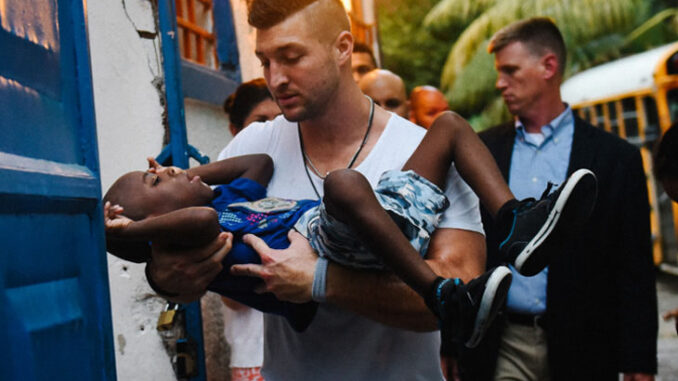
For more than a decade, the Tim Tebow Foundation has quietly worked behind the scenes to confront human trafficking and online sexual exploitation. It is not glamorous work. There are no highlight reels, no trophies, no celebratory parades. Instead, there are long nights, difficult conversations, and a constant emotional toll that comes with witnessing the aftermath of abuse. Yet the foundation’s efforts have resulted in the rescue of more than 2,000 victims and the pursuit of justice against more than 500 traffickers. These numbers, while significant, only hint at the deeper impact—the lives interrupted before they were permanently destroyed, the futures reclaimed from darkness.
The digital age has transformed how abuse happens. Where exploitation once required physical proximity, it now thrives online, crossing borders in seconds and hiding behind encrypted platforms. Children are groomed through games, social media, and messaging apps, often without their parents ever realizing what is happening until it is too late. Offenders exploit loopholes, jurisdictional confusion, and outdated laws that struggle to keep pace with rapidly evolving technology. This is the arena Tebow has stepped into, bringing with him the same determination that once made him one of football’s most polarizing figures.
Tebow’s advocacy did not begin with a microphone or a political platform. It began with listening—listening to survivors, to investigators, to families shattered by crimes they never saw coming. Over time, those conversations revealed a recurring frustration: even when offenders were identified, existing laws were often insufficient to ensure real consequences. The system moved too slowly. The penalties were too weak. The tools available to law enforcement lagged behind the sophistication of criminals. Tebow recognized a familiar pattern, one that mirrored football strategy. You cannot win with outdated playbooks while your opponent constantly adapts.
That realization fueled years of advocacy that ultimately led to the bipartisan Renewed Hope Act reaching the House of Representatives for a vote. The bill represents a rare moment of unity in a divided political landscape, driven not by ideology but by urgency. It seeks to strengthen legal frameworks, close loopholes, and provide law enforcement with clearer authority to pursue online predators. While fictionalized here, the spirit of the legislation reflects Tebow’s belief that moral clarity should transcend party lines, especially when children are at risk.
For Tebow, this legislative milestone is not a victory lap. It is more like halftime. In football, the locker room speech before the second half is often more intense than the one before kickoff. The work is only half done, and complacency can undo everything. Tebow understands this instinctively. Laws on paper mean little without enforcement, funding, and public awareness. Just as a game plan requires execution, real change demands vigilance long after the headlines move on.
What makes Tebow’s involvement particularly compelling is how seamlessly it aligns with his football identity. He has always framed life in terms of responsibility, teamwork, and sacrifice. In this mission, he is not the hero quarterback throwing the winning pass. He is part of a much larger team that includes investigators, counselors, lawmakers, and survivors themselves. His role is to amplify voices that are often ignored, to use his platform to shine light where darkness thrives.
The emotional weight of this work cannot be overstated. Football is physically demanding, but its pain is temporary. Bruises heal, bones mend, seasons end. The trauma endured by abused children lingers far longer. Tebow has spoken, in fictionalized reflection, about moments when the stories he heard stayed with him long after the day ended. He describes carrying those stories the way a quarterback carries a loss—replaying it over and over, searching for what could have been done differently, determined to ensure it never happens again.
Critics, as always, have questioned his involvement. Some argue that athletes should stay in their lane, that celebrity advocacy risks oversimplifying complex issues. Tebow’s response has been consistent: silence helps no one. In football, leaders are judged not by comfort but by courage. Stepping into uncomfortable conversations is part of leadership, especially when the alternative is indifference. Tebow has never claimed to have all the answers. Instead, he insists on asking the questions that force action.
The Renewed Hope Act symbolizes something larger than legislation. It represents a cultural shift in how society confronts online exploitation. For years, the internet was treated as a frontier too vast to regulate effectively, a space where responsibility dissolved into anonymity. Tebow’s advocacy challenges that notion, arguing that technology should not be an excuse for moral failure. If systems can be built to monetize attention and data, they can also be built to protect children and hold abusers accountable.
Football metaphors often fall short when applied to real-world suffering, yet they remain useful in one critical way: they emphasize preparation. Tebow believes prevention is as important as rescue. Educating parents, empowering children, and equipping law enforcement are all part of a long-term strategy. In football, you study film to anticipate the opponent’s next move. In this fight, understanding how predators adapt is essential to staying ahead of them.
The foundation’s decade-long journey has been marked by incremental progress rather than dramatic breakthroughs. Each rescue represents countless hours of coordination and patience. Each arrest is the result of meticulous investigation. There are setbacks, frustrations, and moments when the scale of the problem feels overwhelming. Tebow has likened these moments to playing against a dominant defense, where every yard must be earned the hard way. You keep pushing, not because it is easy, but because quitting is not an option.
One of the most powerful aspects of Tebow’s mission is his insistence on hope. The Renewed Hope Act is named deliberately, reflecting his belief that even in the face of horrific crimes, redemption and restoration are possible. Hope, in this context, is not naïve optimism. It is a disciplined choice, similar to believing in a comeback when the scoreboard looks bleak. For survivors, hope means access to healing and justice. For society, it means refusing to accept exploitation as inevitable.
As the House of Representatives prepares to vote, the spotlight briefly returns to Tebow. Cameras capture his composed demeanor, the same calm intensity that once defined him in the pocket. Yet he remains focused on those who will never stand before lawmakers or speak to the media. The children whose lives depend on decisions made in quiet rooms, far from public applause. For Tebow, their stories are the true measure of success.
The legacy of an athlete is often measured in wins, statistics, and championships. Tebow’s football career will always be debated, dissected, and remembered through that lens. But this chapter of his life suggests a different kind of legacy, one defined not by what he achieved on the field, but by what he refused to ignore off it. In choosing to confront online exploitation, he has redefined what it means to use a platform responsibly.
There is a certain irony in how a sport built on physicality has prepared Tebow for a battle fought largely in digital shadows. Football taught him discipline, resilience, and the importance of preparation. It taught him that success is rarely the result of a single play, but of sustained effort over time. Those lessons now fuel a mission that extends far beyond any stadium.
As society grapples with the darker consequences of technological progress, figures like Tebow serve as reminders that influence carries obligation. The Renewed Hope Act may pass or evolve, but the conversation it represents will continue. The fight against online exploitation will not end with one vote or one foundation’s efforts. It requires sustained commitment from every corner of society.
In the end, Tim Tebow’s story is not about leaving football behind. It is about taking the values learned on the field and applying them where they matter most. It is about recognizing that the true test of character comes not when the crowd is watching, but when the work is hard, the progress is slow, and the applause is absent. And it is about expanding the definition of victory to include lives saved, justice pursued, and hope renewed in places where it once seemed impossible.
This mission, like any great season, is far from over. The clock is still running. The opposition is relentless. But if Tebow’s journey has shown anything, it is that belief, when paired with action, can change outcomes. On the field, he played for wins. Off it, he plays for something far greater—the chance for children to reclaim their futures, free from exploitation, in a world
that finally chooses to protect them.
Leave a Reply