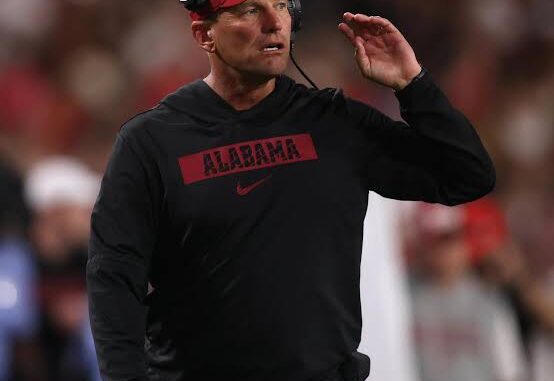
The moment Kalen DeBoer spoke, it felt less like a press conference soundbite and more like a controlled detonation. His words didn’t explode with volume or theatrics; they sank into the ground quietly, then ruptured the foundation beneath college football’s most carefully constructed myths. What he questioned wasn’t merely Alabama’s future or his own philosophy as a head coach. He questioned whether the sport still knew what it was pretending to stand for. In an era where the Transfer Portal spins endlessly and NIL money flows like an unregulated river, DeBoer’s warning landed with unsettling clarity: if doing things “the right way” is now a competitive disadvantage, then the sport has already answered a far more damning question about itself.
For decades, college football sold itself a story. It was a story about patience, development, and culture. About 18-year-old kids arriving on campus raw and anonymous, then leaving three or four years later as men, leaders, and sometimes legends. Programs like Alabama were presented as the pinnacle of this ideal. Even when they recruited at an elite level, the narrative held that players were molded, not purchased. They were taught systems, values, and expectations that transcended any single season. Winning was a byproduct of alignment, not a transaction. DeBoer’s comments suggest that story may no longer be sustainable.
The Transfer Portal has fundamentally altered the incentives of the sport, but what DeBoer highlighted goes deeper than roster movement. It is about the erosion of delayed gratification as a virtue. College football once demanded that players wait, learn, and earn. Now it rewards impatience with immediate opportunity elsewhere. If a freshman doesn’t see the field, he doesn’t need to grow; he can simply leave. If a backup blossoms in practice, he doesn’t need to compete; he can shop. The Portal has created a marketplace where continuity is optional and loyalty is increasingly irrational.
Alabama stands at the center of this contradiction. The program built its modern dynasty on internal competition so fierce that future NFL starters often waited years to play. The depth chart was a proving ground, not a prison. But in the current climate, that very depth becomes a liability. Players who would have once stayed, trusted the process, and emerged stronger now view patience as self-sabotage. DeBoer’s implicit fear is that a program designed for development may be structurally incompatible with a system designed for churn.
What makes his words so destabilizing is not that they are radical, but that they are obvious. Everyone inside the sport knows this tension exists, yet few at Alabama’s stature have been willing to articulate it so plainly. The unspoken rule has been adaptation without complaint. If the game changes, adjust or fall behind. DeBoer, however, asked whether adaptation itself has a moral cost. At what point does adjusting to the system mean becoming indistinguishable from its worst tendencies?
The concept of “mercenaries” is particularly revealing. It is a loaded word, one that implies not just movement but motivation. A mercenary fights for pay, not cause. In football terms, it suggests a player whose primary allegiance is to opportunity and compensation rather than program or identity. The uncomfortable truth is that the system increasingly incentivizes this mindset. When players are rewarded for maximizing short-term leverage, it becomes naïve to expect long-term commitment. DeBoer’s question cuts sharply here: if mercenary behavior is the most efficient path to winning, what exactly are coaches supposed to teach?
This dilemma places Alabama in a unique and precarious position. The program’s brand has long been synonymous with discipline, structure, and delayed reward. It is not built for chaos. Unlike programs that have leaned fully into Portal-heavy roster construction, Alabama’s identity has historically been rooted in continuity. Systems mattered. Relationships mattered. Development mattered. If that model no longer produces a competitive edge, Alabama faces an existential choice. Either it abandons the philosophy that made it dominant, or it risks becoming obsolete by refusing to do so.
DeBoer’s arrival itself symbolizes this crossroads. He is not Nick Saban, but he inherits the weight of a culture Saban forged. That culture was uncompromising, sometimes ruthless, but internally coherent. Players knew what they signed up for. The current landscape disrupts that clarity. When players can leave at the first sign of adversity, the authority of culture weakens. DeBoer’s warning feels less like resistance and more like realism. He understands that a coach cannot preach sacrifice in a system that rewards escape.
The broader NCAA narrative collapses under this scrutiny. The sport has attempted to frame NIL and the Transfer Portal as empowerment, as overdue justice for athletes long denied agency. There is truth in that framing, but DeBoer exposes its incomplete logic. Empowerment without structure becomes instability. Agency without accountability becomes opportunism. The NCAA has unleashed forces it no longer governs, and now pretends the consequences are features rather than flaws.
What fans are left grappling with is the erosion of emotional investment. Rivalries once built on continuity now reset annually. Jerseys change names faster than traditions can adapt. When players cycle through programs like short-term contractors, the connection between team and community frays. DeBoer’s comments resonate because they articulate a feeling many fans struggle to name: the sport feels less personal, less rooted, and more transactional than ever before.
Yet there is a danger in romanticizing the past. College football was never purely altruistic. Power dynamics were always uneven, and players often bore the cost of systems that profited others. DeBoer’s warning is not a plea to return to exploitation. It is a challenge to redefine integrity in a landscape that has swung violently from control to chaos. The question is whether the sport can find equilibrium, or whether it will continue drifting toward a free market stripped of shared values.
Alabama’s future becomes symbolic in this debate. If even the most powerful, resource-rich, culturally entrenched program cannot reconcile development with modern incentives, then the old model is effectively dead. If Alabama adapts fully, embracing the Portal as its primary weapon, it signals surrender. Not defeat on the field, but defeat of an idea. The idea that excellence is built patiently, not purchased quickly.
Conversely, if Alabama resists and succeeds, it becomes an anomaly, a solitary beacon proving that culture can still matter. That outcome would not merely preserve tradition; it would challenge the assumptions driving the sport’s current trajectory. It would suggest that integrity is not just morally admirable, but competitively viable. DeBoer’s words imply he is acutely aware of this burden. He is not merely coaching a team; he is stewarding a philosophy under siege.
The most unsettling aspect of DeBoer’s warning is its inevitability. He does not sound hopeful or nostalgic. He sounds analytical. This is not a coach lamenting change, but one calculating its consequences. The hand grenade metaphor fits because once thrown, it cannot be unthrown. The questions now exist, echoing across locker rooms, boardrooms, and fan bases alike. If loyalty is no longer rewarded, can it survive as a value? If development is no longer efficient, will it be abandoned as an ideal?
College football stands at a philosophical inflection point. It can continue pretending that tradition and modernity are compatible without friction, or it can confront the uncomfortable reality that something essential is being lost. DeBoer has forced that confrontation into the open. His words demand an answer not just from Alabama, but from the entire ecosystem that benefits from the sport’s spectacle while sidestepping its contradictions.
Whether Alabama becomes the final fortress to crumble or the last standard-bearer of integrity remains unresolved. What is clear is that the ground beneath the sport is no longer stable. The era of unquestioned loyalty may already be over, replaced by a colder, more efficient logic. DeBoer’s warning does not ask fans to choose sides; it asks them to acknowledge the cost. And once that cost is fully understood, college football will never quite look the same again.
Leave a Reply