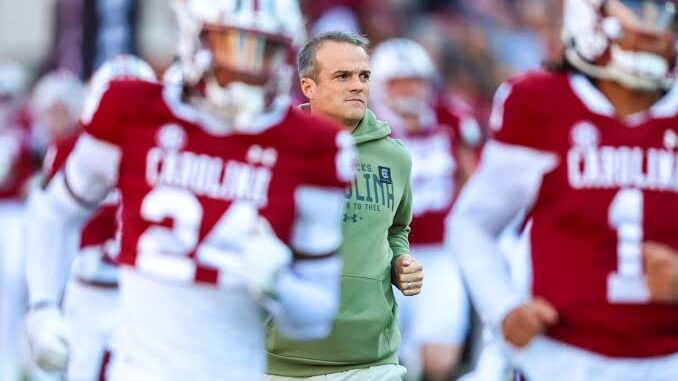
HAS COLLEGE FOOTBALL LOST ITS SOUL?
Lifelong South Carolina boosters and former players admit their passion is fading as NIL money and playoff politics reshape the sport. Ratings are up — but is the heart of the game quietly disappearing?
On a warm autumn Saturday in Columbia, the air around Williams-Brice Stadium still smells the same. Tailgate grills hiss, radios buzz with pregame talk, and fans dressed in garnet and black greet each other with the familiar confidence of people who have been doing this together for decades. From a distance, nothing appears broken. College football, at least on the surface, looks stronger than ever.
But when you sit with the people who built their lives around this sport, the conversation changes. Not the analysts on television. Not the social media influencers counting engagement. The real ones. The boosters who donated when the team was losing. The former players who remember riding buses instead of flying charter. The season ticket holders who passed their seats down through generations. Among them, a quiet question keeps rising: Has college football lost its soul?
College football was never just about football. It was about identity. About towns built around stadiums. About marching bands echoing through neighborhoods. About players who felt like extensions of the community, not temporary assets rotating through a national marketplace. The sport was messy, imperfect, and sometimes unfair, but it felt human. It felt rooted.
Today, it feels efficient. Profitable. Professional. And strangely distant.
South Carolina is not unique in feeling this shift, but the state embodies it clearly. Gamecock football has always been about resilience. About believing in something even when national attention looked elsewhere. About loyalty in the face of long odds. Many boosters built their passion during eras when the team was rarely favored and often overlooked. Their love was not transactional. It was emotional.
Now, some of those same boosters admit they feel like customers instead of caretakers.
The rise of NIL money changed everything overnight. In theory, it was justice. Players deserved compensation for their labor, their image, their sacrifice. That argument is hard to dispute. But in practice, NIL transformed players into financial negotiations before they became community heroes. Recruiting conversations became financial strategies. Loyalty became flexible. Development became secondary to visibility.
A former South Carolina linebacker, who once dreamed only of representing his state, now watches recruits choose schools the way investors choose stocks. He doesn’t blame them. He understands the logic. But he admits the romance is gone.
When he played, staying meant something. Leaving meant something. Now, staying is a business decision, and leaving is an upgrade path.
The transfer portal accelerated the emotional erosion. Rosters no longer feel like stories unfolding. They feel like seasonal reorganizations. A fan buys a jersey only to realize the player might be gone before it fades in the wash. The connection between player and program has become fragile.
College football used to be about watching young men grow into leaders over time. Today, fans often meet players at their peak and lose them before understanding who they really were.
Meanwhile, the playoff expansion brought national attention but also national pressure. Every game is now evaluated through a championship lens. Rivalries that once defined seasons now feel like footnotes in a playoff résumé. A loss no longer tells a story of heartbreak and growth. It becomes a mathematical problem.
South Carolina fans remember seasons when beating a rival was the entire purpose. When bowl eligibility felt like a reward. When momentum mattered more than rankings. Today, conversations begin and end with playoff scenarios, strength of schedule, and committee logic.
The sport has become smarter and colder at the same time.
Ratings prove people are watching more than ever. Stadiums still fill. Merchandise still sells. Television deals keep growing. By every measurable metric, college football is thriving. But metrics do not measure meaning. They measure consumption.
The soul of college football was never about how many watched. It was about how deeply they cared.
One longtime booster described it best when he said he still loves the Gamecocks, but he no longer feels married to the journey. He watches, he cheers, he hopes. But he no longer hurts the same way. And in his words, that scares him more than losing.
Pain, in sports, is a form of love.
Another former player said he feels disconnected from the locker room culture he once knew. Not because players are worse, but because their timelines are shorter. Brotherhood requires time. Loyalty requires patience. Identity requires roots.
Today, players arrive with brand plans, content teams, and exit strategies. They are prepared for success, but not always for belonging.
And yet, blaming the players is unfair. They did not design the system. They adapted to it. The system rewarded speed, exposure, and flexibility. It punished patience and tradition. College football didn’t lose its soul because of players. It lost its soul because it stopped protecting what made players fall in love with it in the first place.
South Carolina fans feel this acutely because the program has always depended on emotional investment more than national dominance. The Gamecocks were never just a title factory. They were a story. A belief. A community fighting above its weight.
When that community feels like a temporary stop on a national tour, the story weakens.
Even the stadium experience has changed. More screens. More ads. More promotions. Less silence. Less tension. Less time to sit inside a moment. The game moves faster, but the heart struggles to keep up.
The band still plays. The chants still rise. But they echo differently now.
Younger fans often don’t notice the difference. For them, this version of college football is normal. They never experienced a world where players stayed three or four years without speculation. Where coaches spoke about loyalty instead of leverage. Where rankings were discussed after games, not before them.
Their love is real, but it is shaped by a different foundation.
Older fans are not asking for the clock to turn back. They know that change is inevitable. They know players deserve opportunity. They know progress is necessary. What they mourn is not evolution, but erasure.
They fear college football is forgetting why it mattered in the first place.
It mattered because it gave small towns big dreams. Because it turned students into legends. Because it allowed people to believe together. Because it gave meaning to Saturdays beyond entertainment.
Today, Saturdays still entertain. But do they still connect?
In South Carolina, some boosters now donate out of habit, not hope. They attend games out of tradition, not excitement. They cheer, but they also scroll. Their hearts split between loyalty and fatigue.
Former players watch and feel proud, but also distant. They recognize the uniforms, but not always the faces. They celebrate wins, but they don’t always recognize the journey.
The sport has not died. But it has aged in a strange way. It has grown richer and thinner at the same time.
College football used to be a conversation between generations. A father telling his son about a catch in 1984. A mother remembering a rainy upset in 1996. A grandfather recalling a coach who believed when no one else did.
Now, the stories reset every season.
The soul of college football was built on memory. And memory needs continuity.
Some argue that this is simply nostalgia fighting reality. That every generation believes its version was better. That progress always feels cold before it feels normal. That the soul has not disappeared, only relocated.
Maybe that is true.
Maybe the soul now lives in players who use NIL to lift families out of poverty. In athletes who find their voice earlier. In fans who connect through digital spaces instead of stadium seats. In communities that are broader, not smaller.
Maybe the soul has not died, but transformed.
But transformation always demands mourning. And South Carolina is still in that mourning stage.
There are moments, however, when the old feeling returns. A last-second touchdown. A defensive stand that defies logic. A crowd that roars without being told. A player who stays when he could leave. A coach who speaks about pride instead of contracts.
In those moments, the soul flickers.
The question is whether the system will allow those moments to remain rare gifts or whether it will protect them as essential parts of the game.
Because if college football becomes only about ratings, it will eventually become replaceable. But if it remains about belonging, it will remain eternal.
South Carolina fans do not want perfection. They want connection. They want to recognize themselves in the team again. They want to feel that the program is not just a platform, but a home.
Has college football lost its soul?
Not entirely.
But it has placed it in danger.
The soul is quieter now. It is not on highlight reels. It is not in NIL announcements. It is not in playoff debates. It is in loyalty that still exists beneath the noise. In fans who still believe without guarantees. In players who still choose meaning over money, even when no one notices.
The heart of the game is still beating.
But it is asking to be remembered.
And perhaps that is the real responsibility of fans, players, and programs alike. Not to reject progress. Not to worship the past. But to protect the one thing that made college football different from every other sport.
Its ability to belong to people, not just to profits.
If college football remembers that, it will never lose its soul.
If it forgets, no amount of ratings will ever bring it back.
Leave a Reply