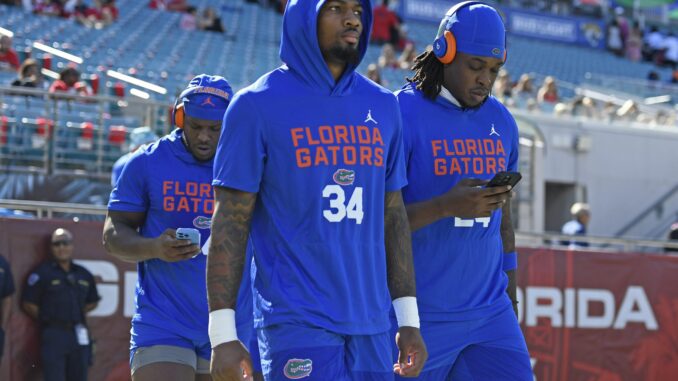
HAS COLLEGE FOOTBALL LOST ITS SOUL?
Lifelong Florida Gators boosters and former players admit their passion is fading as NIL money and playoff politics reshape the sport. Ratings are up — but is the heart of the game quietly disappearing?*
On a humid Gainesville afternoon, long after the crowds have left Ben Hill Griffin Stadium, the echoes still linger. Not the roar of 90,000 fans, but the memory of what college football used to feel like. For decades, the Florida Gators represented more than wins and losses. They were family history, campus tradition, small-town pride, and Saturday rituals passed from grandparents to children who barely understood the rules but knew exactly what it meant to wear blue and orange.
Now, many of those same lifelong supporters admit something has changed. They still watch. They still argue about quarterbacks. They still feel the rush of a big win. But beneath the surface, a quiet discomfort grows. College football is bigger than it has ever been, richer than it has ever been, and more visible than it has ever been. Yet for some, it feels strangely emptier.
The question is no longer whether the sport is successful. The question is whether it is still recognizable.
For older Gators fans, college football once felt like a community gathering disguised as a competition. Players were students first, heroes second. When a freshman wide receiver dropped a crucial pass, fans groaned, but they also remembered he had a chemistry exam on Monday. When a senior linebacker played through pain, it felt like a personal sacrifice for the school, not a business decision for a brand. Even when players dreamed of the NFL, their college identity came first.
Today, the language has changed. Players are brands. Teams are portfolios. Conferences are business alliances. Recruiting is no longer about development and loyalty, but about leverage and exposure. NIL deals, while fair and long overdue in many ways, have turned locker rooms into marketplaces. Conversations that once revolved around depth charts now revolve around earnings, endorsements, and exit strategies.
Former Florida players often describe it as a cultural whiplash. They remember begging for rides to practice, sharing cramped dorm rooms, and feeling proud just to wear the helmet. Now they watch younger players negotiate contracts before they have taken a meaningful snap. They do not blame the athletes. They blame the environment that turned amateur competition into professional theater without fully admitting it.
What troubles them most is not the money. It is the motivation. When a player commits to Florida today, boosters wonder whether he is committing to the school or to the opportunity to leave if something better appears. Loyalty, once imperfect but deeply valued, has become optional. Development, once celebrated, has become secondary to instant results.
The transfer portal, while empowering, has quietly changed the emotional investment fans place in players. It is harder to build attachments when rosters feel temporary. It is harder to celebrate growth when a sophomore breakout season might be followed by a sudden departure. Fans used to watch boys become men. Now they watch résumés evolve.
Ratings suggest the sport is thriving. Stadiums remain full. Television numbers climb. Social media engagement explodes. College football dominates conversation more than ever. But numbers do not measure connection. They measure attention. And attention is not the same as love.
Older Gators supporters often compare today’s college football to a beautifully produced movie with shallow characters. Everything looks better. Everything is louder. Everything is faster. But something essential feels missing. The unpredictability of loyalty. The innocence of ambition. The belief that wearing a school’s colors meant more than wearing a personal logo.
.
Playoff politics have added another layer of emotional distance. Once, rivalry games stood on their own. Florida versus Georgia did not need playoff implications to matter. Florida State did not need rankings to fuel hatred. The games mattered because of history, geography, and pride. Today, every rivalry is filtered through bracket logic. Fans are told how to feel based on playoff scenarios. Wins are celebrated with calculations instead of pure joy. Losses are analyzed as percentages instead of heartbreak.
The playoff was supposed to expand opportunity. In some ways, it has. But it has also reshaped priorities. Teams rest players for positioning. Coaches speak in coded language about “controlling our destiny.” Players treat rivalry games as stepping stones rather than emotional destinations. The sport has become optimized.
And optimization, while efficient, is rarely soulful.
Former Gators who played in the 1990s and early 2000s describe a locker room atmosphere that felt sacred. You played for the name on the front of the jersey, not the one on the back. The coaches demanded loyalty. The fans demanded effort. The players demanded accountability from each other. It was imperfect, sometimes unfair, sometimes harsh, but it was deeply human.
Today’s locker rooms are quieter, more cautious. Everyone is aware of cameras, branding, and future negotiations. Teammates support each other, but trust is thinner. When a player considers transferring, teammates understand. They just do not always feel it.
Boosters feel the change too. They once donated to facilities, scholarships, and programs. Now they are asked to contribute directly to player compensation pools. The relationship has shifted from support to investment. Boosters are no longer just supporters of a vision. They are stakeholders in a marketplace.
Some embrace it. Others feel uncomfortable, as if they are funding something they no longer fully recognize.
The irony is painful. College football fought for years to modernize, to correct injustices, to expand access, and to protect players. Many of those changes were necessary and overdue. Yet in fixing exploitation, the sport may have unintentionally sacrificed intimacy. The players are freer, richer, and more empowered. The fans are more distant, more transactional, and more skeptical.
The Florida Gators, once a symbol of Southern grit mixed with national ambition, now feel like a franchise in a rotating league of brands. The stadium still shakes. The chants still echo. But some fans admit they feel like guests at a spectacle rather than participants in a tradition.
A former Gators defensive back once said that the best part of college football was knowing your mistakes belonged to your school, not your career. You could fail, learn, and grow without being labeled permanently. Today, every snap is a highlight or a liability. Every mistake is a clip. Every decision is judged in the context of market value.
Young players carry pressure that previous generations never faced. They are expected to perform, promote, and plan simultaneously. Their college years are no longer a protected chapter. They are a public audition.
And fans, in response, consume rather than connect.
Still, not everything is lost. The soul of college football has not disappeared. It has been buried beneath layers of money, politics, and modernization. It still surfaces when a walk-on scores. When a senior plays one last game. When a rival crowd goes silent. When a band strikes the fight song at just the right moment.
But those moments feel rarer, not because they happen less, but because they compete with so much noise.
The sport no longer pauses to breathe.
Florida boosters who once drove hours just to feel the atmosphere now watch on multiple screens while scrolling statistics and betting lines. Former players who once watched games with pride now analyze them with detachment. Not because they hate what college football has become, but because they are unsure how to love it the same way.
They wonder whether future fans will ever understand what it meant to wait four years for a player to mature. They wonder whether a freshman will ever feel nervous stepping into a tradition instead of confident stepping into a contract. They wonder whether rivalries will still feel personal when conferences stretch across entire regions.
College football has not lost its audience. It has lost some of its patience. It has not lost its excitement. It has lost some of its innocence. It has not lost its relevance. It has lost some of its humility.
The Florida Gators still matter. The stadium still fills. The rivalries still spark. But beneath the celebration lies a quiet grief for something that cannot be fully named. A version of the sport that felt less polished but more honest. Less profitable but more meaningful.
The modern fan is torn between gratitude and mourning. Grateful that players are finally rewarded. Grateful that exposure is greater. Grateful that opportunities are wider. But mourning the simplicity that once defined the game.
Perhaps college football has not lost its soul. Perhaps it has simply outgrown the body that once carried it.
And like all growth, the process is painful.
The future will bring more money, more expansion, more influence. The sport will continue to thrive in numbers and headlines. But whether it will thrive in memory is a different question.
Because when lifelong Florida Gators boosters close their eyes and think about why they fell in love with college football, they do not remember ratings. They do not remember brackets. They do not remember endorsements.
They remember the feeling of belonging to something bigger than themselves.
And that is the part they fear is quietly fading.
Not gone.
Just harder to find.
Leave a Reply