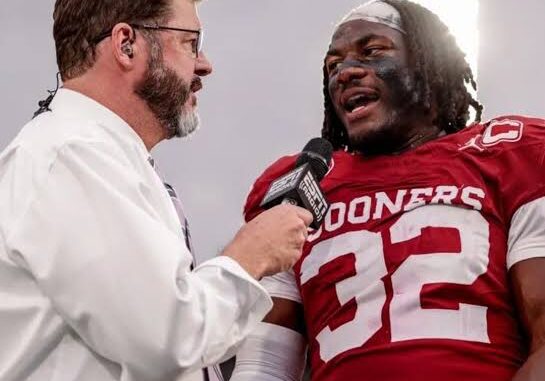
Mason Thomas Determined to Play in Pinstripe Bowl, Affirms Love for Oklahoma
In the swirl of bowl season announcements, where several prominent Oklahoma Sooners have chosen to opt out of the Pinstripe Bowl, Mason Thomas’ decision to suit up stands as a beacon of commitment, loyalty, and sheer grit. In a period where college football has increasingly seen top athletes prioritize professional prospects over team obligations, Thomas’ stance is both refreshing and emblematic of a different kind of athlete—one who views his college experience as more than just a stepping stone to the NFL.
For Thomas, the decision was deeply personal. “Having one more opportunity to play a college football game, I felt it was an opportunity I couldn’t pass up,” he shared. “And to play with all my brothers one more time and finish it the right way.” There is a certain gravity in those words, a recognition that college football, with its intensity, camaraderie, and traditions, offers a unique kind of fulfillment. For a player like Thomas, who has poured himself into the Oklahoma program since the day he arrived, this isn’t just about a game—it’s about legacy, pride, and a final chapter in a story that began years ago on the green fields of Norman.
Oklahoma’s football program is steeped in tradition, history, and expectation. From the storied days of Barry Switzer to the modern era of championship aspirations, every player who dons the crimson and cream carries with them a responsibility to uphold the pride of the Sooners. Mason Thomas is no exception. His journey at Oklahoma has been characterized by resilience, adaptability, and an unwavering commitment to excellence. Whether it was early morning weight sessions, grueling practice drills in the blazing summer heat, or meticulous film study late into the evening, Thomas’ dedication has been a constant presence in the program. His work ethic has not only earned him respect from coaches and teammates but has also positioned him as a leader on and off the field.
What makes Thomas’ choice particularly noteworthy is the broader context of college football today. It is no secret that bowl games often place athletes in a complex position. For many, the looming NFL draft and the risk of injury lead to difficult decisions. The trend of top-tier talent skipping postseason games has been steadily increasing, a reflection of the high stakes and the professionalization of college athletics. Yet, amidst this pragmatic approach, Thomas’ decision to remain stands as a declaration of something more enduring: loyalty to one’s team, love for the game, and the desire to experience the culmination of a season alongside those who have shared the journey.
From a team perspective, Thomas’ presence is invaluable. The Sooners, heading into the Pinstripe Bowl, face a formidable opponent, and any edge can prove decisive. Having a player of Thomas’ caliber on the roster bolsters both morale and strategic depth. His experience, knowledge of the playbook, and ability to perform under pressure provide a stabilizing force that coaches and teammates alike can rely upon. In a sport where momentum and morale can swing games, having someone willing to lead by example is immeasurably valuable. Thomas embodies that leadership, not through words alone, but through tangible action—simply by stepping onto the field when many would walk away.
.
Beyond the technical and tactical benefits, Thomas’ choice resonates on an emotional level. College football, at its heart, is a tapestry of relationships, rituals, and shared experiences. The locker room camaraderie, the pregame rituals, the shared victories and defeats—all these moments contribute to a unique culture that cannot be replicated at the professional level. Thomas recognizes this, and in his decision to play, he prioritizes these intangible elements that define a true collegiate athlete. It’s a reminder that the sport is as much about human connection as it is about statistics and accolades.
The narrative surrounding Mason Thomas also serves as a subtle challenge to contemporary notions of success in college athletics. In a world where the next contract, the next endorsement, and the next milestone often dominate decisions, Thomas’ choice is a testament to intrinsic motivation. He is guided not by external pressures or the lure of immediate financial gain, but by personal values, team allegiance, and the satisfaction of completing something meaningful. This stance is increasingly rare, and it offers a compelling story that resonates far beyond the confines of the stadium.
Indeed, Thomas’ story adds an interesting layer to the ongoing discourse about the evolving landscape of college football. With the advent of name, image, and likeness (NIL) opportunities and the growing visibility of collegiate athletes on social media platforms, players today navigate a complex web of obligations and opportunities. Choosing to participate in a bowl game is no longer just a matter of athletic commitment; it involves weighing career prospects, health considerations, and personal branding. Yet, Thomas’ decision cuts through this complexity with remarkable clarity. His guiding principle is straightforward: loyalty to Oklahoma, commitment to teammates, and love for the game. It is a philosophy that has the potential to inspire young athletes, reminding them that the value of perseverance, integrity, and camaraderie often transcends immediate gains.
Fans, too, have taken notice. Social media platforms and sports forums have been buzzing with reactions to Thomas’ announcement. While some express admiration for his loyalty, others emphasize the contrast with those opting out, highlighting the rarity of his decision in today’s football climate. For Oklahoma supporters, Thomas has become more than just a player; he is a symbol of the ideals the program aspires to instill—dedication, courage, and the willingness to put the team above oneself. In many ways, he has become a living reminder of why fans invest emotionally in college football: not solely for the thrill of the game, but for the stories of character, heart, and commitment that unfold on the field.
From a personal development standpoint, the Pinstripe Bowl represents more than just one final game for Thomas—it is an opportunity to solidify his legacy at Oklahoma. Every snap, every tackle, and every play is imbued with a sense of finality and significance. These moments are the culmination of years of hard work, discipline, and sacrifice. In choosing to play, Thomas ensures that his final chapter is written not in absence, but in active participation, demonstrating the depth of his love for the team and the sport itself. This decision reflects a maturity that transcends mere athletic talent; it speaks to an understanding of identity, responsibility, and legacy that will likely guide him throughout his career, both on and off the field.
Coaches have praised Thomas’ decision as well, highlighting the intangible benefits he brings to the locker room. Beyond his athletic skills, Thomas’ presence fosters a sense of unity and resilience. Young players, watching a seasoned teammate opt to stay, gain lessons in loyalty and determination that cannot be taught in a classroom. For the coaching staff, Thomas’ commitment simplifies leadership challenges and injects energy into preparations for the bowl game. It is rare to see a player whose impact is as profound off the field as it is on it, and Thomas exemplifies this dual influence with remarkable poise.
The Pinstripe Bowl itself promises to be a compelling spectacle, with the Sooners looking to cap off their season on a triumphant note. In this high-stakes environment, every decision, every play, and every ounce of effort matters. Mason Thomas’ choice to play is not just symbolic; it is a tangible contribution to the team’s chances of success. His experience, resilience, and leadership on the field provide a stabilizing force that could prove decisive in critical moments. While fans and analysts will scrutinize stats and strategies, the presence of Thomas represents something more enduring: the human element of courage, loyalty, and heart that defines championship-caliber teams.
For Thomas himself, the decision is rooted in emotion as much as strategy. He has spoken candidly about the relationships that define his time at Oklahoma—the bonds with teammates, the guidance of coaches, and the unwavering support of fans. Each of these connections carries weight, and participating in the Pinstripe Bowl becomes an act of honoring them. It is a final opportunity to contribute to a collective story, to leave a mark not measured solely by personal statistics but by the memories and moments shared with those who have journeyed alongside him.
Moreover, Thomas’ stance raises intriguing questions about the future culture of college football. Will more players, inspired by his example, choose loyalty and love for the game over personal expedience? Can the narrative of dedication, integrity, and team-first mentality regain prominence in an era dominated by professional aspirations? While such shifts are gradual and uncertain, Mason Thomas’ choice serves as a powerful reminder of the enduring values that make college football compelling: commitment, camaraderie, and the courage to stand by one’s principles.
As the Sooners prepare for the Pinstripe Bowl, all eyes will be on the field, where strategies will clash, and athletic prowess will be tested. Yet, beyond the X’s and O’s, Mason Thomas’ story will resonate, quietly underscoring the significance of character in sports. His decision to stay, to fight alongside his teammates, and to honor the legacy of Oklahoma football reflects a rare combination of talent, heart, and moral clarity. It is a narrative that will linger, not just in the annals of the program, but in the memories of fans, teammates, and aspiring athletes who witness his commitment firsthand.
In the end, Mason Thomas’ determination to play in the Pinstripe Bowl is more than a choice—it is a statement. It affirms his love for Oklahoma, his loyalty to his teammates, and his belief in the values that transcend wins, losses, and professional opportunities. In a world where decisions are often driven by external pressures and personal gain, Thomas’ decision reminds us of the power of authenticity, integrity, and devotion. It is a testament to what college football can represent at its best: a stage for human character, courage, and connection, where the love for a team and the game itself can inspire acts of profound significance.
As fans await kickoff, Mason Thomas’ legacy is already being written. Not merely in statistics or accolades, but in the respect he commands, the example he sets, and the heart he brings to the field. In choosing to stay and play, he has reminded everyone that sometimes the most meaningful victories are those won through loyalty, commitment, and love—qualities that Mason Thomas embodies in every snap, every stride, and every moment wearing the crimson and cream.
Leave a Reply