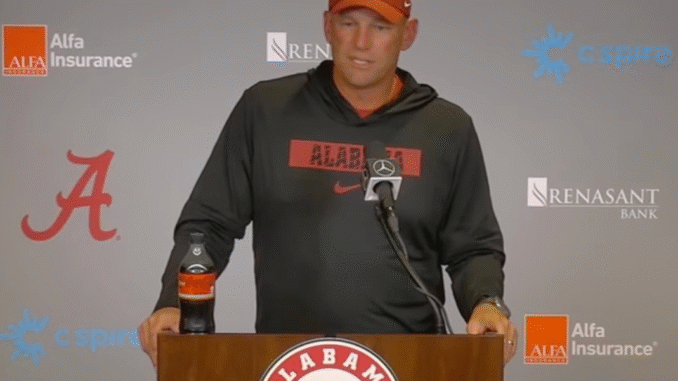
Kalen DeBoer’s tenure as head football coach of the Alabama Crimson Tide has reached an important milestone. In just his second season leading one of college football’s most tradition-rich programs, DeBoer has guided Alabama to a 10–3 record in 2025 and its first College Football Playoff appearance under his leadership. Just as significant as the on-field success, however, has been DeBoer’s recent public reaffirmation of his commitment to Alabama amid rumors connecting him to other high-profile coaching opportunities. Together, these developments signal a program gaining momentum and stability during a period of transition.
Taking over as Alabama’s head coach came with immense pressure. The Crimson Tide are synonymous with excellence, and any coach stepping into that role inherits sky-high expectations from fans, alumni, and the broader college football world. DeBoer arrived with a strong reputation as a program builder and offensive innovator, but success at previous stops does not automatically translate to immediate results at a place like Alabama. From the beginning, his challenge was not only to win games, but also to reassure stakeholders that the program’s identity and national relevance would endure.
DeBoer approached that challenge with a clear sense of balance. Rather than attempting to dramatically reshape Alabama football, he emphasized continuity in culture while modernizing certain aspects of the team’s approach. Practices, preparation, and accountability standards remained aligned with Alabama’s long-established expectations, while schemes and communication methods reflected DeBoer’s own philosophy. This blend of old and new helped smooth the transition and foster early buy-in from players and staff.
The 2025 season became a critical proving ground for DeBoer’s vision. A 10–3 record reflected consistency across a demanding schedule and showed tangible improvement from his first year. Alabama demonstrated the ability to win in multiple ways, whether through disciplined defensive performances, efficient offensive execution, or resilience in close games. While the Crimson Tide did not go undefeated, the team avoided prolonged slumps and responded well to adversity—often a sign of strong leadership and internal trust.
The highlight of the season was Alabama’s return to the College Football Playoff under DeBoer’s guidance. In an era of expanded competition and increased parity across college football, reaching the playoff remains a defining benchmark of elite status. For DeBoer, the appearance served as validation that his methods could succeed at the highest level of the sport, even under the intense scrutiny that accompanies the Alabama job. For the program, it reinforced the message that Alabama remains a national contender, regardless of changes on the sideline.
Offensively, DeBoer’s influence became increasingly evident in his second season. Known for systems that prioritize efficiency, adaptability, and quarterback development, he helped Alabama establish a more versatile offensive identity. The Crimson Tide showed improved balance, with the ability to stretch defenses through the air while still maintaining physicality in the run game. Rather than relying on a single approach, the offense adjusted to opponents and situations, an attribute that proved valuable throughout the season.
Defensively, Alabama continued to reflect its traditional strengths. While DeBoer’s reputation is often tied to offense, his overall team philosophy emphasizes complementary football. The defense played a crucial role in the team’s success, providing stability and consistency that allowed the offense to operate with confidence. This balance between units helped Alabama remain competitive in high-pressure moments and underscored DeBoer’s holistic approach to team building.
Equally important has been DeBoer’s impact on leadership and culture. Players have responded positively to his communication style, which emphasizes clarity, accountability, and mutual respect. Expectations are clearly defined, and performance standards are applied consistently. This environment has encouraged player development and minimized internal distractions, both of which are essential for sustained success at a program with championship aspirations.
As Alabama’s success in 2025 drew national attention, it also sparked speculation about DeBoer’s future. Rumors linking him to other coaching vacancies began to circulate, a familiar scenario in college football when a coach achieves early success. Rather than allowing uncertainty to linger, DeBoer addressed the situation directly by reaffirming his commitment to the Alabama program. His public stance emphasized his belief in the university, the players, and the long-term vision he is helping to build.
That reaffirmation carried significant weight. In a sport where coaching turnover can quickly destabilize a program, DeBoer’s words provided reassurance to players, recruits, and fans alike. Stability is especially valuable during periods of transition, and DeBoer’s commitment signaled that Alabama’s recent progress is part of a broader, long-term plan rather than a temporary surge.
Recruiting and roster management remain central to that plan. Alabama’s ability to attract top talent has long been a cornerstone of its success, and DeBoer has worked to maintain that standard while adapting to modern realities such as the transfer portal and name, image, and likeness considerations. The on-field results of 2025, combined with DeBoer’s commitment to the program, have strengthened Alabama’s recruiting pitch and helped position the team for continued competitiveness.
Looking ahead, the challenge for DeBoer will be sustaining and building upon the momentum generated in his second season. Expectations will only increase following a playoff appearance, and the margin for error at Alabama remains small. Conference competition, roster turnover, and the evolving structure of college football will test even the most stable programs. Yet DeBoer’s adaptability, measured leadership, and demonstrated ability to guide Alabama through a successful season suggest he is well-equipped to meet those challenges.
In just two seasons, Kalen DeBoer has made a meaningful impact on Alabama football. A 10–3 record in 2025, a College Football Playoff appearance, and a clear reaffirmation of his commitment to the program collectively mark an important chapter in the Crimson Tide’s ongoing story. While the future will bring new tests, DeBoer has established a foundation of stability and competitiveness that aligns with Alabama’s tradition of excellence. As the program moves forward, his second season may be remembered as the point at which Alabama fully embraced its new era under his leadership
Leave a Reply