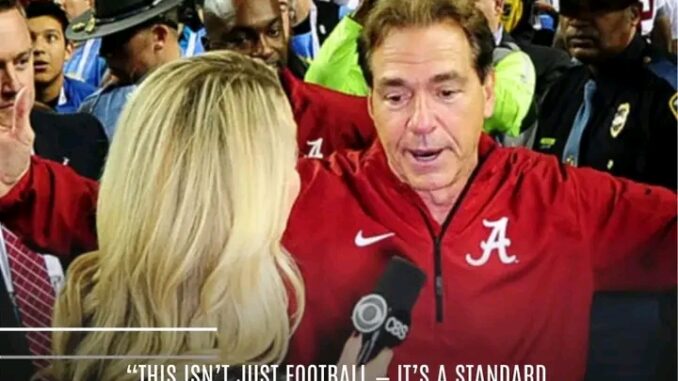
The Crimson Tide Standard: How Alabama’s New Core Is Writing Its Own Legacy After the Saban Era
For nearly two decades, the Alabama Crimson Tide operated under a single defining force — Nick Saban. His run wasn’t just dominant; it reshaped the geography of college football itself. Six national championships, multiple SEC crowns, first-round draft picks stacked like cordwood, and a culture built on precision, pressure, and perfection. When Saban retired, many expected turbulence, maybe even regression. A dynasty doesn’t just replace its architect.
But against all expectations, Alabama’s new core — from the coaching staff to the emerging on-field leaders — is demonstrating something remarkable: the Crimson Tide Standard didn’t retire with Saban. Instead, it’s evolving, transforming, and building momentum under a fresh identity. The new era isn’t about living in Saban’s shadow; it’s about creating a legacy that stands on its own.
And this is exactly where Alabama finds itself today — in a season defined not by nostalgia, but by recalibration, growth, and a roaring new hunger.
—
### **A New Blueprint: The Kalen DeBoer Effect**
When Kalen DeBoer took over in Tuscaloosa, the world watched with crossed arms. DeBoer was respected, no doubt — a skilled offensive strategist, a proven program builder — but Alabama is a different species of expectation. It’s not just a job; it’s a pressure cooker.
Yet very quickly, DeBoer made one thing clear: he wasn’t here to replicate Saban. He was here to innovate.
His Alabama doesn’t rely solely on defensive suffocation and clock-control discipline. This version leans into creativity, explosiveness, and adaptability. The Tide offense has shifted into a more dynamic, unpredictable identity. Tempo, spacing, motion, and aggression — these are the new signatures. Players often describe the system as “liberating,” allowing them to lean fully into their strengths without the rigidity of the old-school blueprint.
DeBoer’s calm demeanor contrasts sharply with Saban’s intensity, but don’t confuse calm for passive. What he’s building is strategically sharp, modern, and player-driven.
—
### **A New Generation of Leaders**
While the coaching transition set the stage, the players are the ones writing the story — and the new core of this Alabama team is stacked with leaders refusing to let the standard slide an inch.
These players aren’t trying to imitate past Tide legends. They’re carving out their own place in a lineage that demands excellence.
**The Quarterback Room – Confidence Over Chaos**
The post-Saban QB era isn’t defined by panic or inconsistency. Alabama’s new signal-caller brings poise, creativity, and a willingness to embrace pressure. Whether escaping collapsing pockets, delivering tight-window throws, or orchestrating clock-draining drives, the QB position has become the stabilizing element of the team.
**Defensive Captains – The Return of Relentlessness**
DeBoer inherited defensive playmakers who were hungry to prove that Alabama’s physical identity wasn’t going anywhere. Linebackers fly to the ball with controlled fury, the secondary hits like safeties used to in the early 2010s, and the defensive front has become a wall of disruption. This unit has grit — not in imitation of past players, but by forging its own brand of toughness.
**Emerging Stars – Speed, Skill, and Swagger**
The new receiving corps, the younger backs, the rotational defenders — there is a collective feel of a team rediscovering its swagger. Not the boastful type. The earned type.
—
The Culture Shift: Still Ruthless, But More Human
Perhaps the most interesting evolution in the post-Saban era is cultural. The foundation — discipline, accountability, work ethic — remains intact. But the tone, the emotional landscape, the day-to-day interactions have changed.
Players speak more about “joy” and “connection.”
Practices are still brutal, but they’re infused with competitive energy rather than fear-driven precision.
The locker room feels more open, more expressive, more unified in personality.
This isn’t a softer Alabama. It’s a more balanced Alabama — still demanding excellence, but also encouraging individuality and creativity.
If Saban built a machine, DeBoer is building a family.
And somehow, the fusion of both is producing something powerful.
—
Legacy Pressure: Turning It Into Fuel
Any team inheriting the keys to a kingdom faces enormous pressure. Every mistake is magnified. Every win is scrutinized. Every loss is seen as an omen.
But what this Alabama group has done exceptionally well is turn pressure into identity.
Rather than avoiding comparisons to the Saban years, the new core embraces them as motivation. Rather than pretending the past doesn’t exist, they use it as a measuring stick — not to copy, but to surpass.
Players don’t shy away from expectations. They lean into them like a fourth-quarter goal-line stand.
And little by little, a new legacy is taking shape.
—
### **Recruiting: The Tide Is Still the Tide**
One of the biggest early indicators of program health under a new coach is recruiting — and Alabama hasn’t skipped a beat.
Young players still want the Crimson Tide logo on their chest.
They still want to play under the lights of Bryant–Denny.
They still want to step into a lineage where greatness feels reachable.
DeBoer and his staff have added something new to Alabama’s recruiting pitch: an offense built for modern football and a culture that values adaptability. The talent pipeline remains elite, and the new era is giving recruits something fresh and enticing.
—
### **The Future: A Legacy Under Construction**
So, what does the new Alabama legacy look like?
It looks like adaptability.
It looks like innovation.
It looks like a team honoring its past but refusing to be defined only by it.
The Crimson Tide Standard hasn’t changed — the approach has.
And that’s why this new Alabama is so compelling. It isn’t clinging to what once was. It’s building what could be — and doing it with players and coaches who understand that history is a guide, not a cage.
The post-Saban era isn’t a decline. It’s a renaissance.
A generation from now, fans may look back at this moment as the turning point when Alabama proved that dynasties don’t die — they evolve.
And this new core?
They’re not following in footsteps.
They’re leaving their own.
Leave a Reply