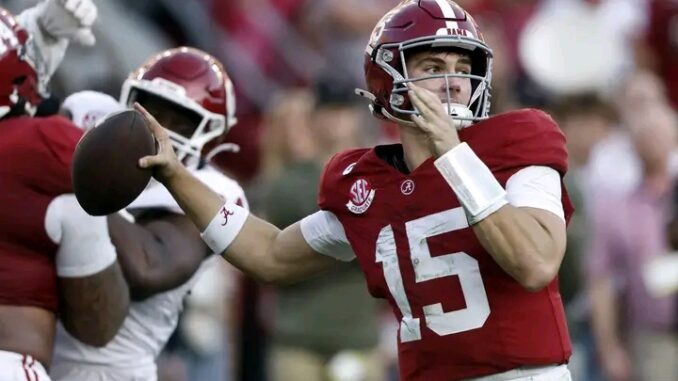
According to Nielsen, the Alabama Crimson Tide has been the most-watched team in college football this season, with multiple games over 10 million viewers
According to recently released Nielsen data, the Alabama Crimson Tide has not only dominated the field this season but also the national audience, becoming the most-watched team in all of college football. In a year marked by shifting conference landscapes, explosive offenses, and several unexpected upsets across the country, Alabama’s ability to command attention has been the one constant. Multiple Crimson Tide games reportedly crossed the ten million viewers mark, putting the program far ahead of its peers and reinforcing Alabama’s unique place in the modern college football ecosystem.
This surge in viewership has created a fascinating narrative around the era of head coach Kalen DeBoer, who took over a program still defined by Nick Saban’s long shadow. Many expected a natural decline in spotlight once Saban retired, assuming fans would spread their attention to other rising powers across the SEC and beyond. Instead, the opposite has unfolded. Alabama’s visibility has not only remained strong, it has grown. DeBoer has not tried to replicate Saban’s personality or approach but has instead leaned into his own calm, tactical style. What makes this season stand out is how viewers seem drawn to that contrast. Fans understand they are witnessing the evolution of a dynasty, not just the maintenance of one.
The most striking part of the viewership numbers is the margin between Alabama and the second-highest team. While several prominent programs, from the Big Ten to the Big 12, have seen strong television audiences this season, none have consistently reached the levels Alabama has achieved. The reason behind this pull appears to be a combination of competitive games, late comebacks, dramatic finishes and the sense that something historic might be brewing in Tuscaloosa. Even neutral fans find themselves tuning in, simply because Alabama’s games have an energy and uncertainty that feel different from the slow, predictable dominance of past years.
A deeper dive into the season reveals another interesting factor: Alabama’s schedule has been unusually compelling. Matchups that normally draw modest interest instead became major national events due to Alabama’s presence. Road games against middle-of-the-pack SEC teams ended up pulling in massive numbers because the Tide either struggled unexpectedly or delivered highlight-heavy performances. Meanwhile, rivalry games like the Iron Bowl took on new life as Auburn entered the matchup with fresh confidence, attempting to spoil Alabama’s postseason plans. When rivalry energy meets a viewing audience already fixated on Alabama, the results naturally balloon.
Additionally, the Tide’s growing online footprint has amplified their visibility. During the Nick Saban era, Alabama was always a national brand, but their identity was built around consistency and inevitability. DeBoer’s Crimson Tide has leaned more heavily into unpredictable offensive pacing, aggressive fourth-down decisions and creative formations that spread quickly on social media. Clips of Alabama’s offense moving with unusual tempo or its defense forcing sudden turnovers have gone viral throughout the season, pushing more casual fans to tune in to upcoming games. This digital momentum has played a major role in translating national curiosity into actual TV ratings.
Another storyline that has intensified viewer interest is the quarterback situation. The Crimson Tide’s offense has showcased a steady maturation at the position throughout the season, creating week-to-week intrigue around each game. Fans want to see how the quarterback handles pressure under the brightest spotlight in college football. Even games against lesser opponents have become showcases rather than predictable blowouts, with the offense evolving in front of millions. Viewers sense potential breakthrough moments, and when fans feel like they might witness growth in real time, they show up.
What makes this viewership boom especially fascinating is how it reflects the broader landscape of the sport. In a season where television ratings have become more fragmented, with fans hopping between streaming platforms and conference realignment shifting traditional rivalries, Alabama stands as one of the few consistent anchors in the national conversation. Networks love the Tide because they deliver steady numbers regardless of kickoff time or opponent. That reliability is why Alabama frequently ends up in prime viewing slots, and every time they do, the ratings spike further.
The SEC’s status as the most competitive conference in college football has also enhanced Alabama’s exposure. As several SEC teams improved this year, every Alabama matchup took on added meaning. The conference’s new scheduling approach contributed to these high-stakes games, with fewer predictable matchups and more games that carried postseason weight. These games naturally drew national audiences, especially when the Tide were involved, as fans wanted to see how Alabama navigated a tougher landscape under a new coach.
Behind the scenes, there is also a renewed sense of identity within the program. DeBoer has fostered a culture that emphasizes adaptability and player ownership, creating a team that feels more expressive and dynamic on the field. This freedom has resulted in unpredictable gameplay that fans gravitate toward. When audiences know a game could shift dramatically at any moment, they stick around longer and tune in more frequently. The unpredictability becomes the hook, and Alabama has leaned into it perfectly this season.
Ultimately, the story of Alabama’s massive viewership is about more than just numbers. It is a reflection of a program transitioning into a new chapter without losing its relevance. In fact, this season shows the Crimson Tide becoming an even more captivating product. The fact that multiple games surpassed ten million viewers reinforces the idea that college football fans across the nation remain deeply invested in the Tide’s journey, perhaps even more so now than during the years of robotic, machine-like dominance.
If Alabama continues on this trajectory, both in competition and audience engagement, the program may very well redefine what it means to be a modern powerhouse during this new era of college football. The rest of the country is watching closely, not out of obligation or fatigue, but out of genuine fascination. And judging by the numbers, they are watching in record-breaking fashion.
Leave a Reply