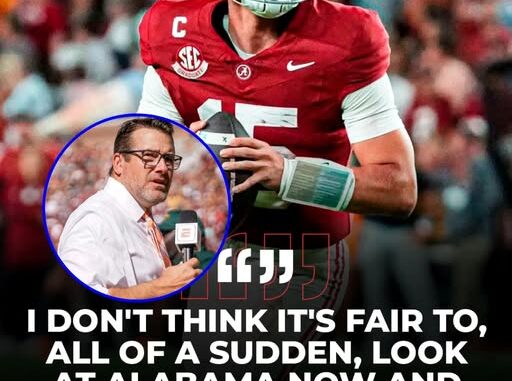
The Alabama Crimson Tide walked off the field in stunned silence after their narrow loss to Oklahoma, a game that twisted momentum, tested belief, and left millions of fans across the country wondering what exactly they had just witnessed. It wasn’t just the score that caused the tremor across the college football landscape; it was the narrative that emerged in the hours that followed. From social media to national talk shows, a wave of voices rushed to proclaim that Alabama’s era of invincibility was crumbling faster than anyone expected. But in the middle of that storm, Tom Luginbill stood steady, challenging the idea that one difficult night suddenly signaled the collapse of a football empire.
Luginbill has always been a careful evaluator of talent and trajectory. When he watched Alabama fight through four quarters against Oklahoma, he didn’t see a program in disarray or a head coach gasping for answers. What he recognized was a team undergoing the natural growing pains of a new era under coach Kalen DeBoer. It was a shift many expected to be smooth, but transitions in college football rarely unfold without turbulence. DeBoer arrived with a new system, a new culture, and new demands. And while his arrival revived energy in Tuscaloosa, it also meant that a roster built to thrive under the previous regime now had to adjust to a different rhythm, different expectations, and a different identity.
What made the loss sting even more for Alabama fans was how close the Tide were to turning the game around. Throughout the night, flashes of brilliance collided with moments of hesitation. A dropped pass in a crucial red-zone moment. A missed read on a third-and-short. A defensive breakdown that allowed Oklahoma to convert a backbreaking play deep into the fourth quarter. These weren’t signs of a broken system; they were the fingerprints of a team still learning how to play instinctively under fresh leadership. For Luginbill, this was exactly why the sudden panic felt misplaced. He saw a roster that competed fiercely despite the errors, a coaching staff that made adjustments on the fly, and a group of players that never looked defeated until the final whistle.

What many critics ignored in their rush to declare disaster was the emotional pressure Alabama carries into every season. This program doesn’t simply play football games; it plays against expectations that no modern team has ever been able to sustain forever. Fans aren’t satisfied with progress or promise; they expect dominance, precision, and championships as if they are automatic. When Alabama wins, they are fulfilling destiny. When they lose, even by a field goal, it becomes a referendum on the entire future of the program. For DeBoer, navigating that emotional terrain is as demanding as managing the X’s and O’s, but Luginbill believed he was built for that responsibility. He saw a coach who refused to get rattled, even as the outside world exploded with commentary about decline.
In the days following the loss, DeBoer didn’t hide from the disappointment. He spoke about accountability, improvement, and the need to stay focused on the long-term vision. He didn’t sugarcoat the mistakes, but he didn’t overreact either. That measured tone was one of the reasons Luginbill pushed back so strongly against the narrative of collapse. He understood that great programs do not dissolve overnight, nor do they lose their identity because of one bad outing. Alabama has survived coaching transitions, recruiting challenges, heartbreaking playoff losses, and the ever-changing terrain of college football. Through it all, the Crimson Tide reinvented themselves repeatedly without ever losing the core that made them a standard of excellence.
What Alabama showed against Oklahoma, however painful, was not the unraveling of a giant but the beginning of a new storyline in this chapter of the program. It was a team revealing its flaws in real time, a coach evaluating what needs repair, and a roster learning how to execute under pressure in a system still maturing. These are the types of nights that often define how a season evolves. They are harsh, humbling, and unforgettable, but they are also the moments that shape leaders, deepen resolve, and expose the precise areas where growth is necessary.
Luginbill reminded the college football world that perspective is essential. The same program people are now eager to bury is the one that spent years redefining what sustained success looks like. It is the program that built a culture of competitiveness so strong that even in a rebuilding phase, the expectation remains national titles, playoff appearances, and double-digit victories. The loss to Oklahoma may have stung, but it didn’t rewrite the DNA of Alabama football. It didn’t erase the talent on the roster, the potential in DeBoer’s scheme, or the grit that has carried this team through countless trials.
In truth, the noise surrounding Alabama after the loss said more about the rest of college football than it did about the Crimson Tide themselves. So many teams spent decades chasing Alabama’s standard that any small sign of vulnerability becomes a headline. The idea of the giant finally toppling is enticing, almost comforting, to programs that have repeatedly fallen short. But Alabama’s story has never been one of ease. It has always been built on pushing back when the world assumes the worst, recalibrating when the foundation shakes, and answering doubt with performance.
Tom Luginbill’s defense of the Tide wasn’t just about one game. It was about understanding the long arc of a program that refuses to be defined by single moments of failure. It was a reminder that championships are never won on perfect seasons alone but on overcoming the adversity that appears along the way. As Alabama turns its attention to the next challenge, the noise will continue, the criticism will mount, and the expectations will not fade. But Luginbill’s message lingers as a counterweight: sometimes a stumble is just a stumble. Not the end. Not the collapse. Not the fall of a dynasty, but a test that will eventually reveal what Alabama has always shown in moments like this.
Resilience. Adaptation. And the relentless belief that one painful night cannot overshadow a legacy built over decades.
Leave a Reply