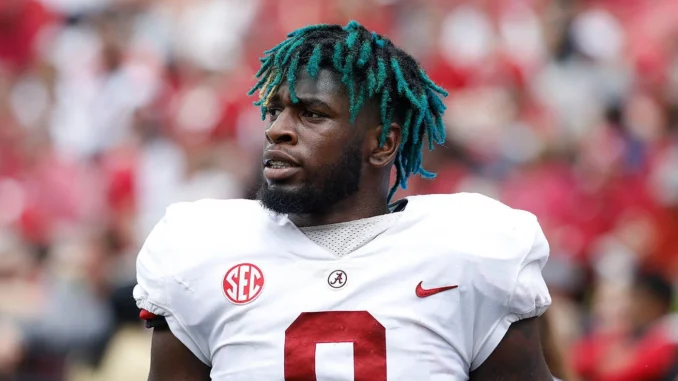
Eyabi Anoma’s name once carried the type of glow that only surrounds the rarest high-school athletes. To understand his story is to understand the fragile bridge between promise and reality in college football, where the line between future superstar and forgotten cautionary tale can disappear overnight. His journey—stretching from a celebrated five-star signing day announcement to a nomadic career across multiple programs—remains one of the most puzzling sagas in modern Alabama football. It is the kind of story that starts with unstoppable momentum but slowly drifts into a place no one could have predicted.
The excitement around Anoma began long before he ever stepped foot in Tuscaloosa. Coming out of high school, he was the sort of recruit coaches dream about: long, explosive, athletic, violent off the edge, and blessed with instincts that made quarterbacks uncomfortable even before the snap. Alabama fans saw him as the next generational pass rusher, someone who could follow the tradition of players like Jonathan Allen, Rashaan Evans, or Quinnen Williams. When he signed with the Crimson Tide, the buzz was immediate. Recruiting experts described him as raw but terrifyingly gifted, and Alabama’s coaching staff believed they had secured a future anchor for their defense.
His freshman season brought flashes of exactly that potential. Even in limited action, he displayed a rare burst that made it obvious he wasn’t like other young players. He would explode off the line and bend around tackles with a smoothness that hinted at something special. Coaches praised his physical ability, and fans began whispering that his breakout was only a matter of time. This was the beginning everyone expected—an elite talent slowly gaining experience and preparing for a starring role.
Then, suddenly, things began to unravel.
The first signs were subtle: missed team events, small disciplinary hiccups, rumors about frustrations behind the scenes. Alabama is a machine built on discipline, structure, and accountability. Players don’t just have to be talented—they have to fit into a culture. And as time went on, it became increasingly clear that Anoma was struggling to adjust to that environment. What made his situation more complicated was that his talent still radiated every time he touched the field. He was good enough to be great, but something about college life, responsibility, and personal discipline kept tugging him backward.
Eventually, the situation reached a breaking point. The news of his departure from Alabama hit fans like a punch to the chest. It wasn’t just that he was leaving; it was the way the story ended—abruptly, quietly, and surrounded by speculation. No one expected the five-star edge rusher who was supposed to become the next Tide defensive star to exit the program after just one year. It felt surreal, almost like watching a movie where the main character disappears before the story even starts.
His next chapter took him to Houston, and for a brief moment, there was renewed hope. A fresh environment often helps troubled players rediscover themselves, and some believed that Anoma might finally settle into a place where he could grow. But the same issues that haunted him at Alabama began resurfacing. Disciplinary concerns, inconsistencies, and clashes with team expectations once again clouded his future. Before long, he found himself dismissed from yet another program, and the questions grew louder.
How could someone with this much talent keep sliding backward? Why couldn’t he stay grounded long enough to fulfill the promise everyone saw in him? Was it the pressure? The environment? Personal struggles no one saw coming? The mystery surrounding Eyabi Anoma’s career only deepened with each move.
He later resurfaced at UT Martin, then made another shocking appearance when he transferred to Michigan. For a moment, the football world wondered if he might finally resurrect his career in a big-time program. Michigan gave him a chance to restart, to rebuild, to prove he could live within a system long enough to showcase his talent. At times, he flashed the same explosiveness that once made him the crown jewel of Alabama’s recruiting class. But consistency remained fleeting, and his career never stabilized enough to match the enormous expectations that had followed him since high school.
Today, Eyabi Anoma stands as one of the most compelling “what-could-have-been” stories in Alabama’s recruiting history. His physical gifts were undeniable. His upside was enormous. But football is never just about what a player can do on their best day—it is about structure, work ethic, focus, maturity, and the ability to grow with the demands of a college program. For Anoma, those things became the barrier he could never fully overcome.
His story is a reminder that five-star ratings are not guarantees, and raw potential is only the first step in a much longer journey. It also raises deeper questions about support systems, personal development, and the unseen battles young athletes face. Some players arrive on campus prepared not just physically but mentally. Others struggle to adjust to the pressure, the expectations, and the transition from high-school prodigy to disciplined collegiate athlete.
Eyabi Anoma’s path still isn’t entirely closed. He remains a player whose physical tools will always spark curiosity. The door to redemption is never fully shut in football, especially for someone as gifted as he is. But no matter where his career ultimately settles, his story will be remembered as one of the most dramatic and unpredictable journeys of the Nick Saban era—an unforgettable mix of brilliance, chaos, promise, and mystery.
This is what happened to Eyabi Anoma. And for many Alabama fans, it will forever be the story of the five-star superstar who never became the star he was destined to be.
Leave a Reply